
Framekit templates
Start from a designer-made template
 Use template
 Use template
 Use template
 Use template
 Use template
 Use template
 Use template
 Use template

Sellfy advertises no transaction fees. Gumroad advertises no monthly fee. Both claims are true, and both leave out the part that decides the bill.
Sellfy's plans carry an annual sales ceiling, so its "free" transactions are really a subscription you outgrow. Gumroad's 10% plus 50 cents excludes card processing, which its own fee article lists separately at 2.9% plus 30 cents.
Put a $25 preset pack through both at $2,000 a month in sales and the year looks like this: $3,864 on Gumroad, $1,692 on Sellfy's Business plan billed yearly.
But Sellfy's cheaper Starter plan stops at $10,000 of sales a year, which is $833 a month, so a seller doing $2,000 a month has to be on Business, and one doing $5,000 a month has to be on Premium, at $119 a month billed yearly.
We read Sellfy's pricing page and help centre for this update on 12 October 2026 and re-verified every Gumroad figure against Gumroad's own help articles the same day; Sellfy's plan prices, file limits and overage rule all changed from what the August version of this page said, and the tables below use the October terms.
A digital product platform is software that hosts your files, takes the payment and delivers the download automatically, and Sellfy and Gumroad charge for that service in opposite ways: Sellfy with a flat plan capped by annual sales, Gumroad with a percentage of every sale and no plan at all.
Sellfy is cheaper than Gumroad for anyone selling more than about eight to ten items a month, because its plans charge no transaction fee: on a $25 product it costs $510 a year at $500 a month in sales against Gumroad's $966, and $1,692 against $3,864 at $2,000 a month, with processing included.
Gumroad wins if you are still testing a product, because it costs nothing until you sell, if its Discover marketplace brings you buyers, or if you want worldwide sales tax handled, since Gumroad is a merchant of record and Sellfy is not.
Plan around Sellfy's sales ceilings: $10,000 a year on Starter, $50,000 on Business, $200,000 on Premium. Framekit is a separate third option with no sales ceiling for creators who want the store on their own portfolio site.
Full disclosure: Framekit is our product and appears below as a labelled third option, not as the winner of Sellfy vs Gumroad. We made no purchases on either platform for this page; every Sellfy and Gumroad figure comes from their own pricing pages and help centres, read on 12 October 2026 and linked where it carries the argument.
How We Compared Sellfy and Gumroad
This comparison prices Sellfy and Gumroad from the plans, fees and limits each one publishes, applies them to one carried product at three monthly sales volumes, and separates what was read at the source from what was calculated, because nothing was test-purchased.
Read at the source on 12 October 2026. Sellfy's pricing page, including its FAQ on processing fees, payouts and the sales limit, and its help centre articles on merchant of record status, EU VAT, refunds and digital delivery.
Gumroad's fees article, its getting-paid article and its help on chargebacks and file limits.
Calculated. A $25 preset pack sold to US card buyers at $500, $2,000 and $5,000 a month, which is 20, 80 and 200 sales a month, or $6,000, $24,000 and $60,000 a year.
Card processing is 2.9% plus 30 cents on both, the figure Sellfy's FAQ calls typical and Gumroad's fee article names. Each Sellfy column uses the cheapest plan whose annual ceiling covers that volume.
Not tested. The August version of this page described both accounts as opened fresh and labelled some figures "measured"; nothing here depends on a test we ran, and those labels are gone.
Sellfy vs Gumroad at a Glance
This table sets Sellfy and Gumroad side by side on the sixteen points creators selling presets, LUTs, templates and merch ask about most, using each platform's October 2026 terms.
| Sellfy | Gumroad | |
|---|---|---|
| What it is | A hosted store for digital, physical, subscription and print-on-demand products | Product pages, checkout, a buyer library and the Discover marketplace |
| Monthly cost | Starter $29, Business $79, Premium $159; $22, $59 and $119 billed yearly | $0 |
| Transaction fee | 0% on every plan | 10% + $0.50 per direct sale; 30% on Discover sales |
| Card processing | Your Stripe or PayPal rate on top, typically 2.9% + 30c | 2.9% + 30c on top |
| Annual sales ceiling | $10,000 Starter, $50,000 Business, $200,000 Premium | None |
| Over the ceiling | Upgrade expected; otherwise a 2% overage fee may apply | Not applicable |
| Free plan | No; 14-day free trial | Yes, free until you sell |
| Merchant of record | No, you are the seller | Yes, since 1 January 2025 |
| Tax | Calculates and charges EU and UK VAT, gives you a report; you register and file | Collects and remits sales tax and VAT worldwide |
| Where the money goes | Your own PayPal or Stripe account, instantly | Your Gumroad balance, paid weekly after a 7-day hold |
| Product types | Digital, physical, subscriptions, print-on-demand | Digital, memberships, courses, license keys, pay what you want |
| Max file size | 10GB Starter, 15GB Business, 20GB Premium | 20 GB per file on paid products |
| Email marketing | 2,000, 10,000 or 50,000 email credits by plan | Posts and emails to past buyers |
| Upsells, cart abandonment, affiliates | Business and Premium | Affiliates on every account |
| Remove platform branding | Business and Premium | Not covered in what we read |
| Custom domain | Every plan | Free, for a profile or product page |
In one lineSellfy is a full store you rent by the year, cheap once you fill its band and expensive when you don't, while Gumroad is a checkout and marketplace you pay for sale by sale, with the tax work thrown in.
A Plan With a Ceiling vs a Percentage With No Floor
Sellfy's annual sales ceiling turns its flat plan into a percentage you can calculate in advance, and on yearly billing that percentage is 2.64% at the top of Starter, 1.42% at the top of Business and 0.71% at the top of Premium, against Gumroad's 10% plus 50 cents before processing.
Every Sellfy plan allows a maximum amount of sales a year. Divide the plan cost by the ceiling and you get Sellfy's effective rate when you fill the band:
| Sellfy plan | Monthly billing | Yearly billing | Annual sales ceiling | Effective rate at the ceiling, yearly | Effective rate at the ceiling, monthly |
|---|---|---|---|---|---|
| Starter | $29 a month | $22 a month ($264 a year) | $10,000 | 2.64% | 3.48% |
| Business | $79 a month | $59 a month ($708 a year) | $50,000 | 1.42% | 1.90% |
| Premium | $159 a month | $119 a month ($1,428 a year) | $200,000 | 0.71% | 0.95% |
The catch is that you rarely sit at the ceiling. A seller doing $24,000 a year has outgrown Starter and pays for Business, which then works out at 2.95% of their sales, because half the band is unused.
A seller doing $6,000 a year on Starter pays 4.4%. Sellfy is cheapest when you fill a tier and noticeably less so just after you cross one.
What happens when you cross. Sellfy's FAQ says you are expected to upgrade to the next plan when you pass your limit, and that if you do not, Sellfy may charge a 2% overage fee on the revenue above the limit.
The step from Starter to Business more than doubles the plan cost, so a single strong launch month can change what an otherwise modest year costs.
Gumroad has no ceiling and no floor. It charges nothing in a month with no sales, and 10% plus 50 cents on every direct sale whatever your volume, until paid sales pass $20,000 in a single calendar month, when new direct sales that month drop to 5% plus 50 cents.
What Sellfy and Gumroad Cost Over a Year
At $2,000 a month in sales of a $25 product, Gumroad costs $3,864 a year including card processing and Sellfy costs $1,692 on its Business plan billed yearly, the cheapest Sellfy plan whose ceiling covers $24,000 a year, so Sellfy keeps about $2,170 more with the seller.
Every figure is the full annual cost: plan, platform fee and card processing at 2.9% plus 30 cents. Framekit columns are included for orientation.
| Monthly sales (a year) | Gumroad direct | Gumroad via Discover | Sellfy, yearly billing | Sellfy, monthly billing | Framekit Free | Framekit Business, yearly |
|---|---|---|---|---|---|---|
| $500 ($6,000) | $966 | $1,800 | $510 (Starter) | $594 (Starter) | $546 | $618 |
| $2,000 ($24,000) | $3,864 | $7,200 | $1,692 (Business) | $1,932 (Business) | $2,184 | $1,356 |
| $5,000 ($60,000) | $9,660 | $18,000 | $3,888 (Premium) | $4,368 (Premium) | $5,460 | $2,832 |
Sellfy beats Gumroad at every volume a working seller reaches. The gap is $456 a year at $500 a month, $2,172 at $2,000 and $5,772 at $5,000, on yearly billing.
The Discover column is the ceiling, not the norm. It assumes every sale came through Gumroad's marketplace. Most sellers see a minority of orders there, but every one is charged 30%.
Billing period matters on Sellfy. Paying monthly adds $84 a year on Starter, $240 on Business and $480 on Premium. A seller confident of a full year saves 25% by paying up front.
Where Sellfy starts to beat Gumroad
On a $25 product, every Sellfy sale saves $3.00 against Gumroad, which is Gumroad's 10% plus 50 cents; processing is identical. Divide the plan cost by that saving:
| Sellfy plan | Monthly cost | Sales a month to beat Gumroad | Sales revenue a month |
|---|---|---|---|
| Starter, yearly billing | $22 | About 7 | About $183 |
| Starter, monthly billing | $29 | About 10 | About $242 |
| Business, yearly billing | $59 | About 20 | About $492 |
| Premium, yearly billing | $119 | About 40 | About $992 |
Run it yourselfmultiply your product price by 10% and add 50 cents; that is what Gumroad takes from each direct sale on top of processing. Divide your Sellfy plan's monthly cost by that number.
If you sell more items than the answer every month, and your annual total stays under the plan's ceiling, Sellfy is cheaper. Check the ceiling with your best month times twelve, not your average.
Tax, Refunds, Chargebacks and Payouts: The Mechanics
Gumroad is the legal seller, so it files tax worldwide, fights disputes and holds your money before paying it out, while Sellfy routes every payment straight into your own PayPal or Stripe account and leaves you as the merchant for tax, refunds and disputes.
| What happens | Sellfy | Gumroad |
|---|---|---|
| Merchant of record | You; Sellfy's help centre says it is not the merchant of record | Gumroad |
| Sales tax and VAT | Sellfy detects the buyer's location and charges EU and UK VAT, then gives you a VAT MOSS report; you register and file | Gumroad collects and remits worldwide |
| Blocking EU buyers | A setting to refuse EU purchases if you do not want to register | Not needed |
| When the money is yours | Instantly, in your own PayPal or Stripe account | After a minimum 7-day hold, on a weekly payout covering sales to the previous Friday |
| Payout minimum | None from Sellfy | $100 on weekly, monthly and quarterly payouts |
| Payout day | Your processor's schedule | Thursday for US banks; Wednesday for euro, UK, Canadian and Australian accounts; Tuesday for most others |
| You refund a $25 sale | You refund in PayPal or Stripe; Sellfy cannot issue refunds; Stripe keeps its $1.03 | Gumroad returns its $3.00 fee; you lose about $1.03 of processing |
| A chargeback | Arrives in your own PayPal or Stripe account; Stripe US charges $15, plus $15 to counter | Treated as a full refund; Gumroad returns its fee and contests it |
| Dispute evidence | Sellfy's order activity log shows when the buyer accessed the files | You add evidence within 72 hours; Gumroad argues |
| PayPal | Buyers pay straight into your PayPal account | PayPal payouts cost 2% |
The tax row is the one most Sellfy reviews get wrong. Sellfy does a lot of the VAT work: it works out where the buyer is, adds the right rate and compiles the report for your quarterly return.
But you register, with HMRC for the UK and through the EU's One Stop Shop or each member state for the EU, and you file and pay.
A seller outside the EU owes VAT on digital sales to EU consumers from the first sale; Gumroad takes that obligation entirely, Sellfy helps you meet it.
Our VAT on digital products guide covers registration.
The payout row is the one Sellfy sellers feel weekly. A Sellfy sale is in your processor balance at once. A Gumroad seller waits at least seven days and needs $100 in the balance; three $25 sales in a quiet month pay nothing until a later month lifts the total.
The dispute row favours Gumroad. On Sellfy you answer every chargeback yourself, though Sellfy's activity log of download attempts is useful evidence. On Gumroad the platform argues for you.
Our guide to refunds and chargebacks on digital products covers both cases.
Checkout, Files and Delivery Specs
Sellfy limits each purchase to five download attempts per file across devices and gives sellers branded email, upsells and cart recovery on its higher plans, while Gumroad gives buyers a library to return to and accepts more payment methods at checkout.
| Detail | Sellfy | Gumroad |
|---|---|---|
| Payment methods | PayPal and Stripe; if neither works in your country, you can only offer free products | Cards, PayPal and local methods such as UPI |
| File size | 10GB, 15GB or 20GB per file by plan | 20 GB per file on paid products; 250 MB in total on free products |
| Delivery | Confirmation page and email with a unique download link | Receipt email with a View content button |
| Download limits | Five download or streaming attempts per file, across devices; repeat downloads on the same device are not limited | No per-file cap documented in what we read |
| Lost or used-up links | The buyer resets attempts by verifying their email; the new link works on that device | Receipt link, or the Gumroad Library account and app |
| Subscriptions | Supported; access runs with the billing period | Memberships |
| Physical and print-on-demand | Yes, on every plan | No |
| Upsells and cart abandonment | Business and Premium | Not compared here |
| Email marketing | Built in, with 2,000 to 50,000 credits by plan | Posts and emails to past buyers |
| Store design | Store editor, themes and custom code on every plan | Profile and product pages |
Sellfy's five-attempt limit is the row to explain to buyers. A photographer installing presets on a laptop, a desktop and an editing workstation uses three attempts on three devices; most will never notice.
A buyer who does run out can reset their attempts by email without contacting you, which is better than many platforms manage.

Where Gumroad Wins
Gumroad is the better choice for a seller testing a first product, for anyone whose sales are small or irregular, for sellers who want a merchant of record to take tax and disputes off their desk, and for those whose buyers come through its Discover marketplace.
Nothing to pay until you sell. Sellfy has no free plan, only a 14-day trial, so testing a product costs at least $22 a month. On Gumroad the experiment costs nothing if no one buys.
Tax handled everywhere. Gumroad has been the merchant of record since 1 January 2025 and collects and remits sales tax and VAT worldwide, where Sellfy calculates European VAT but leaves registration and filing to you.
No ceiling to plan around. One launch month never pushes you into a bigger plan or a 2% overage fee.
Discover. A sale credited to Gumroad's marketplace costs a flat 30%, $7.50 on a $25 pack. That is a steep fee and a cheap customer, if that buyer later buys again from your own link.
Attribution follows how the buyer arrived, so check your sales CSV to see how many orders were charged at 30%.
Kinder refunds and a dispute desk. Gumroad returns its own fee when you refund and contests chargebacks for you.
Verdict: start on Gumroad when you are validating a product or selling a handful of copies a month, and stay if worldwide tax handling or Discover is worth more to you than the fee. When the percentage starts to sting, Gumroad's fees explained shows the per-order maths and the best Gumroad alternatives ranks where sellers move.
Where Sellfy Wins
Sellfy is the better choice for any seller past about ten sales a month who wants a proper branded store, because it charges no transaction fee, pays instantly into their own account and sells physical, subscription and print-on-demand products as well as downloads.
Much cheaper at real volume. $510 against $966 a year at $500 a month, $1,692 against $3,864 at $2,000 and $3,888 against $9,660 at $5,000, on a $25 product with processing counted.
A store, not a set of product pages. A store editor, themes, custom code and a custom domain on every plan; branding removal, upsells, cart abandonment and an affiliate program from Business.
Merch and subscriptions in one place. Sellfy sells print-on-demand merchandise, physical goods and subscriptions beside downloads, which Gumroad does not do for physical products.
Email marketing included. 2,000 email credits on Starter, 10,000 on Business and 50,000 on Premium, so a launch email to buyers needs no separate tool at small scale.
Money on the day. Payments land in your PayPal or Stripe account instantly, with no balance, hold or minimum from Sellfy.
Predictable cost. Because the fee is a plan and the ceiling is published, you know your platform cost for the year in advance.
The honest limits. No free plan, a sales ceiling you must watch, not a merchant of record, and a five-attempt download limit per file.

Verdict: Sellfy is the better home once a product is proven and sells every week, especially for creators who sell merch or subscriptions too; pick the plan whose ceiling covers your best-case year. For the wider field, our Sellfy alternatives guide runs the same arithmetic across twelve platforms.
Framekit: A Third Option With No Sales Ceiling

Framekit does not decide Sellfy vs Gumroad, and it sells far fewer kinds of product than Sellfy, but it fits one seller well: a photographer, filmmaker or designer who sells digital downloads beside client work and wants the store inside their portfolio site, with no annual sales ceiling to manage.
Framekit is an AI website builder with a digital-download store, client galleries, Frame.io-style video review and Slides decks on one account, so a preset store, a wedding gallery and a client's review link can share one login and one storage pool.

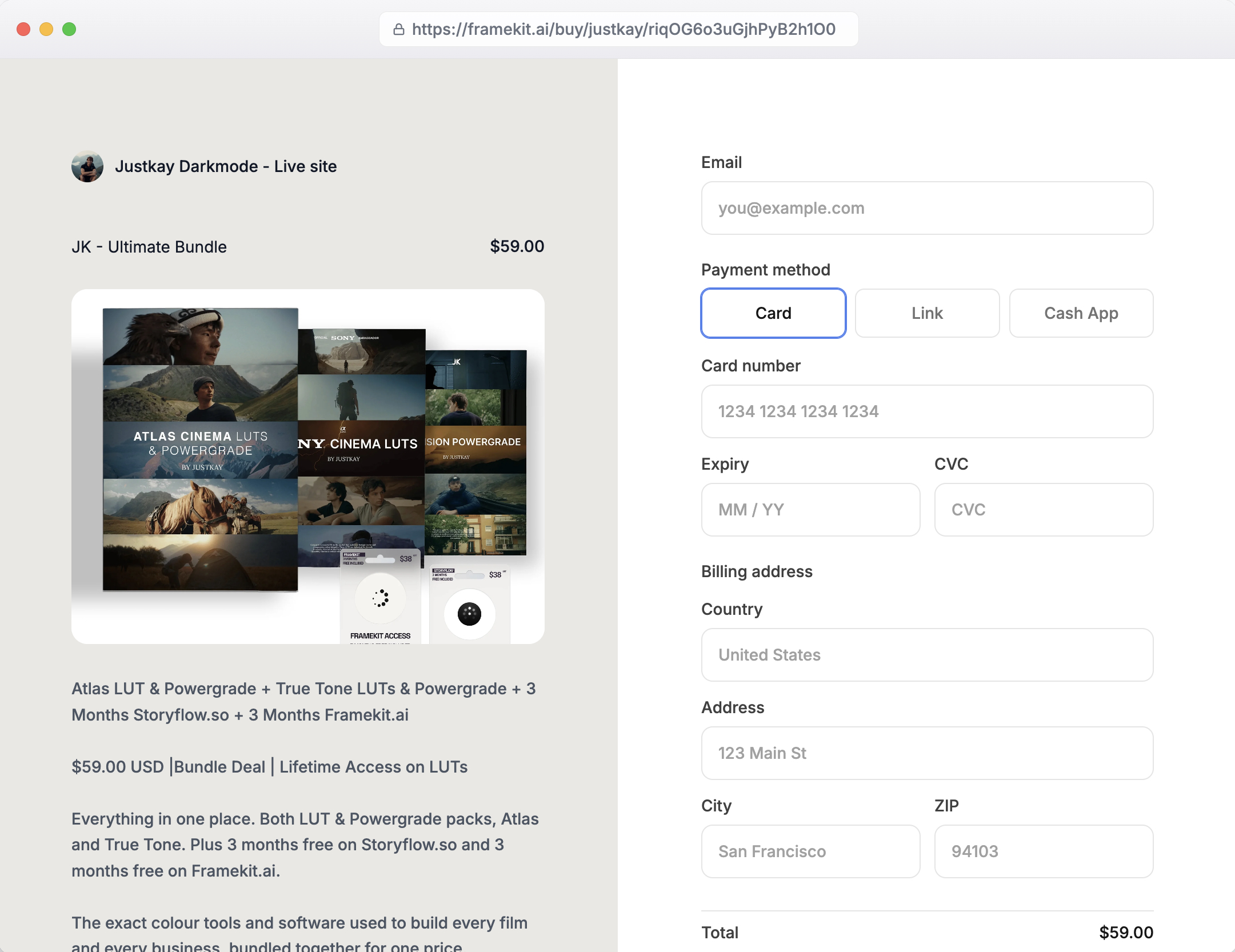
What it does that neither does. Each product appears as a section on any page of your portfolio site, beside the work that made someone want it, and gets a direct framekit.ai/buy link that sells without a website, the way a Gumroad link does.
Sellfy gives you a well-designed store; Framekit gives you the whole creative site with a store inside it.
The money, against both. Framekit charges 5% on Free and Starter, 3% on Pro and 0% on Business at $39 a month ($31 billed yearly), with Stripe's processing on top and the fee taken after any discount code, and there is no sales ceiling on any plan.
At $500 a month, Framekit Free costs $546 a year, $36 more than Sellfy Starter billed yearly and $420 less than Gumroad.
At $2,000 a month, Framekit Business costs $1,356 against $1,692 on Sellfy Business; at $5,000 a month, $2,832 against $3,888 on Sellfy Premium.
Within Framekit, Business beats Free at $780 a month and Pro at about $667 ($533 on yearly billing).
Against Sellfy, the order is: Framekit Free is cheaper below about $440 a month, Sellfy Starter billed yearly is cheapest from there to its $10,000 ceiling, and Framekit Business is cheaper than every Sellfy plan once you pass that ceiling, about $833 a month.

What you give up. Framekit sells digital downloads only: no physical goods, print-on-demand, subscriptions, courses, affiliates, license keys, pay what you want, upsells or abandoned-cart emails.
It has no email marketing credits and no PayPal. Like Sellfy, it is not a merchant of record, and it goes further: Framekit does not calculate or charge VAT at all, so any tax you owe has to sit inside your price.
Framekit keeps its fee on a refund. Checkout always opens at framekit.ai/buy with your name, logo and a "Powered by Framekit" line, even when the store pages use your own domain.
Download links in order emails last 7 days and can be resent; updated files are not pushed to past buyers.

Skip it ifyou sell merch, subscriptions or courses, want VAT calculated for you, or rely on built-in email marketing.
Verdict: for a working creative selling presets, LUTs or templates beside client work, Framekit is the cheapest of the three once sales pass about $833 a month, where Sellfy Starter's ceiling ends, and the only one that also runs the portfolio, the galleries and the review links. For merch and subscription sellers, Sellfy remains the better store. The Gumroad pairing is priced in detail in Gumroad vs Framekit.
Moving From Gumroad to Sellfy: A Checklist
Moving from Gumroad to Sellfy is a re-upload, a store build and a link swap, and the two decisions to make first are which plan's ceiling covers your best-case year and how you will register for the VAT that Gumroad used to remit.
| Step | What to do | Why it matters |
|---|---|---|
| 1 | Export Gumroad customers and sales as CSV | Your buyer list is the asset that does not rebuild itself |
| 2 | Download every file, cover and description | Sellfy lists product migration help only on its higher plans |
| 3 | Size your year: best month times twelve | Picks the plan whose ceiling you will not cross |
| 4 | Decide on VAT: register for EU OSS and UK VAT, or block EU buyers in Sellfy's tax settings | Gumroad remitted it; on Sellfy you file |
| 5 | Connect PayPal and Stripe to Sellfy | Payments land there instantly |
| 6 | Recreate products and check file sizes against your plan's limit | 10GB on Starter, 15GB on Business, 20GB on Premium |
| 7 | Rebuild discount codes, affiliates and subscriptions | Affiliates and upsells need Business |
| 8 | Import your list into Sellfy's email tool if you plan to use it | Credits depend on the plan |
| 9 | Swap links in bios, video descriptions and newsletters | Old links keep selling through Gumroad until changed |
| 10 | Leave Gumroad products live for past buyers | Their receipts and Library still deliver from Gumroad |
| 11 | Use the 14-day trial to build before you pay | Sellfy has no free plan |

Sellfy's pricing table lists product migration as a Premium service and store design migration from Business, while its FAQ mentions migration help on Business and Premium; if you want help moving a large catalogue, confirm with Sellfy before choosing a plan.
How to Choose Between Sellfy and Gumroad
Work through these questions in order and stop at the first clear answer, because the first three are about what you sell and whether you have proven demand, and they settle Sellfy vs Gumroad before the fee tables do.
1. Have you sold fewer than about ten copies a month so far, or not launched yet? If yes, Gumroad, which costs nothing until you sell. If not, go to question 2.
2. Do you sell merch, print-on-demand or physical goods as well as downloads? If yes, Sellfy, which sells all of them on every plan. If not, go to question 3.
3. Do you want worldwide sales tax and VAT handled by the platform as merchant of record? If yes, Gumroad. If you are happy to register for VAT, or sell mostly at home, go to question 4.
4. Does Gumroad's Discover marketplace bring you a meaningful share of sales? If yes, keep at least an entry product there. If not, go to question 5.
5. What is your best-case year? Under $10,000, Sellfy Starter; under $50,000, Business; under $200,000, Premium. Pay yearly if you are confident, which saves 25%.
6. Do your buyers come to a portfolio site you run, and do you also deliver client work? If yes, compare Framekit, which has no sales ceiling and costs less than any Sellfy plan above about $833 a month, provided you sell downloads only and handle tax yourself.
Frequently Asked Questions
Is Sellfy cheaper than Gumroad?
Yes, Sellfy is cheaper than Gumroad for anyone selling more than about eight to ten items a month.
On a $25 product with card processing counted, Gumroad costs $966 a year at $500 a month in sales, $3,864 at $2,000 and $9,660 at $5,000; Sellfy's cheapest qualifying plan, billed yearly, costs $510, $1,692 and $3,888.
How much does Sellfy cost in 2026?
Sellfy costs $29 a month on Starter, $79 on Business and $159 on Premium when billed monthly, or $22, $59 and $119 a month billed yearly, which saves 25%.
Every plan charges a 0% transaction fee, and payment processing, typically 2.9% plus 30 cents, is paid to PayPal or Stripe. There is no free plan, only a 14-day trial.
What is Sellfy's sales limit and what happens if I exceed it?
Sellfy's plans allow up to $10,000 of sales a year on Starter, $50,000 on Business and $200,000 on Premium.
Sellfy's FAQ says you are expected to upgrade when you pass the limit, and that if you do not, it may charge a 2% overage fee on the revenue above it. Size your plan on your best-case year.
Does Sellfy really charge no transaction fee?
Sellfy charges no platform transaction fee on any plan.
What it charges instead is a subscription capped by annual sales, which works out at 2.64% of sales at the top of Starter, 1.42% at the top of Business and 0.71% at the top of Premium on yearly billing.
Card processing is separate and goes to PayPal or Stripe.
How much does Gumroad take from a $25 sale?
Gumroad takes about $4.03 from a $25 direct sale to a US card buyer: its 10% plus $0.50 platform fee ($3.00) and card processing of 2.9% plus $0.30 ($1.03), which its fee article says is not included.
A sale credited to Gumroad's Discover marketplace pays a flat 30% instead, $7.50, with processing included.
Is Sellfy a merchant of record?
No. Sellfy's help centre says it is not the merchant of record and that you are, for all your transactions. Sellfy detects the buyer's location, charges EU and UK VAT and gives you a report for your return, but you register and file.
Gumroad, by contrast, has been a merchant of record since 1 January 2025 and remits tax worldwide.
How fast do Sellfy and Gumroad pay out?
Sellfy pays instantly: each payment goes straight into your own PayPal or Stripe account, with no hold or minimum from Sellfy.
Gumroad holds each sale for at least seven days, pays weekly by default covering sales through the previous Friday, needs a $100 balance, and pays US bank accounts on Thursdays.
Who handles refunds and chargebacks on Sellfy and Gumroad?
On Sellfy you do: refunds are issued from your own PayPal or Stripe account, and Sellfy says it cannot issue them itself; chargebacks arrive at your processor, and Sellfy's order activity log helps as evidence.
On Gumroad, refunds return Gumroad's fee to you, and chargebacks are contested by Gumroad with any evidence you add within 72 hours.
How many times can a buyer download a Sellfy product?
A Sellfy buyer gets five download or streaming attempts per file, counted across devices, while repeat downloads on the same device are not limited.
A buyer who runs out can reset their attempts from the download page by verifying their email, and the fresh link works on the device where they reset it.
Which is better for a first digital product?
Gumroad is better for a first digital product, because it costs nothing until you sell and Sellfy has no free plan beyond a 14-day trial.
Move to a flat plan like Sellfy once you consistently sell more than about ten items a month, which is when Gumroad's percentage starts costing more than the subscription.
Can Sellfy sell physical products and merch?
Yes. Every Sellfy plan sells digital, physical, subscription and print-on-demand products, so a photographer can sell presets, prints and branded merchandise from one store. Gumroad sells digital products, memberships and courses but not physical goods.
Can I use Sellfy and Gumroad at the same time?
Yes, and some sellers keep an entry product on Gumroad for Discover reach while running the main catalogue on Sellfy. Remember that sales on both count toward your income, but only Sellfy sales count toward Sellfy's ceiling, and only Gumroad remits tax for you.
Sellfy vs Gumroad vs Framekit: which suits a photographer selling presets?
A photographer still testing a preset pack should start on Gumroad; one selling presets with prints or merch should pick Sellfy.
A photographer selling presets beside client work, with a portfolio site and more than about $833 a month in sales, pays least on Framekit Business, which has no sales ceiling.
Our guide to the best platforms to sell presets compares the wider field.
Final Verdict
Start on Gumroad, and move to Sellfy once a product sells every week.
That is the recommendation for most sellers, and the number to watch is about eight to ten sales a month on a $25 product, after which Sellfy's flat plan costs less than Gumroad's percentage at every volume we priced.
Choose Sellfy for the long run if you want a branded store, sell merch or subscriptions too, and are comfortable registering for VAT; pick the plan whose ceiling covers your best-case year and pay yearly.
Stay on Gumroad if you want a merchant of record to carry worldwide tax and disputes, or if Discover brings buyers you cannot reach yourself.
Where Framekit loses is breadth: it sells downloads only, with no merch, subscriptions, email credits or PayPal, does not calculate VAT and is not a merchant of record, so it is not for a seller who needs any of those.
The trade-off is a store with no sales ceiling that costs less than Sellfy above about $833 a month and lives inside a portfolio site that also delivers client work.
Related readingGumroad vs Payhip, Shopify vs Gumroad, the best zero-commission selling platforms and what it costs to sell digital products online.