Framekit templates
Start from a designer-made template
 Use template
 Use template
 Use template
 Use template
 Use template
 Use template
 Use template
 Use template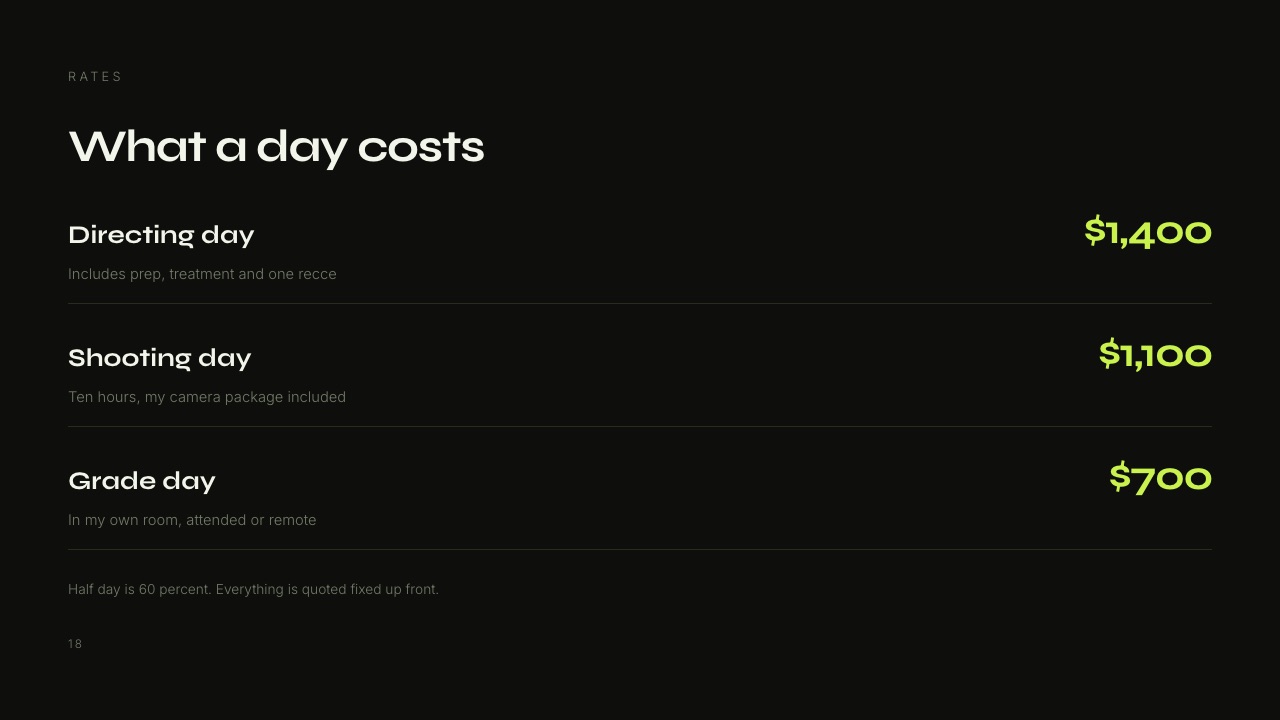
A brand's producer asks for your videographer rate card by Friday. You send one line, £600 a day, and the reply comes back in an hour: does that include the camera, the sound, the drive time, and the edit?
You have just negotiated against yourself, because every one of those answers is now a discount on the £600.
The Camera Branch of Bectu, the UK union's camera section, puts the fix in one line on its rate card: all displayed rates are labour only, and crew should keep equipment hire and other charges separate. Discount the kit if you must. Never the day.
A videographer rate card is a one-page price list that sets your labour day and half-day rate, then prices everything that changes a quote as its own line: kit, extra crew, travel, overtime, editing, revisions, usage and rush fees, so a client can build their own estimate and you never have to explain what "a day" includes.
Build a videographer rate card around a labour-only day rate and itemise everything else.
The most complete public benchmarks in 2026 are British: the APA's commercial crew terms (effective 1 September 2026) put a camera operator at £529 to £656 and a director of photography at £935 to £1,561 for a ten-hour day, and Bectu's Camera Branch card puts drama and feature camera operators at £563 to £808.
In the US, where no public freelance standard exists, work back from the BLS median camera operator wage of $74,990 and the days you can really bill.
Make the card in Framekit Slides if you want it as a link beside your portfolio, in Google Sheets if you want a calculator, or in HoneyBook if it should turn straight into an invoice.
Full disclosure: Framekit is our product, and it is ranked first in the tools section for one job: a rate card that lives as a designed link next to your portfolio site. We did not use the other tools for this guide; we read their pricing pages in September 2026. Framekit cannot issue invoices, take deposits or calculate a quote for you, so HoneyBook and Google Sheets are the better fits for those parts, and we say so where they come up.
How These Day Rates Were Sourced
Every rate in this guide comes from a published rate sheet or a government statistic, or it is an example we built and labelled, and the three are kept apart so you can tell a benchmark you can quote to a client from arithmetic you should redo with your own numbers.
Read at the source. Commercial crew rates come from the APA Recommended Terms for Engaging Crew on Commercials, effective 1 September 2026, which Bectu's ratecards page points commercials and promos crew to.
Drama and feature rates come from the Camera Branch rate card for film and TV drama, dated 1 January 2025, and the branch's rates page.
US wages come from the Bureau of Labor Statistics Occupational Outlook Handbook (May 2025 data), which refuses automated requests, so it is cited by name without a link.
Calculated. The day rate from a salary, the worked quote and the overtime figures are our arithmetic from those sources, shown line by line.
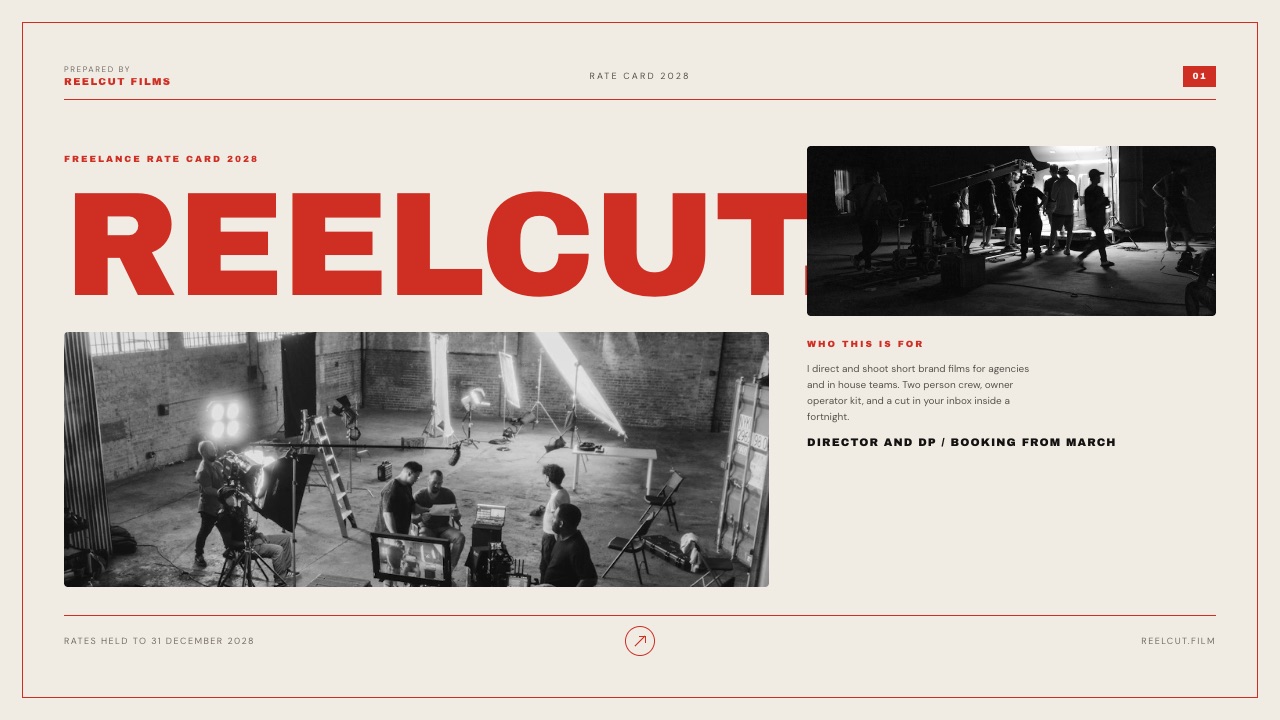
Rendered. The Framekit slides pictured are real templates rendered slide by slide. Their prices are template sample copy, not market data.
Reported by users. Nothing. We looked for a US marketplace dataset of freelance day rates and did not find one consistent enough to quote, so this guide uses none.
The carried example. A freelance shooter-director in the UK quoting a two-day brand film with sound on one day and three edit days. The same job is priced in full later on.
Videographer Day Rates in 2026, by the Numbers
These are the figures worth having in front of you before you set a single price, each from a published source, because a client's producer has probably seen at least one of them and will use it as the yardstick for yours.
- £529 to £656: the APA's recommended basic daily rate for a camera operator on UK commercials from 1 September 2026, for ten working hours plus an hour's lunch.
- £935 to £1,561: the same card's range for a director of photography. A director tops out at £961 and a sound mixer runs £541 to £668.
- £563 to £808: the Camera Branch's ten-hour day for a camera operator across TV drama budget bands and feature budgets, as of January 2025.
- One tenth: under the APA terms, your basic hourly rate is a tenth of your day rate, and overtime is 1.5, 1.25 or 1.0 times that depending on how high your day rate is.
- $74,990: the BLS median annual wage for US television, video and film camera operators in May 2025; film and video editors earned a median $75,420. The BLS also reports that 35% of camera operators are self-employed, and its wage figures exclude them.
- Seven days: the APA's cancellation cliff. Cancel a week or more ahead and no fee applies; four to six days out costs 50%, two to three days 75%, and the day before 100%.
2026 Day Rate Benchmarks by Role
In one lineThe two British rate cards give the clearest public picture of what a camera crew costs in 2026, and even if you work elsewhere they show how the market structures a day, which matters more than the currency.
| Role | APA commercials, from 1 Sep 2026 (10 + 1 hours) | Camera Branch drama and features, Jan 2025 (10 + 1 hours) | Overtime under the APA terms |
|---|---|---|---|
| Director of photography | £935 to £1,561 | Individually negotiated | Grade III: 1.0 times the hourly rate |
| Camera operator | £529 to £656 | £563 (TV band 1) to £808 (mid and major features) | Grade II: 1.25 times |
| Steadicam operator | Not listed separately | £808 to £1,010, commercials £927 | Not applicable |
| Focus puller (1st AC) | £461 to £575 | £453 to £565, commercials £536 | Grade II: 1.25 times |
| Clapper loader (2nd AC) | £355 to £448 | £339 to £415 | Grade I: 1.5 times |
| DIT | Up to £527 | £453 to £565 | Grade II: 1.25 times |
| Sound mixer | £541 to £668 | Not on the camera card | Grade II: 1.25 times |
| Gaffer | Up to £585 | Not on the camera card | Grade II: 1.25 times |
Sources: the APA crew terms appendix and the Camera Branch film and TV drama card, both read 19 September 2026. Camera Branch figures are for standard day shooting hours only, and the TV bands are set by budget per hour of programme (band 1 is under £1m an hour).
The older Camera Branch card for factual, documentary, digital content and corporate work, dated January 2022, listed a cameraperson at £465 for a nine-hour day and a DoP or lighting cameraperson at £556 for nine hours and £711 for eleven.
It is four years old, so treat it as a floor rather than a current rate, but it is the branch's card that covers corporate and social content directly.
What the table does not tell you. These are crew rates: someone else is producing, owns the footage, and books you for your role.
A videographer who sells directly to a brand is also the producer, the editor and often the director, so their rate card starts from these numbers and adds lines for everything a production company would normally carry.
Why Every Serious Rate Card Says "Labour Only"
In one lineA labour-only day rate with kit, crew and travel priced separately is the single most useful rule in videographer pricing, because it gives you something to discount that is not your own time, and it keeps your day rate intact for the next job.
The Camera Branch card spells out the reasoning.
If a production pleads poverty but can find money to top up your rate through equipment fees, it can afford you, and it has also recorded you accepting a low labour rate, which can be used to justify a low rate later.
The branch's advice: keep the labour rate on the invoice and discount the equipment.
That logic applies at least as much to a freelancer selling to brands. A single all-in number teaches a client that "a day" includes a camera package, a sound kit and a drive to Manchester. The next time they ask for a cheaper day, the only thing left to cut is you.
| All-in pricing | Labour-only pricing |
|---|---|
| "£1,100 a day" | "£600 a day labour, £250 camera package, sound recordist £560, travel at cost" |
| A discount comes off your time | A discount comes off the kit line, which you own and have already paid for |
| The client cannot see why two quotes differ | The client can compare line by line, and the extra crew is visibly optional |
| Next year's rate starts from the discounted number | Next year's labour rate starts from the same number |
| One figure to argue with | Several lines, each with a reason |
The Director and DP Portfolio template in Framekit Slides shows the other common approach, a shooting day with "my camera package included", and it is not wrong; many clients want one number.
If you do bundle, write the bundle as a sum of two parts in your own notes, and put a line under the card that says what a day without the kit costs. Then there is still a labour rate to protect.
Working Out Your Own Day Rate From the Days You Can Bill
In one lineA freelance day rate is a salary divided by billable days, not by working days, so the question that sets your rate is how many days a year a client actually pays for, and for most freelancers that is far fewer than 230.
An employed camera operator in the US earning the BLS median of $74,990 is paid for roughly every working day of the year.
A freelancer is paid only for the days a client books, and spends the rest pitching, prepping, maintaining kit, editing unpaid showreels and doing admin.
They also carry costs an employer would normally cover: gear, insurance, software and, in the US, health cover and self-employment tax.
The formula is: (the income you want + what the business costs) ÷ billable days = your day rate. Here it is with the BLS median as the income and an example $20,000 a year of business costs, which you should replace with your own.
| Billable days a year | Day rate needed to match the $74,990 median plus $20,000 of costs |
|---|---|
| 60 | about $1,583 |
| 80 | about $1,187 |
| 100 | about $950 |
| 120 | about $792 |
Calculated: $94,990 divided by each number of days. The BLS figure is for employees and excludes the self-employed, so it is a reference income, not a freelance rate.
The same logic works in pounds. A camera operator at the APA's £600 midpoint who bills 100 days earns £60,000 before costs and tax; at 60 days, £36,000. That is why published crew rates can look generous per day and still add up to an ordinary income.
The test you can run tonightcount the days you invoiced for in the last twelve months, not the days you worked. Divide the income you need by that number. If the answer is higher than the rate on your card, the card is the problem, not your client list.
The Nine Lines of a Videographer Rate Card
In one lineA rate card that survives a producer's questions has nine lines, from the labour day to the rush fee, and every line either has a published rule behind it or a clearly stated rule of your own that a client can read before they ask.
| Line | What it covers | A published reference | How to write it on your card |
|---|---|---|---|
| 1. Day rate | Ten hours of your labour plus lunch | APA and Camera Branch days are 10 + 1 hours | "Shoot day, ten hours on location, labour" |
| 2. Half day | Up to five hours | APA prices a recce day at 8 hours of the hourly rate, 80% of a day | A percentage of the day, stated once |
| 3. Kit | Camera, lenses, support, lighting, sound kit | Camera Branch: keep kit separate from labour | A per-day kit fee, or a list of what is included |
| 4. Crew | Sound recordist, assistant, second shooter, gaffer | APA sound mixer £541 to £668, focus puller £461 to £575 | "Quoted per job" or a fixed rate per role |
| 5. Travel | Time and costs to reach the location | APA: travel time at the hourly rate, less the first hour each way | A radius included, and a rule beyond it |
| 6. Overtime | Hours past ten | APA: 1.5, 1.25 or 1.0 times the hourly rate by grade, triple after midnight | Per hour, rounded to the half hour |
| 7. Edit day | Offline, grade, sound mix, exports | No union card for freelance short-form edit days found | A day rate, with what a day typically produces |
| 8. Revisions and usage | Rounds of changes; where and how long the film may run | No published standard found | Rounds included; usage terms by media and duration |
| 9. Rush and cancellation | Short-notice delivery, cancelled shoots | APA cancellation: 50%, 75%, 100% inside seven days | A percentage per notice window |
Half days: price the day you lose, not the hours you work
A half day rarely frees the other half for paid work, so every structure we could find prices it well above 50%. The APA terms charge a recce or prep day by the hour, which puts an eight-hour non-shooting day at 80% of the day rate.
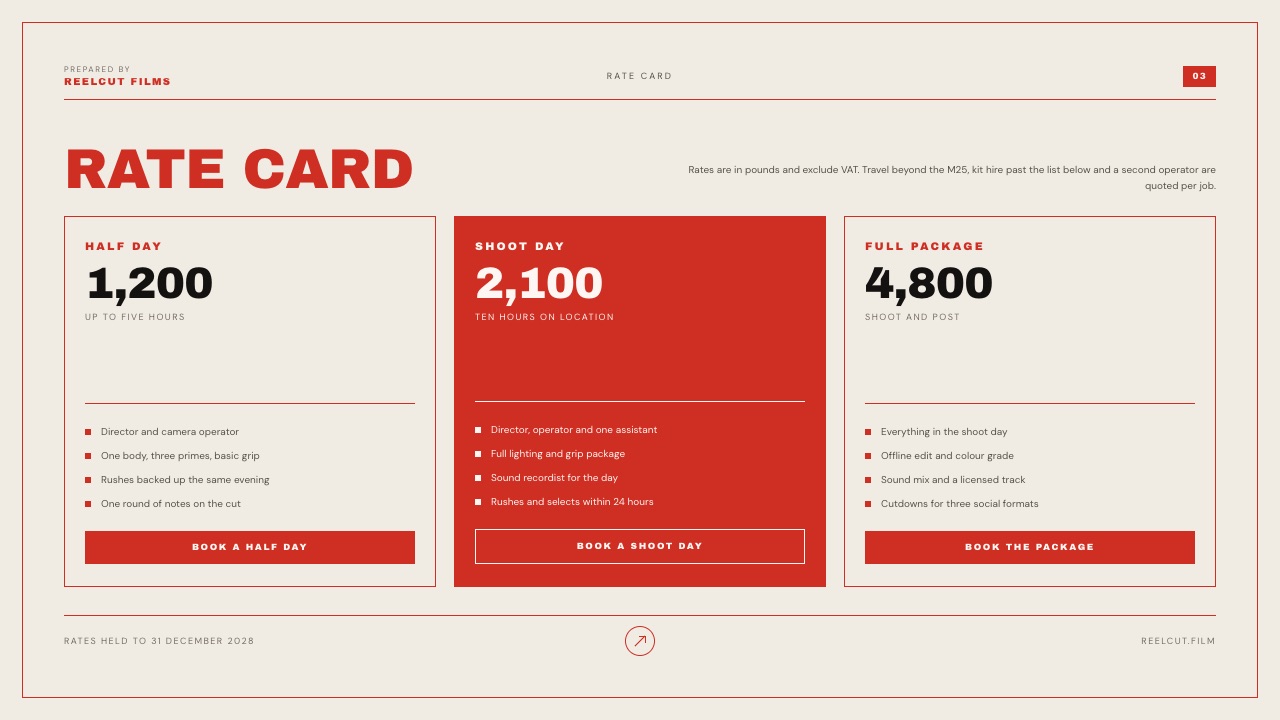
Framekit's Director and DP Portfolio template states "half day is 60 percent" as sample copy, and the Rate Card and Cold Outreach Deck prices its sample half day at 1,200 against a 2,100 shoot day, about 57%.
Pick one percentage and put it on the card. The number matters less than the fact that it is written down before a client asks for "just a couple of hours".
Overtime: the APA's three grades, and why higher rates get a lower multiplier
Under the APA terms your basic hourly rate is one tenth of your day rate. If your day rate is £458 or less you are Grade I and overtime is paid at 1.5 times the hourly rate.
From £459 to £696 you are Grade II at 1.25 times, and from £697 up you are Grade III at 1.0 times. Overtime after midnight is three times the hourly rate, and overtime is rounded up to the half hour.
On a £600 day that is a £60 hourly rate and £75 an hour of overtime. The sliding multiplier is worth copying even outside commercials: the better paid you are, the less a long day should cost the client per extra hour, and the less likely they are to argue about it.
The APA also sets weekend and night terms: a Saturday pays 1.5 times the hourly rate for every hour with a ten-hour minimum, a Sunday or bank holiday twice, and a night call (starting between 5pm and 5am) twice the hourly rate with a ten-hour minimum.
A line that says "weekends 1.5x, Sundays and nights 2x" covers most of it.
Cancellation: the seven-day scale
The APA scale is the clearest published one: no fee with seven or more days' notice, 50% with four to six days, 75% with two to three days and 100% on the day before.
For engagements of three days or fewer, the fee applies to the whole booking. Copy the structure, adjust the percentages if you like, and say it on the card rather than only in the contract.
Usage: the line crew rates do not have
Crew on an APA engagement assign the copyright in their work to the production company, which is why crew rate cards have no usage line at all.
A videographer selling directly to a brand is in a different position: the film is yours until you license it, and the licence decides what the brand can do with it.
No union or government source publishes a standard usage fee for freelance video, and we found none we could verify, so this is a method rather than a number.
Define usage by three things: where the film runs (the client's website and organic social, paid social and online ads, broadcast or cinema), where in the world, and for how long.
Include the lightest tier in the day rate, and price the heavier tiers as a clearly stated uplift you set yourself.
Whatever you choose, write the default on the card: "includes organic web and social use, worldwide, no end date; paid media quoted per campaign".
A Worked Rate Card Quote: Two-Day Brand Film
In one linePricing the carried example line by line shows why itemising pays off, because when the client's budget comes in £462.50 short, the whole gap closes from kit, edit scope and travel while the £600 labour day stays exactly where the rate card put it.
The job: a UK brand wants a two-minute film and three social cutdowns. Day one is an interview and product scenes in a studio with a sound recordist. Day two is exteriors three hours' drive away. Post is three days.
The labour and crew rates sit inside the APA ranges; the kit fee and edit rate are examples you should replace with your own.
| Line | Basis | Amount |
|---|---|---|
| Shoot days, labour | 2 days at £600, inside the APA camera operator range of £529 to £656 | £1,200 |
| Camera package | 2 days at £250 (example kit fee) | £500 |
| Sound recordist, day one | £560, inside the APA sound mixer range of £541 to £668 | £560 |
| Travel time, day two | 6 hours round trip, less the first hour each way under the APA rule, so 4 hours at the £60 hourly rate | £240 |
| Overtime, day one | 1.5 hours at £75 (Grade II: £60 × 1.25) | £112.50 |
| Edit days | 3 days at £450 (example edit rate) | £1,350 |
| Revisions | Two rounds included | Included |
| Usage | Organic web and social, worldwide, included; paid media quoted per campaign | Included |
| Total, excluding VAT and expenses | £3,962.50 |
Now the client replies that the budget is £3,500. With an all-in day rate, the only answer is a cheaper day. With this card there are three better ones.
| Where the £462.50 comes from | Change | New total |
|---|---|---|
| Kit | Camera package at £125 a day instead of £250 | £3,712.50 |
| Edit scope | Third edit day becomes a half day at 60%, dropping one cutdown | £3,532.50 |
| Travel | Client agrees to a location an hour closer, saving 2 hours of travel time | £3,412.50 |
Taken together, the three changes save £550 and land the job at £3,412.50, under budget. The labour day on the invoice still reads £600, which is the number your next quote starts from.
For what a sensible edit day looks like in your market, see how much to charge for video editing.
The Videographer Rate Card Template, Slide by Slide
In one lineFramekit's Rate Card and Cold Outreach Deck is a four-slide template built for exactly this document, and three larger templates carry a rates slide for when the rate card has to sit inside a portfolio, a credentials deck or a full production quote.
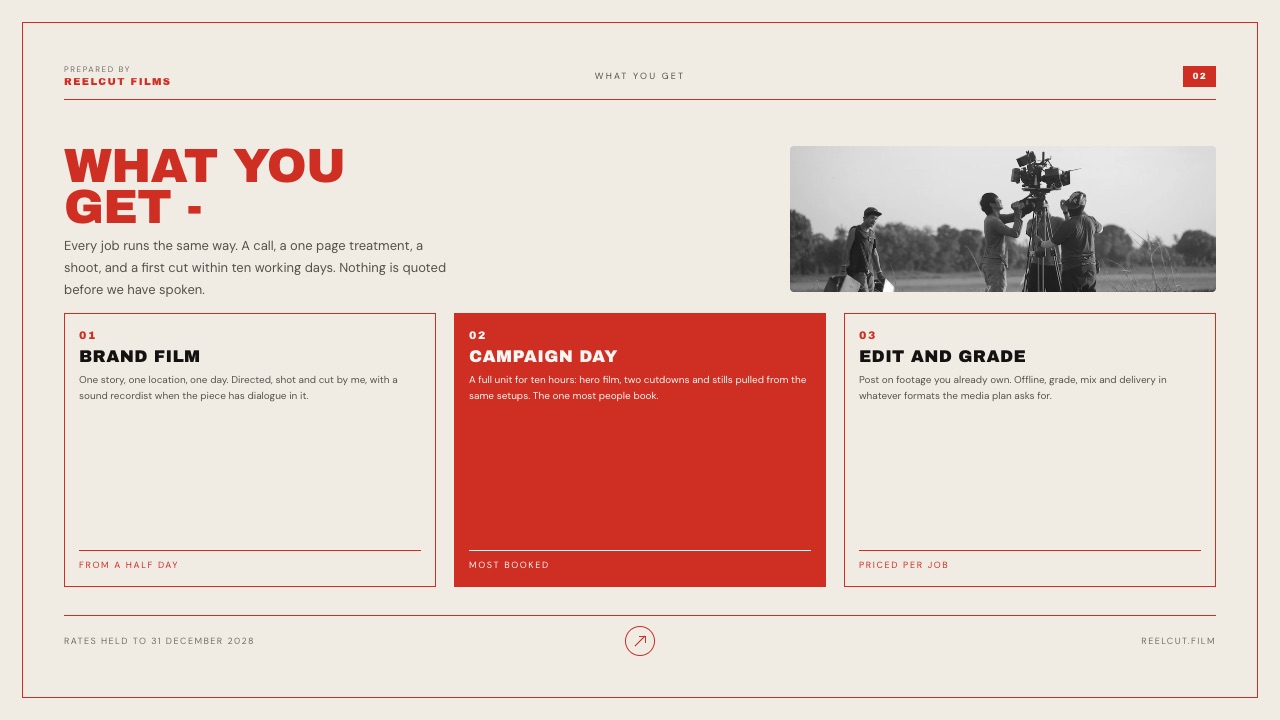
The Rate Card and Cold Outreach Deck has four slides: Cover, What you get, Rate card and Next step. It is short on purpose. It is designed to go out with a cold email or a reply to an inquiry, where a producer will give it a minute, not a meeting.
| Slide | What it does | What to write on it |
|---|---|---|
| Cover | Who you are and what kind of work you do | Name, role, city, one line on the work |
| What you get | The three ways people hire you | The template's sample shows a brand film from a half day, a ten-hour campaign day marked most booked, and edit and grade priced per job |
| Rate card | Prices, with the default terms underneath | Half day, shoot day, and a shoot-and-post package, with the currency, VAT, travel radius and what is quoted per job |
| Next step | How to book | One action: a call, a hold on a date, or a reply with the brief |
The sample Rate card slide is a good model of the labour-only idea done in a design-friendly way.
It shows three prices in pounds excluding VAT, lists what each includes, and says underneath that travel beyond the M25, kit hire past the listed package and a second operator are quoted per job.
It even carries a "rates held to" date, which quietly answers the question of whether the price will change before the client signs.
For other contexts, three templates carry the same information in a longer document:
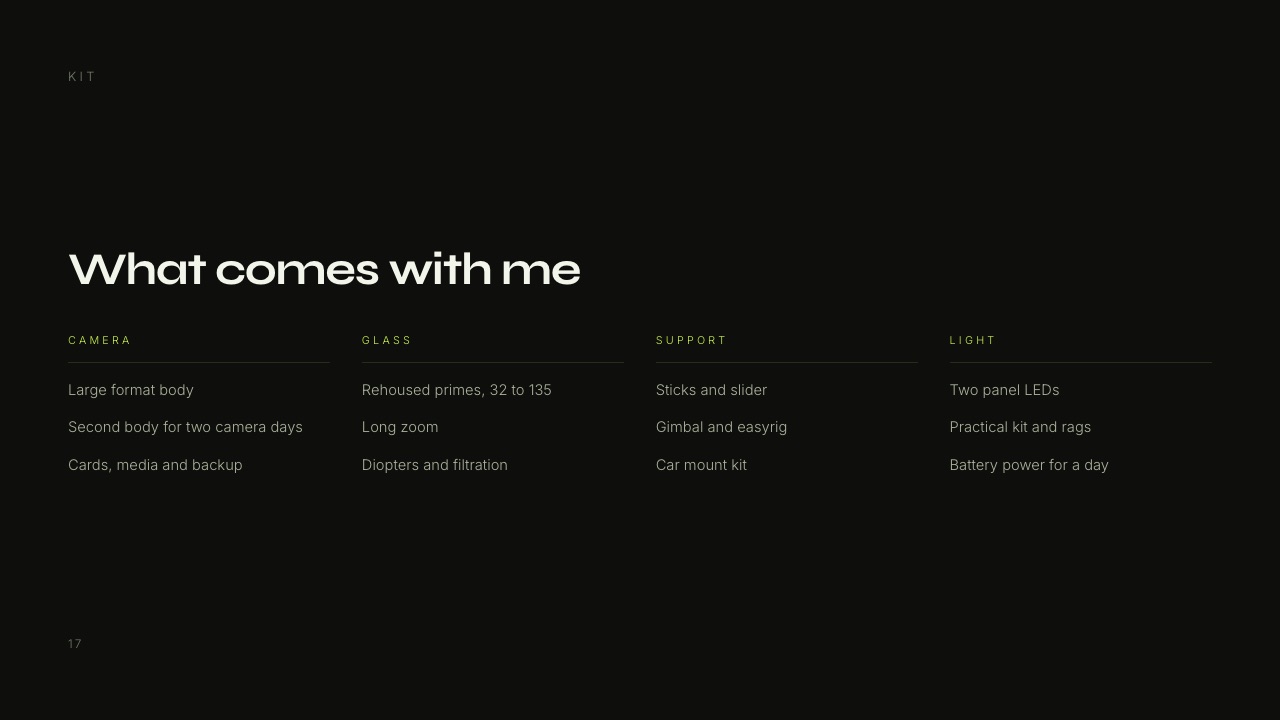
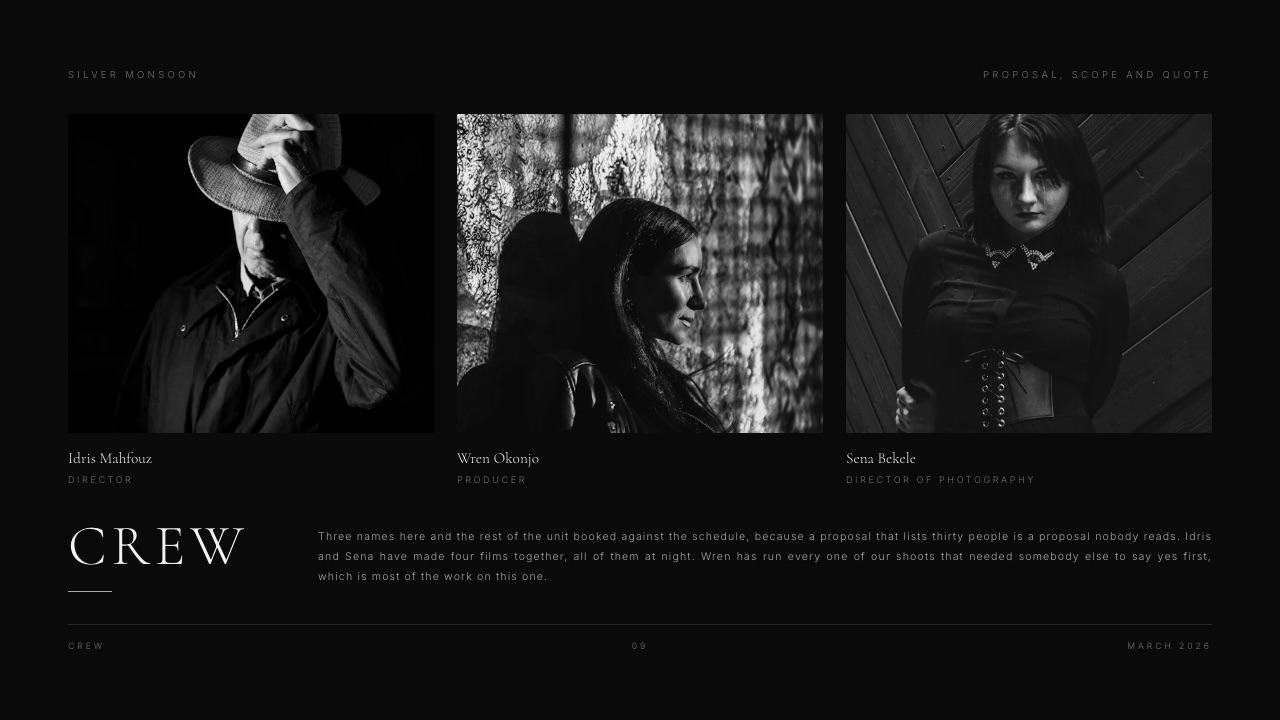
- Director and DP Portfolio (20 slides) includes Kit and Rates slides near the end: what comes with you, then a directing day, shooting day and grade day, with the half-day percentage stated. Use it when the rate card follows your work rather than leading.
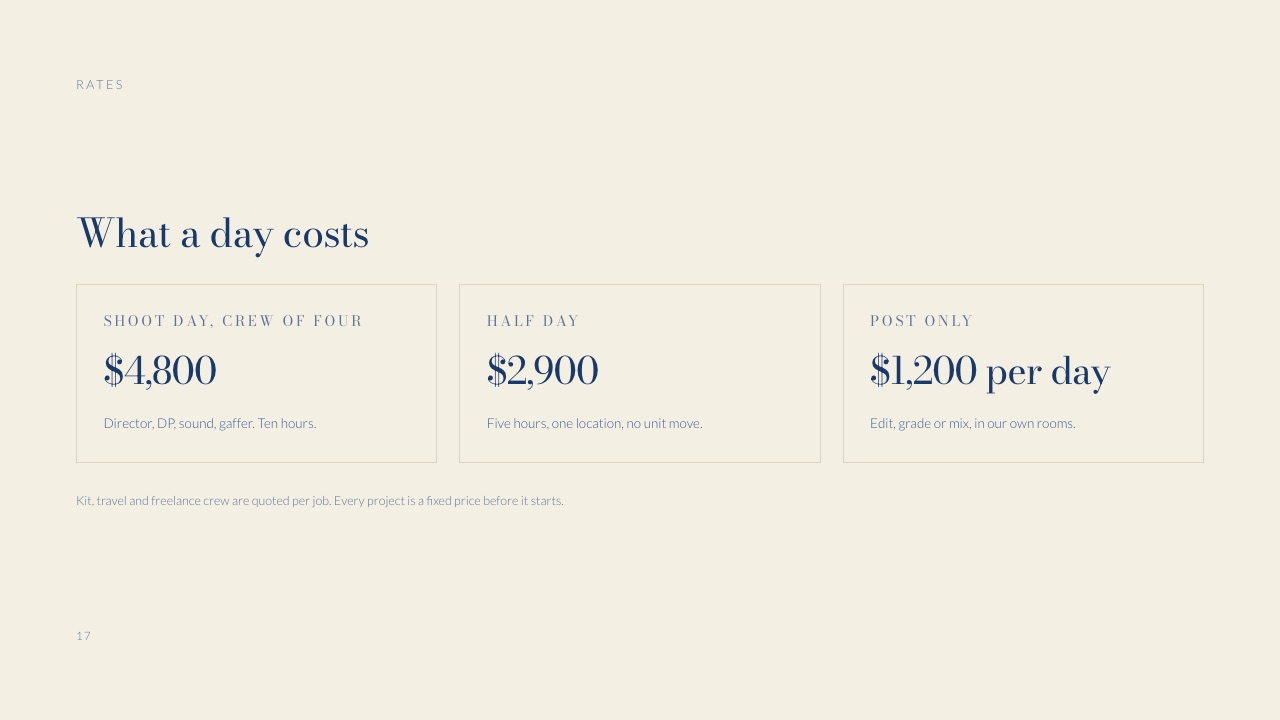
- Production Company Credentials (20 slides) has a Rates slide pricing a crew of four, a half day and post only, with kit, travel and freelance crew quoted per job. Use it when you sell as a small company rather than a person.
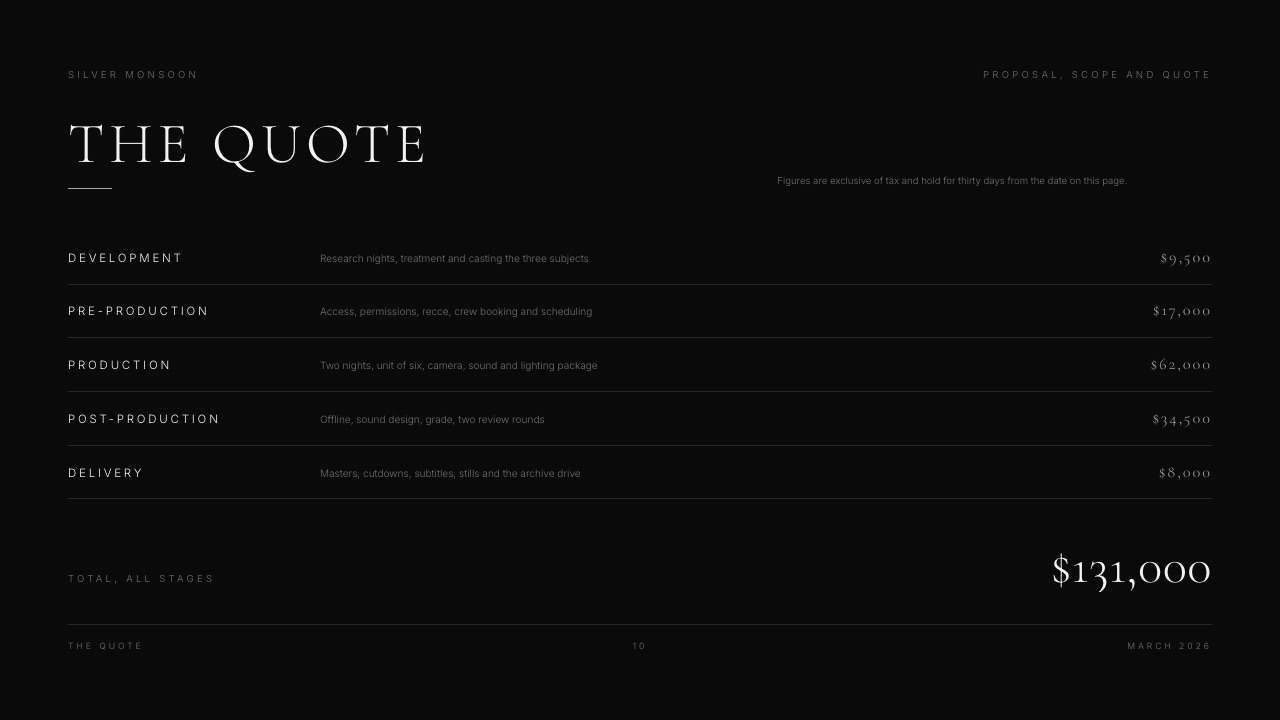
- Film Production Proposal and Quote (12 slides) has a stage-by-stage quote, from development through delivery, held for thirty days. Use it when the rate card has turned into a real job with a real scope.
Tools to Build a Videographer Rate Card
A rate card can be made in anything, so the five tools below are ranked by the job the rate card does after you make it: sit beside your portfolio, calculate a quote, look polished as a PDF, or turn into an invoice with a deposit.
| Tool | Price read in September 2026 | What the rate card becomes | Calculates totals |
|---|---|---|---|
| Framekit Slides | Free plan; template library from Starter at $9 a month ($7 billed yearly) | A designed link and a PDF | No |
| Google Sheets | Free with a Google account | A live calculator and a PDF | Yes |
| Canva | Free; Pro EUR 110 a year (European pricing) | A designed PDF or Canva link | No |
| HoneyBook | Starter $29 a month billed yearly | A proposal and invoice inside HoneyBook | Yes, inside its invoices |
| Affinity | Free | A print-grade PDF you lay out yourself | No |
1. Framekit Slides: Best for a Rate Card That Travels With Your Portfolio
Framekit Slides is the deck tool inside Framekit, and it is the only tool here with a template called Rate Card and Cold Outreach Deck, plus the Director and DP Portfolio and Production Company Credentials templates that carry rates slides.
Framekit is an AI website builder for filmmakers and videographers, so the rate card can be shared as a link from the same account as the portfolio site a producer checks before they call you.
The real numberdecks, sharing, full-screen presenting and PDF export are on the free plan; the template library, custom fonts and removing the Framekit byline need Starter at $9 a month, or $7 billed yearly.
The honest limita deck does not add up a quote, and a shared deck link has no password and shows only a total view count, not who opened it. There is no invoicing, no deposits and no e-signature in Framekit, so the rate card ends where the paperwork begins.
Skip it if your rate card is really a spreadsheet that changes on every call; build that in Google Sheets and design it later.
Verdict: the right home for the rate card you send cold, and the wrong place to calculate the quote that follows it.
2. Google Sheets: Best for a Rate Card That Does the Maths
Google Sheets is free with a Google account, and it is the natural place to turn the nine lines into a calculator: day rate in one cell, the APA overtime multipliers in another, travel hours times the hourly rate, and a total that updates as you type.
The standout detailthe overtime grade can be a formula. If your day rate cell is £458 or less the multiplier is 1.5, up to £696 it is 1.25, above that 1.0, and the sheet applies it without you remembering.
The gotchaa spreadsheet sent to a client looks like a spreadsheet. Keep the sheet for yourself and export the client version as a PDF, or paste the result into a designed card.
Verdict: every freelancer should have this sheet, even if the client never sees it.
3. Canva: Best for a Designed One-Page PDF
Canva is the quickest route to a polished single page, with a template library Canva puts at 3.6 million or more on Pro. Pro was listed at EUR 110 a year for European buyers in September 2026; Canva's pricing page does not load for automated readers, so it is not linked.
The gotchait is easy to end up with a beautiful card that has no terms on it. Whatever template you start from, add the small print: currency, VAT, travel radius, overtime rule and cancellation scale.
Verdict: a good choice if Canva already makes your social posts and invoices look the way you want. Looking beyond it for decks? See the best Canva alternatives for presentations.
4. HoneyBook: Best When the Rate Card Should Become an Invoice
HoneyBook is a client-management platform, and on its pricing page Starter is $29 a month billed yearly, with Essentials at $49 and Premium at $109.
Its value for a rate card is what happens next: the same line items become a proposal, a contract and an invoice with payment, without retyping a line.
The gotchait is priced as a business system, so at $348 a year for Starter it only pays off if you also use the contracts and payments. Removing "Powered by HoneyBook" needs Essentials.
Skip it if you send a handful of quotes a year; a sheet and a simple invoicing tool cover you. Compare options in the best invoicing tools for freelance creatives.
Verdict: the best fit for a busy videographer whose bottleneck is getting from "yes" to "paid".
5. Affinity: Best Free Layout Tool for a Print-Quality PDF
Affinity now offers design, photo editing and page layout in one app, free for everyone. For a videographer who can design, it produces the cleanest typographic PDF here for nothing.
The gotchayou start from a blank page, and a PDF is frozen the moment it is exported, so every rate change means a new file and a new email.
Verdict: worth it for the rate card you print or attach to tenders; overkill for one you update every quarter.
Where the Rate Card Goes Once It Exists
In one lineA rate card earns its keep in three places, the reply to an inquiry, the cold email and the portfolio site, and each one wants a slightly different version, so decide which numbers are public before you decide how the card looks.
On your website. A "from" price per service ("brand films from £1,200") filters out budgets that will never fit, without publishing the full card to competitors.
Put it beside the work it prices; see the best portfolio website builders for videographers for sites built around video.
In a cold email. Send the short four-slide deck as a link rather than an attachment, so nothing has to be downloaded and nothing large sits in a spam filter.
Put a "rates held to" date on it, as the template does, so an old copy cannot be mistaken for a current one.
For finding the people to send it to, how to get clients as a videographer covers the outreach side.
In reply to an inquiry. Send the full card with all nine lines, and follow it with a written quote for the specific job. The rate card sets expectations; the quote is what gets signed.
Starting out? How to start a videography business covers insurance, kit and registration, and how to make money as a videographer looks at which kinds of work sustain the day rate you set here.
How to Set Your Rate Card: A Decision Guide
Work through these questions in order, because the right rate card depends first on who books you and how, and only then on which template or tool you use to present the numbers.
- Are you booked as crew by a production company, or directly by brands? If as crew, start from the APA or Camera Branch rate for your role and keep usage off the card, because the production owns the footage. If directly, go on.
- Do you know how many days you invoiced last year? If not, count them before setting a rate. Then divide the income you need by that number and compare it with the published ranges.
- Does your current rate include kit? If yes, split it into labour and kit on your own sheet, and show a labour-only day on the card, so any discount comes off the kit line.
- Do clients ask about overtime, travel or cancellations after booking? If yes, add those three lines using the APA structures as a starting point: graded overtime, travel time less the first hour each way, and the seven-day cancellation scale.
- Do you sell directly for paid media? If yes, write a default usage line and price paid campaigns separately.
- Where will the card be read? As a cold link beside your portfolio, build it in Framekit Slides. As a calculator, in Google Sheets. As the first step of a proposal and invoice, in HoneyBook.
Frequently Asked Questions
How much should a freelance videographer charge per day in 2026?
A freelance videographer's day rate in 2026 should cover the income they need divided by the days they actually bill.
As published UK benchmarks, the APA's commercial crew terms from 1 September 2026 put a camera operator at £529 to £656 for ten hours plus lunch and a director of photography at £935 to £1,561.
In the US, $74,990 (the BLS median camera operator wage) plus $20,000 of costs over 100 billable days works out at about $950 a day.
What should a videographer rate card include?
A videographer rate card should include a labour-only day rate, a half-day rate, a kit fee, rates or a rule for extra crew, a travel rule, overtime, an edit day rate, revisions and usage terms, and rush and cancellation fees.
Framekit's four-slide Rate Card and Cold Outreach Deck puts the prices and default terms on one slide, with currency, VAT and what is quoted per job underneath.
Should a videographer's day rate include equipment?
A videographer's day rate is best quoted as labour only, with equipment as a separate line.
The Camera Branch of Bectu states that its rates are labour only and advises crew to keep equipment hire separate, keep the labour rate on the invoice and discount the equipment instead, because an accepted low labour rate can be used to justify a low rate later.
How much is a half day for a videographer?
A half day for a videographer is usually priced well above half the day rate, because the other half is rarely sold. The APA terms charge a recce or prep day by the hour, so an eight-hour non-shooting day costs 80% of the day rate.
Framekit's Director and DP Portfolio template uses 60% as sample copy, and the Rate Card template's sample half day is about 57% of its shoot day.
How do videographers charge overtime?
Videographers usually charge overtime per hour beyond a ten-hour day.
Under the APA's 2026 commercial terms, the hourly rate is a tenth of the day rate, and overtime is 1.5 times that for day rates up to £458, 1.25 times from £459 to £696 and 1.0 times from £697, with triple time after midnight and overtime rounded up to the half hour.
How do I calculate my videographer day rate?
To calculate a videographer day rate, add the income you want to your yearly business costs and divide by the number of days you realistically bill.
For example, $74,990 of income plus $20,000 of costs is $94,990; at 80 billable days that is about $1,187 a day, and at 120 days about $792. Count last year's invoiced days, not the days you worked.
What is the difference between a rate card and a quote?
A rate card lists your standard prices and terms for any job, while a quote prices one specific job's scope. The rate card is sent early to set expectations; the quote follows a brief and itemises days, kit, crew, travel, edit and usage.
Framekit's Film Production Proposal and Quote template carries a stage-by-stage quote held for thirty days.
Do videographers charge for usage rights?
Videographers who sell directly to brands can charge for usage, because the footage is theirs until they license it, whereas crew on APA commercial engagements assign copyright to the production company and charge no usage.
No union or government source publishes a standard freelance usage fee, so define usage by media, territory and duration, include the lightest tier and price paid media separately.
How much does a camera operator charge per day in the UK?
A UK camera operator's recommended day rate is £529 to £656 on commercials under the APA crew terms effective 1 September 2026, and £563 to £808 for a ten-hour day on TV drama and features under the Camera Branch's January 2025 card.
Both are labour-only rates for ten hours plus an hour's lunch, with overtime and kit charged separately.
Framekit Slides vs Google Sheets for a rate card: which is better?
Framekit Slides is better for the rate card a client sees, because it has a dedicated Rate Card and Cold Outreach Deck template and shares as a link from the same account as your portfolio.
Google Sheets is better for the rate card you use to price a job, because it calculates overtime, travel and totals. Most videographers will end up using both.
Final Verdict
A videographer rate card works when it separates your labour from everything else.
Start from a published benchmark if your market has one (the APA and Camera Branch cards in the UK), or from your own billable days if it does not, write a labour-only day rate, and give kit, crew, travel, overtime, edit days, usage and cancellations their own lines with the rules written down.
Framekit Slides is our pick for presenting that card, because its Rate Card and Cold Outreach Deck is built for the job and lives as a link beside your portfolio.
Where Framekit loses: it does not calculate a quote, send an invoice or collect a deposit, so Google Sheets is the better fit for the calculator behind the card and HoneyBook for turning it into paid work.
Framekit is not for a videographer who wants the rate card and the invoice to be one document.
Related readingprice the post side with how much to charge for video editing, choose a billing tool in the best invoicing tools for freelance creatives, and put the card to work with how to get clients as a videographer.
Wedding work prices differently, so see the wedding videography pricing guide; creators quoting brand content should compare the UGC rate card guide.