Framekit templates
Start from a designer-made template
 Use template
 Use template
 Use template
 Use template
 Use template
 Use template
 Use template
 Use template
In January 2026 the co-founder of Lemon Squeezy (lemonsqueezy.com) told sellers, in the company's own 2026 update, that the team had spent the year building Stripe Managed Payments and that the goal was an easy way for Lemon Squeezy users to migrate to Stripe.
Checkouts still run and VAT still gets filed, but a seller who reads that post and then waits 13 days for a payout starts shopping for a Lemon Squeezy alternative.
The answer depends on why you chose Lemon Squeezy in the first place. If it was the tax filing, you need another merchant of record.
If it was a quick checkout link for a preset pack, you might be better off with a store that sits inside your own portfolio site and drops to a 0% platform fee.
Those are different tools, and most lists of the best Lemon Squeezy alternatives blur them together.
A Lemon Squeezy alternative is any platform that can take over the job Lemon Squeezy does for you today, whether that is hosting and delivering digital files, running checkout, or acting as the merchant of record that collects and remits sales tax and VAT on your behalf.
For a photographer, filmmaker or designer selling one-off downloads to their own audience, the best Lemon Squeezy alternative in 2026 is Framekit, because the store lives inside a full portfolio site, payments land in your own Stripe account, and the Business plan charges 0%: $1,316 a year all-in at $2,000 a month in sales of a $29 product, against $1,614 on Lemon Squeezy.
Framekit is not a merchant of record, so if tax handling is the reason you used Lemon Squeezy, pick Polar (the closest like-for-like, with published lower rates) or Stripe Managed Payments (the official successor).
Payhip is the best all-round store if you sell into the EU and want VAT remitted.
Full disclosure: Framekit is our product and sits first below on a rubric we publish in full, including the weights that would push it down. Every competitor fee, payout term and limit was re-verified on the vendor's own pricing page or help docs on 12 October 2026, replacing the July version of this page, which overstated what we had tested and listed Gumroad as a non-merchant of record.
How This Ranking Was Built and Weighted
This ranking reads each platform's published pricing and documentation, prices one carried product at three sales volumes, and scores each tool on five weighted criteria, and nothing in it comes from a test purchase or a timed setup on any platform.
Read at the source on 12 October 2026. Lemon Squeezy's pricing page and fee docs; Paddle's pricing page; Polar's published pricing and its docs on file downloads and license keys; Stripe's pricing page, including the Managed Payments line; Payhip's and Podia's pricing pages; and Gumroad's fee and payout articles.
Shopify, Ko-fi and some Stripe pages served regional prices or refused our automated read, which is noted where it applies.
Read in the product. Framekit's store creates each payment as a direct charge on the seller's own connected Stripe account and takes its percentage as an application fee on the amount after any discount code.
That is where its fee, refund and payout rows come from.
Calculated. A $29 template pack bought by US card holders, sold at $500, $2,000 and $5,000 a month, which is about 17, 69 and 172 orders. Card processing is 2.9% plus 30 cents wherever it is charged separately.
The weights. Cost over a year at the three volumes carries 30%, because it compounds every month.
The website the store lives in carries 25%, because the creatives this blog writes for need a portfolio anyway, and running it as a second subscription is a real cost.
Tax and compliance handled carries 20%, getting paid (holds, minimums, payout fees) 15%, and product range beyond one-off downloads 10%.
How the weights change the answer. Framekit leads by a narrow margin and only because the site criterion exists. Raise tax handling to 35% and Polar takes first, with Payhip, Paddle and Gumroad all moving above Framekit.
Raise product range to 25% (subscriptions, licence keys, courses) and Polar or Paddle wins. Drop the site criterion entirely and Shopify ties Framekit on cost while Payhip edges ahead on breadth.
Lemon Squeezy and Its Alternatives by the Numbers
Seven figures shape this decision more than any feature grid, because each one is either a fee you pay every month or a limit that decides whether a tool can carry your catalogue at all.
- 5% + $0.50 is what Lemon Squeezy takes per order, processing included, plus 1.5% on international payments and 1.5% on PayPal.
- 13 days is Lemon Squeezy's hold before a payout, with payouts paid twice a month and a $50 minimum.
- 3.5% is Stripe Managed Payments' fee per transaction, on top of Stripe's standard processing.
- 3.8% + $0.40 is Polar's rate on its $20 a month Pro plan, against 5% + $0.50 on its free Starter plan.
- $780 a month is where Framekit's 0% Business plan becomes cheaper than its 5% free plan.
- $1,111 a month is where Framekit Business, billed yearly, becomes cheaper than Lemon Squeezy for a $29 product.
- $10 is the price below which Paddle asks you to contact it for custom pricing.
The 10 Alternatives at a Glance
The table below sorts the ten Lemon Squeezy alternatives by this guide's ranking and shows the four facts that usually settle the choice: whether the tool is the legal seller, what it charges, what it costs to start, and the catch.
| Rank | Tool | Merchant of record | Fee per sale | Monthly cost | The catch |
|---|---|---|---|---|---|
| 1 | Framekit | No | 5% Free, 3% Pro, 0% Business, plus Stripe | $0, $9, $19 or $39 ($7, $15, $31 yearly) | You handle VAT and sales tax |
| 2 | Payhip | No, but remits EU and UK VAT | 5% Free, 2% Plus, 0% Pro, plus processing | $0, $29 or $99 | Zero percent costs $99 a month |
| 3 | Polar | Yes | 5% + $0.50 Starter; 3.8% + $0.40 Pro | $0 or $20 | +1.5% on non-US cards, Stripe payout fees |
| 4 | Stripe Managed Payments | Yes | 3.5% on top of Stripe processing | $0 | No storefront or file hosting |
| 5 | Shopify | No | Card processing only with Shopify Payments | $39, or $29 yearly | No free plan; downloads need an app |
| 6 | Paddle | Yes | 5% + $0.50, processing included | $0 | Built for software; under-$10 products need a quote |
| 7 | Gumroad | Yes | 10% + $0.50, plus processing | $0 | The highest per-sale cost here |
| 8 | Stripe Payment Links | No | Processing only | $0 | You host and deliver the file yourself |
| 9 | Ko-fi | No | 5% on shop sales, 0% with Gold | $0, or about $12 for Gold | A creator page, not a store |
| 10 | Podia | No | 5% on Mover, 0% on Shaker | $42 or $84 billed yearly | No free plan; built for courses |
In one lineThe ten split into three camps, merchants of record (Polar, Stripe Managed Payments, Paddle, Gumroad), stores that pay into your own processor (Framekit, Payhip, Shopify, Ko-fi, Podia), and raw checkout (Stripe Payment Links), and the camp you need is decided by tax before price.
How each tool placed on the five criteria
| Tool | Cost over a year (30%) | The site around the store (25%) | Tax handled (20%) | Getting paid (15%) | Product range (10%) |
|---|---|---|---|---|---|
| Framekit | 4/5 | 5/5 | 1/5 | 5/5 | 2/5 |
| Payhip | 3/5 | 3/5 | 3/5 | 5/5 | 5/5 |
| Polar | 3/5 | 2/5 | 5/5 | 3/5 | 5/5 |
| Stripe Managed Payments | 2/5 | 1/5 | 5/5 | 4/5 | 4/5 |
| Shopify | 4/5 | 4/5 | 2/5 | 4/5 | 4/5 |
| Paddle | 3/5 | 1/5 | 5/5 | 3/5 | 4/5 |
| Gumroad | 1/5 | 2/5 | 5/5 | 2/5 | 5/5 |
Framekit's tax score is the lowest on the board, and its product range sits below every merchant of record. Those two rows are the honest cost of putting it first.
What Each Alternative Costs Over a Year
At $2,000 a month in sales of a $29 product, Lemon Squeezy costs $1,614 a year, Framekit Business costs $1,316 billed yearly, Polar Pro costs $1,483, Payhip Plus $1,772 and Gumroad $3,758, with card processing counted on every line.
Every figure below is the full annual cost to the seller for US card buyers: the platform percentage, any fixed fee per order, card processing where it is charged separately, and the plan price where there is one.
Merchants of record that include processing in their rate (Lemon Squeezy, Paddle, Polar) are shown at that rate.
| Platform, cheapest setup at each volume | $500 a month | $2,000 a month | $5,000 a month |
|---|---|---|---|
| Lemon Squeezy | $403 | $1,614 | $4,034 |
| Framekit (Free, then Business yearly) | $536 | $1,316 | $2,733 |
| Payhip (Free, Plus, then Pro) | $536 | $1,772 | $3,549 |
| Polar (Starter, then Pro) | $403 | $1,483 | $3,348 |
| Stripe Managed Payments | $446 | $1,784 | $4,461 |
| Shopify Basic, yearly billing | $584 | $1,292 | $2,709 |
| Paddle | $403 | $1,614 | $4,034 |
| Gumroad, direct sales | $940 | $3,758 | $9,395 |
| Stripe Payment Links, no tax tool | $236 | $944 | $2,361 |
| Podia (Mover, then Shaker, yearly) | $1,040 | $1,952 | $3,369 |
Four things in that table are worth a sentence each.
At $500 a month, the merchants of record are the cheap option. Lemon Squeezy, Polar and Paddle all cost $403 a year, below every store that charges processing separately.
Above about $1,111 a month, Framekit Business undercuts Lemon Squeezy. Lemon Squeezy's rate works out at about 6.7% of a $29 sale; Framekit Business is Stripe's 3.9% plus a flat $31 a month billed yearly.
The gap is 2.8 points, and $31 divided by 2.8% is $1,111. On monthly billing the line moves to about $1,398.
Shopify and Framekit are level on cost. Shopify Basic billed yearly is $24 a year cheaper than Framekit Business billed yearly at the two higher volumes; Framekit's free plan is $48 cheaper at the lowest one.
Added across all three volumes, both come to $4,585. Pick between them on what else you need, not on fees.
Stripe alone is cheapest and does the least$944 a year at $2,000 a month buys a checkout page, with no file hosting, storefront or tax filing.
What each tool keeps from one $29 sale
| Tool | Seller keeps | Effective cost |
|---|---|---|
| Stripe Payment Links, Shopify Basic or Framekit Business (before plan cost) | $27.86 | 3.9% |
| Polar Pro (before plan cost) | $27.50 | 5.2% |
| Payhip Plus (before plan cost) | $27.28 | 5.9% |
| Lemon Squeezy, Paddle or Polar Starter | $27.05 | 6.7% |
| Framekit Pro (before plan cost) | $26.99 | 6.9% |
| Stripe Managed Payments | $26.84 | 7.4% |
| Framekit Free, Payhip Free or Ko-fi Free | $26.41 | 8.9% |
| Gumroad direct | $24.46 | 15.7% |
Run it yourselfexport last month's Lemon Squeezy orders and add up the platform fee column, then multiply by twelve. Next, take the same gross sales, multiply by 2.9%, add 30 cents per order and add $372, which is Framekit Business billed yearly.
Do the same with 3.8% plus 40 cents per order plus $240 for Polar Pro. Whichever of the three is lowest is your cost floor; the difference between it and Lemon Squeezy is what you pay for the tax filing.

1. Framekit: Best for Selling Downloads From Your Own Site

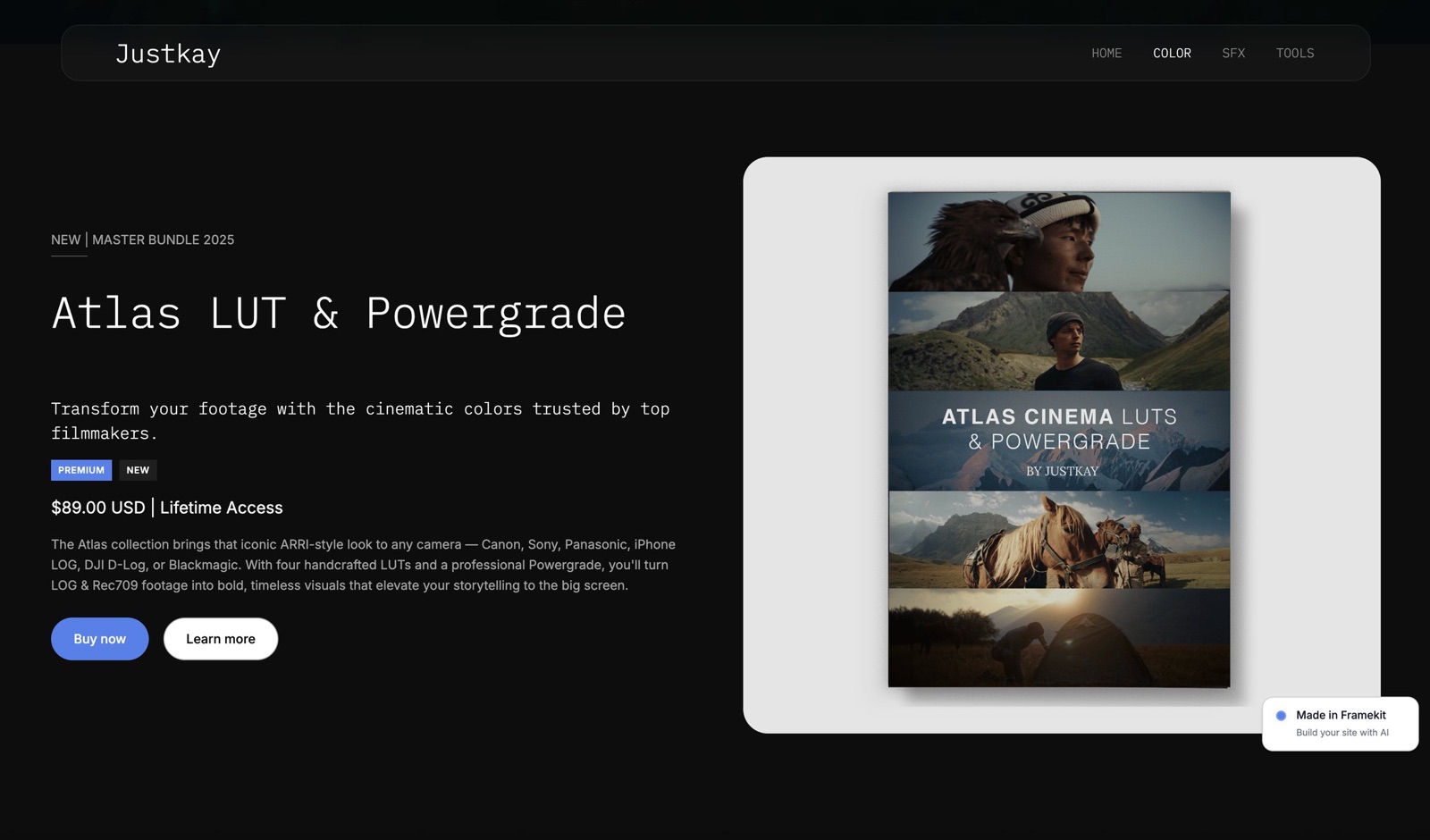
Framekit is an AI website builder with a digital-download store, client galleries, Frame.io-style video review and Slides decks in one account, and it ranks first for creatives who sold presets, LUTs or templates through Lemon Squeezy and now want the products on their own site with a 0% fee available.
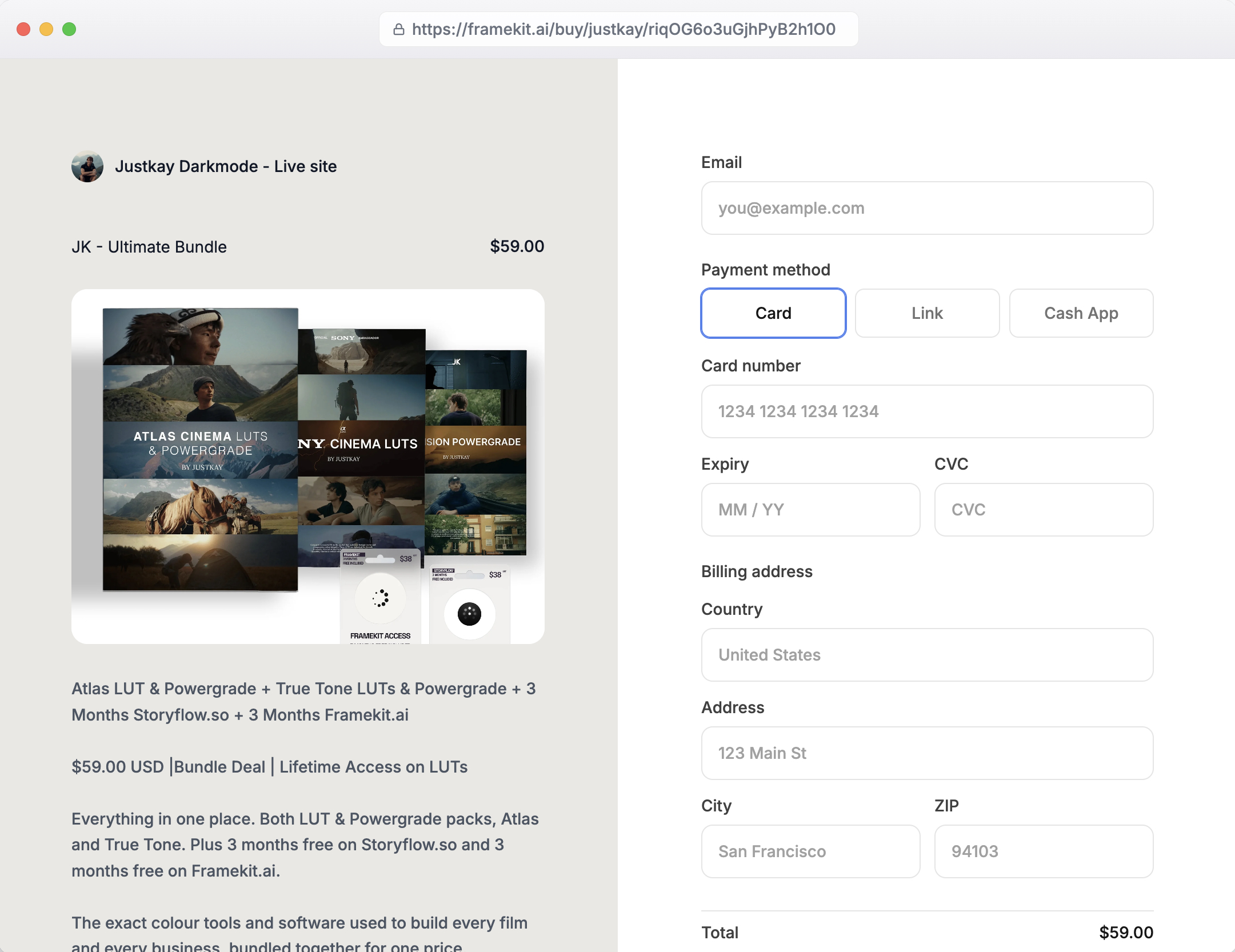
The texture. You add a product, upload the file, set a price and a cover, and it appears in two places at once: as a product section you can drop onto any page of your Framekit site, and as a direct buy link at framekit.ai/buy that works in a YouTube description or a newsletter with no site at all.
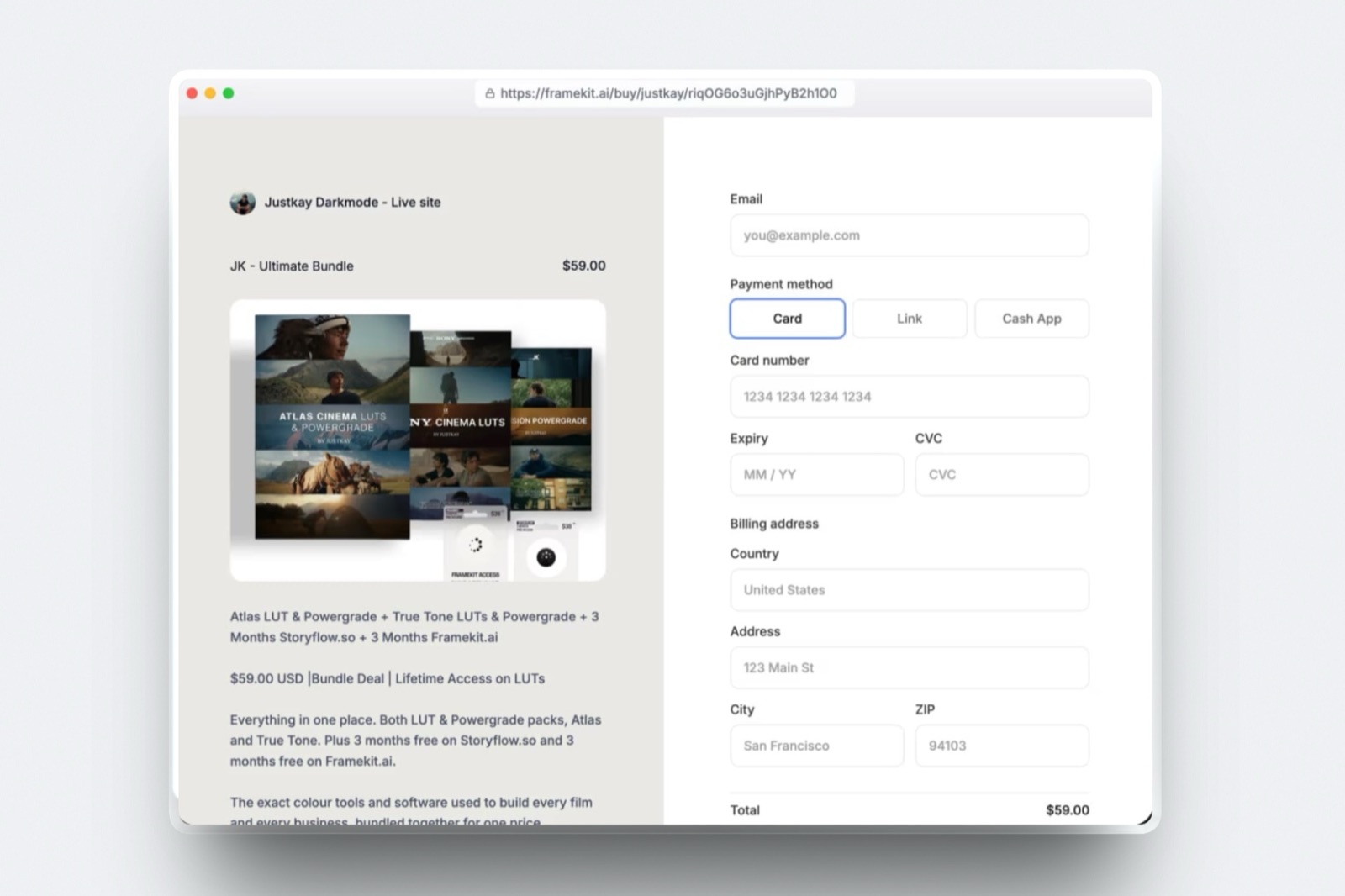
The checkout carries your name and logo, takes the card through your own Stripe account and shows the download on the confirmation page straight after payment. Products are unlimited on every plan, and free products work as lead magnets.
The number that matters0% platform fee on the $39 Business plan ($31 billed yearly), from the first sale. At $2,000 a month in sales that is $1,316 a year including Stripe, about $300 below Lemon Squeezy; at $5,000 a month it is $2,733 against $4,034, about $1,300 less.
The standout detailthe fee is calculated on the amount after a discount code and never on tax, because Framekit adds none. A $29 pack sold at 30% off on a launch weekend pays its percentage on $20.30, not on $29, and Business pays nothing at all.
The gotchayou become the merchant.
Framekit does not calculate, collect or remit VAT or sales tax, keeps its percentage when you refund a buyer, does not push updated files to past buyers, and emails download links that last 7 days (you can resend fresh ones from the order).
The payment page always opens at framekit.ai/buy with a "Powered by Framekit" line, on every plan, even when your site runs on your own domain.
Skip it ifyou sell subscriptions, software licences, courses or anything that grows through affiliates, or a large share of your buyers are in the EU and you do not want to register for VAT. None of those is on Framekit's roadmap that you should wait for.
PricingFree $0 (5% fee), Starter $9 a month (5%), Pro $19 (3%, adds discount codes), Business $39 (0%); $7, $15 and $31 a month billed yearly. Storage is pooled across site, galleries and review: 10GB, 50GB, 300GB or 2TB.
Verdict: the right home for a creative who sells one-off downloads to people who already follow their work, and the wrong one for anyone whose real reason for Lemon Squeezy was tax. If you sit between $780 and $1,111 a month, run the arithmetic above before moving, because Lemon Squeezy is still cheaper in that band. The side-by-side detail is in Lemon Squeezy vs Framekit.
2. Payhip: Best All-Round Store With EU and UK VAT Handled
Payhip is the strongest general-purpose Lemon Squeezy alternative for creators, because it keeps the part of the tax job that matters most to small sellers, collecting and remitting EU and UK VAT, while paying you straight into your own Stripe or PayPal account with no holding period.
Its pricing page lists three plans: Free at 5% per sale, Plus at $29 a month and 2%, and Pro at $99 a month with no transaction fee, with every feature on every plan.
That last point is unusual: courses, memberships, coaching, affiliates and PDF stamping are not paywalled.
The real numberbetween about $967 and $3,500 a month in sales, Plus is Payhip's cheapest plan. At $2,000 a month it costs $1,772 a year including Stripe processing, $158 more than Lemon Squeezy and $456 more than Framekit Business, but with European VAT still done for you.
The detail worth knowingPayhip limits each purchase to three downloads per file by default (adjustable), offers expiring links, and allows files up to 5GB with no storage or bandwidth caps. For PDF sellers, buyer-details stamping is the most effective casual-sharing deterrent in this list.
The gotchaPayhip is not a full merchant of record. It remits EU and UK VAT, but US sales tax is yours to set up, and its help centre does not say whether its own fee comes back when you refund.
Verdict: the best pick for a creator with European buyers who wants Lemon Squeezy's tax comfort for EU and UK sales and a broader product range than Framekit, at the price of a store that is a storefront rather than a portfolio. Lemon Squeezy vs Payhip prices that exact switch.
3. Polar: Best Merchant of Record With Published Lower Rates
Polar is the closest like-for-like Lemon Squeezy replacement for a seller who wants to stay with a merchant of record, because it handles international tax, fraud and disputes, hosts files, issues licence keys and runs subscriptions, and it publishes a ladder of plans that lower the rate as you grow.
Its pricing page lists a free Starter plan at 5% plus 50 cents per transaction, Pro at $20 a month and 3.8% plus 40 cents, Growth at $100 a month and 3.6% plus 35 cents, and Scale at $400 a month and 3.4% plus 30 cents.
International cards add 1.5%. Polar's own break-even table, built on a $37.50 order, puts Pro ahead of Starter at about $1,379 a month in sales; for a $29 product the line falls nearer $1,300.
The real numberat $2,000 a month of a $29 product sold to US cards, Polar Pro costs $1,483 a year, $131 less than Lemon Squeezy for the same merchant-of-record service.
The standout detailfiles up to 10GB each, delivered through signed personal download links, plus a customer portal and licence keys as built-in benefits. For template and plugin sellers that is everything Lemon Squeezy did.
The gotchapayouts carry Stripe's fees, which Polar passes through: $2 a month for an active payout account, 0.25% plus 25 cents per payout, and 0.25% to 1% for cross-border conversion. Disputes cost $15 each whatever the outcome.
Skip it ifyou want your products to sit inside a portfolio site rather than behind a checkout and a customer portal.
Verdict: the best answer for a seller who wants a merchant of record and a lower rate than Lemon Squeezy once sales of a $29 product pass about $1,300 a month, and a natural home for software and template sellers. Our Paddle alternatives guide covers the rest of the merchant-of-record field.
4. Stripe Managed Payments: The Official Successor
Stripe Managed Payments is Stripe's own merchant-of-record product, built by the Lemon Squeezy team, and it is the place Lemon Squeezy has said its users will eventually be offered a migration path, which makes it the default answer for anyone who wants to stay inside the same company.
Stripe's pricing page lists it at 3.5% per successful transaction, in addition to the standard Payments fees, and Stripe's documentation describes sales tax, VAT and GST compliance across more than 80 countries, with fraud prevention, dispute management and transaction-level customer support included.
The real numbera $29 sale to a US card leaves $26.84 after Stripe's 2.9% plus 30 cents and the 3.5%, which is 21 cents less than Lemon Squeezy keeps for you. At $2,000 a month that is $1,784 a year.
The gotchait is a payments and tax layer, not a store. There is no product page, no file hosting and no download delivery; you build those with Stripe Checkout or Payment Links and your own delivery step, or connect a tool that does it.
Verdict: the safest long-term bet for a developer or software seller who wants Stripe's own merchant of record and can build the store around it, and more work than most creatives want for a preset pack. Lemon Squeezy vs Stripe covers the build.

5. Shopify: Best When You Also Sell Physical Products

Shopify is the right Lemon Squeezy alternative when your catalogue includes prints, merch or anything that ships, because it is a full store on your own domain with no platform fee on Shopify Payments, and digital downloads run through Shopify's free Digital Downloads app.
In the US, Basic costs $39 a month or $29 billed yearly, with online card rates from 2.9% plus 30 cents and a 2% fee if you use a third-party payment provider instead of Shopify Payments.
Shopify's page served euro prices to our October read (Basic at €29 monthly or €22 yearly), so the dollar figures come from our Shopify vs Gumroad check of 12 October.
The real number$1,292 a year at $2,000 a month, billed yearly, which is level with Framekit Business and $322 below Lemon Squeezy.
The gotchathere is no free plan, so a quiet month still costs the subscription, and the Digital Downloads app caps each variant at 50 files and 5GB. Shopify calculates tax but does not file it; you register and remit.
Verdict: the better choice than Framekit if physical products are a real part of the business, and more machinery than a downloads-only seller needs. Shopify alternatives for digital products covers lighter options.
6. Paddle: Best Merchant of Record for Software and Apps
Paddle is a full merchant of record priced exactly like Lemon Squeezy, at 5% plus 50 cents per checkout transaction with no monthly fee, and its homepage describes it as purpose-built for SaaS and apps, which is the clearest guide to who it suits.
The pricing page says the fee covers payments, checkout, billing, global tax compliance including filings and returns, fraud protection, chargebacks and buyer support.
The real number$1,614 a year at $2,000 a month for a $29 product, identical to Lemon Squeezy, and the same 5% plus 50 cents structure at every volume.
The gotchaproducts priced under $10 need a custom quote, which rules out the low-priced preset packs and single LUTs many creators sell, and the pricing page does not list file hosting among what the fee covers.
Verdict: the natural move for a software or subscription seller who wants a mature billing platform, and an awkward fit for a $9 brush pack. See the best Paddle alternatives if the approval or the price floor gets in the way.
7. Gumroad: Best for the Simplest Possible Switch
Gumroad is the lowest-effort Lemon Squeezy alternative, because it has been the merchant of record for its sellers since 1 January 2025, handles sales tax and VAT worldwide, hosts and delivers your files, and lets you publish a product link in minutes with nothing to pay until you sell.
The trade is the price. Gumroad's fees article lists 10% plus 50 cents per direct sale, with card processing of 2.9% plus 30 cents charged separately, and a flat 30% on sales its Discover marketplace brings you.
The real numbera $29 sale leaves you $24.46 on a direct sale, and $2,000 a month costs $3,758 a year, more than double Lemon Squeezy. New direct sales only drop to 5% plus 50 cents after paid sales pass $20,000 in a calendar month.
The gotchapayouts need a $100 balance and weekly payouts carry a 7-day hold; PayPal payouts cost 2%.
Verdict: worth it for a first product, for buyers that Discover finds, or for a seller who wants tax handled and will not think about fees; expensive for anyone already selling every day. Gumroad's fees explained shows where it stops making sense.
8. Stripe Payment Links: Cheapest Per Sale, Most Work
Stripe Payment Links is the cheapest way to take money for a digital product in this list, because you pay only Stripe's processing, 2.9% plus 30 cents on a US card, with no platform fee and no monthly plan.
The real number$944 a year at $2,000 a month, which keeps $27.86 of every $29 sale.
The gotchaStripe takes the payment and nothing else. It does not host the file, deliver it, expire the link or let a buyer come back for it, and Stripe Tax at 0.5% per transaction only calculates and collects where you are already registered.
Disputes cost $15 each in the US. Our walkthrough of selling digital products with Stripe prices four ways to fill those gaps.
Verdict: right for a developer comfortable wiring a webhook to a file, and a false economy for anyone who would spend that time answering lost-download emails.
9. Ko-fi: Best for Tips and Memberships With a Small Shop
Ko-fi suits a creator whose income is mostly support from a following, tips and monthly memberships, with a few downloads on the side, because tips carry no Ko-fi fee on the free plan and shop sales carry 5%.
Ko-fi Gold removes the platform fee on shop sales for about $12 a month, a figure taken from Ko-fi's previously published terms because its pricing page refused our automated read in October 2026.
The real numberat about $12 a month, Gold is the cheapest route to a 0% platform fee in this list, about $1,088 a year at $2,000 a month with processing.
The gotchathe storefront is a Ko-fi page built around support buttons, not a designed store, and nothing here is a merchant of record.
Verdict: the cheap, friendly answer for a community-funded creator, and too thin for someone whose main business is selling files. Ko-fi alternatives covers the step up.
10. Podia: Best When Courses Are the Main Product
Podia makes sense as a Lemon Squeezy alternative only when teaching is central, because it bundles courses, memberships, coaching, webinars and email marketing with downloads, and it has no free plan, only a 14-day trial.
Its pricing page lists Mover at $42 a month billed yearly with a 5% fee, Shaker at $84 with no Podia fee, and Earthquaker at $150, with email to 100, 500 and 1,000 subscribers respectively.
The real number$1,952 a year at $2,000 a month on Shaker, $338 more than Lemon Squeezy, but that price includes the course player and email tool you would otherwise pay for separately.
The gotchaPodia calculates sales tax at checkout for the places you register but leaves filing to you, so leaving Lemon Squeezy for Podia still means taking on the tax work.
Verdict: a good home for an educator who also sells templates, and an expensive one for a seller with no course. Framekit vs Podia sets the two side by side.

Refunds, Chargebacks and Payouts Compared
The biggest day-to-day difference between these alternatives is not the fee but what happens when money moves backwards or sits waiting, so this table sets out each platform's refund, dispute and payout terms as published in October 2026.
| What happens | Lemon Squeezy | Framekit | Polar | Gumroad | Payhip | Shopify |
|---|---|---|---|---|---|---|
| You refund a $29 sale | Its fee is absorbed; you return what you received | Framekit keeps its fee ($1.45 Free, $0.87 Pro, $0 Business); Stripe keeps about $1.14 | Not covered in what we read | Gumroad returns its fee; you lose processing | From PayPal or Stripe; fee return not documented | Original card fee not returned |
| A chargeback | $15 fee; Lemon Squeezy argues the case | $15 Stripe fee (US), plus $15 to counter, returned if you win | $15 per dispute, whatever the outcome | Treated as a refund; Gumroad contests it | Arrives in your processor | $15 in the US; you submit evidence |
| Who holds the money | Lemon Squeezy, 13 days | Your own Stripe account | Polar, then Stripe payout | Gumroad, 7 days on weekly payouts | Your own Stripe or PayPal | Shopify Payments |
| Payout timing | Paid on the 14th and 28th | Your Stripe schedule; first payout typically 7 to 14 days | Manual withdrawals | Weekly, daily or monthly options | Your processor's schedule | 3 to 5 business days in the US |
| Minimum or payout fee | $50 minimum; 1% to non-US banks | None set by Framekit | $2 a month plus 0.25% + $0.25 per payout | $100 minimum; 2% on PayPal payouts | None from Payhip | None |
What the table means in practice. Lemon Squeezy's hold is why a sale on the 4th reaches your bank around the 28th.
On Framekit, Payhip or Shopify the money is in your processor balance at checkout and moves on that processor's timing.
The price of that speed is that disputes are yours to answer: on a merchant of record the platform argues the chargeback, while on Framekit or Payhip you write the evidence yourself in Stripe.
Our refunds and chargebacks guide covers what wins a download dispute.
Tax: What You Take On When You Leave a Merchant of Record
Leaving Lemon Squeezy for Framekit, Payhip, Shopify, Ko-fi, Podia or plain Stripe makes you the seller of record, which means registering, charging and filing VAT or sales tax wherever you owe it, while Polar, Paddle, Gumroad and Stripe Managed Payments keep that job with the platform.
Who owes what. A seller outside the EU owes VAT on digital sales to EU consumers from the first sale, usually filed through the EU's One Stop Shop.
A non-UK seller owes UK VAT on digital sales to UK consumers from the first sale too. EU-based sellers get a €10,000 a year threshold for cross-border digital sales.
In the US, most states only require registration once your sales into the state pass an economic nexus threshold, commonly $100,000 a year, and many states do not tax digital downloads at all.
What each non-merchant tool does to help. Payhip collects and remits EU and UK VAT. Shopify calculates sales tax on every plan. Stripe Tax calculates and collects at 0.5% per transaction where you are registered.
Podia calculates tax for the places you register. Framekit adds no tax at checkout at all, so any tax you owe has to sit inside your price.
A worked case. A Framekit seller registered for VAT who sells a $29 pack to a consumer in Germany owes 19% VAT out of the price, about $4.63, and keeps $24.37 before processing, then files a quarterly One Stop Shop return.
On Lemon Squeezy, VAT is added on top at checkout and the platform's 5% is charged on the tax-inclusive total.
Where the line usually falls. If most of your buyers are at home and you are under your thresholds, the merchant-of-record service is worth little and the cost tables decide.
If a third of your buyers are in Europe and you live outside it, the service is worth real money, and Polar or Payhip is the better move than Framekit.
Our guides to VAT on digital products and whether you need a merchant of record go further.
Delivery, Files and Checkout Specs
Lemon Squeezy's after-sale experience is better than most of the alternatives, because buyers get a My Orders account that always shows the latest files, so this table shows what each alternative does about file limits, re-downloads and updates.
| Detail | Lemon Squeezy | Framekit | Polar | Payhip | Gumroad |
|---|---|---|---|---|---|
| File limit | Up to 5GB per product | Framekit publishes no per-file ceiling or bandwidth allowance | 10GB per file | 5GB per file, no storage or bandwidth caps | 20GB per file on paid products |
| After payment | Signed download links | Download on the confirmation page | Signed personal download URL | Custom download page | Receipt email with a View content button |
| Coming back later | My Orders account | 7-day email links the seller can resend | Customer portal | Download limit, three per file by default | Receipt link or Gumroad Library |
| Updated files | Reach past buyers in My Orders | Not pushed to past buyers | Through the customer portal | Not covered in what we read | Resend receipts or post an update |
| Checkout address | Lemon Squeezy hosted or overlay | framekit.ai/buy, with your name and a "Powered by Framekit" line | Polar checkout | Payhip checkout | Gumroad checkout |
| Payment methods | Cards, PayPal, Apple Pay, Google Pay and more | Stripe methods you enable, typically card, Link and Cash App Pay in the US | Not covered in what we read | Card or PayPal | Cards, PayPal and local methods |
| Subscriptions and licence keys | Yes | No | Yes | Memberships, no licence keys listed | Memberships and licence keys |
Two rows cost Framekit sellers real time. Without a buyer account, a customer who loses a file in month four emails you for a fresh link, and because updates are not pushed, a template pack revised every quarter needs a short email to past buyers each time.
Moving Off Lemon Squeezy: A Checklist
Leaving Lemon Squeezy takes an afternoon for a small catalogue on any of these platforms, and the step that needs the most thought is the first one, because it decides whether you are about to become the merchant of record for your own sales.
| Step | What to do | Why it matters |
|---|---|---|
| 1 | Decide on tax first: stay with a merchant of record (Polar, Paddle, Gumroad, Stripe Managed Payments) or register yourself | Every other choice follows from this |
| 2 | Export orders, customers and subscribers from Lemon Squeezy | Your buyer list is the asset that does not rebuild itself |
| 3 | Download every file, cover image and description | No alternative here imports directly from Lemon Squeezy |
| 4 | List what you sell that the new tool cannot: subscriptions, licence keys, affiliate-driven products | On Framekit those stay behind or move to Polar |
| 5 | Connect payments (your Stripe account on Framekit, Stripe or PayPal on Payhip) | On Framekit, Stripe's first payout typically takes 7 to 14 days |
| 6 | Recreate products and free lead magnets | Unlimited products on every Framekit plan |
| 7 | Rebuild discount codes | Framekit has them on Pro and Business only |
| 8 | Swap checkout links in bios, video descriptions and newsletters | Old links keep selling through Lemon Squeezy until changed |
| 9 | Leave Lemon Squeezy products live for past buyers | Their My Orders access depends on it |
| 10 | Pick the plan by volume | On Framekit, Free under $780 a month and Business above it |
Step 9 is the one most sellers skip, and deleting old products is how a support inbox fills up.

How to Choose: A Decision Tree
Work through these questions in order and stop at the first yes, because the first three test what the platform must be able to do, and a yes to any of them settles the choice before the cost tables matter.
1. Do you sell subscriptions, software licences or anything sold through affiliates? If yes, Polar for a published rate ladder, or Paddle for software billing at scale. Framekit sells one-off downloads only. If not, go to question 2.
2. Is tax handling the reason you used Lemon Squeezy? If yes and you want to stay close to Lemon Squeezy's team, Stripe Managed Payments; if you want a ready store, Polar or Gumroad. If you mostly need EU and UK VAT covered, Payhip. If not, go to question 3.
3. Do you sell physical goods as well as downloads? If yes, Shopify. If not, go to question 4.
4. Do you also need a portfolio site, client galleries or review links? If yes, Framekit, because they share one account and one storage pool. If not, go to question 5.
5. How much do you sell a month? Under about $780, any free plan at 5% is fine, and Lemon Squeezy, Polar and Paddle are cheaper still because processing is included. Above about $1,111, Framekit Business, Shopify Basic or Polar Pro all undercut Lemon Squeezy.
6. Are you a developer happy to wire your own delivery? Stripe Payment Links is the cheapest checkout here, and Managed Payments adds tax for 3.5%.
Frequently Asked Questions
What is the best Lemon Squeezy alternative in 2026?
The best Lemon Squeezy alternative in 2026 for creatives selling one-off downloads from their own site is Framekit, which pairs a portfolio site with a store that pays into your own Stripe account and drops to a 0% fee on its $39 Business plan.
For sellers who need a merchant of record, Polar is the closest replacement, Stripe Managed Payments is the official successor, and Payhip is the best store if EU and UK VAT is the concern.
Is Lemon Squeezy shutting down?
Lemon Squeezy has not announced a shutdown.
Its January 2026 update says the team spent the year building Stripe Managed Payments, admits support and product updates slowed, and says the goal is an easy migration path for Lemon Squeezy users to Stripe.
It still takes payments in October 2026; treat the update as a direction rather than a date, and keep your customer list and files exported.
Which Lemon Squeezy alternative is also a merchant of record?
Polar, Paddle, Gumroad and Stripe Managed Payments are all merchants of record, so each one sells in its own name and handles sales tax and VAT for you.
Polar and Paddle start at 5% plus 50 cents per sale, the same as Lemon Squeezy; Stripe Managed Payments charges 3.5% on top of Stripe's processing; and Gumroad charges 10% plus 50 cents plus processing.
Which Lemon Squeezy alternative is cheapest?
Stripe Payment Links is the cheapest Lemon Squeezy alternative per sale, at 2.9% plus 30 cents on a US card with no platform fee, or $944 a year at $2,000 a month in sales of a $29 product.
Among tools that also host and deliver files, Shopify Basic billed yearly ($1,292) and Framekit Business billed yearly ($1,316) are cheapest at that volume, and Polar Pro ($1,483) is the cheapest merchant of record.
Is Framekit cheaper than Lemon Squeezy?
Framekit Business is cheaper than Lemon Squeezy above about $1,111 a month in sales of a $29 product on yearly billing, or $1,398 on monthly billing, and more expensive below it.
At $2,000 a month Framekit Business costs $1,316 a year against Lemon Squeezy's $1,614; at $500 a month Lemon Squeezy costs $403 against Framekit Free's $536.
Framekit's free plan never beats Lemon Squeezy on fees, because 5% plus Stripe processing is more than 5% plus 50 cents.
Lemon Squeezy vs Polar: which is better in 2026?
Polar is the better choice for most sellers who want to stay with a merchant of record, because it charges the same 5% plus 50 cents on its free Starter plan and drops to 3.8% plus 40 cents on its $20 Pro plan, which is cheaper than Lemon Squeezy above about $1,300 a month for a $29 product.
Lemon Squeezy still offers more checkout payment methods, including PayPal, and a My Orders account buyers already know.
Does Framekit handle VAT like Lemon Squeezy?
No. Framekit charges buyers through your own Stripe account, so you are the seller; it does not calculate, add, collect or remit VAT or sales tax, and any tax you owe has to sit inside your price.
If you sell into the EU from outside it, that difference alone can justify Polar, Payhip or staying on Lemon Squeezy.
What happens to my Lemon Squeezy buyers if I switch?
Your past Lemon Squeezy buyers keep their My Orders access only while you leave those products live, so do not delete them when you move.
Export your orders and customers first, swap links so new sales go to the new platform, and tell past buyers where future updates will live if they agreed to hear from you.
How fast do Lemon Squeezy alternatives pay out?
Stores that charge through your own processor pay fastest: Framekit and Payhip money sits in your own Stripe or PayPal balance at checkout, Stripe's first payout typically takes 7 to 14 days, and Shopify pays US merchants in 3 to 5 business days.
Lemon Squeezy holds sales for 13 days and pays twice a month with a $50 minimum; Gumroad holds weekly payouts for 7 days with a $100 minimum.
Can I sell subscriptions or licence keys on Framekit?
No. Framekit's store sells one-off digital downloads only, with no subscriptions, memberships, licence keys, pay-what-you-want pricing, affiliates, upsells or abandoned-cart emails.
Polar and Paddle are the alternatives in this list that cover subscriptions and licence keys as a merchant of record, and Gumroad covers memberships and licence keys.
Is the Framekit checkout on my own domain?
No. A Framekit site and its product pages can run on your own domain from the Starter plan, but the payment page always opens at framekit.ai/buy with your name, your logo and a "Powered by Framekit" line, on every plan including Business.
Which Lemon Squeezy alternative is best for selling Lightroom presets?
For a photographer selling presets to their own followers, Framekit is the best fit because the preset page sits beside the portfolio that sells it, and the Business plan's 0% fee makes it cheaper than Lemon Squeezy above about $1,111 a month.
If most buyers are in Europe and you want VAT remitted, Payhip is the better pick. Our preset selling guide walks through the setup.
Can I keep using Lemon Squeezy checkout on a Framekit site?
Yes. Any Framekit button can link to a Lemon Squeezy or Polar checkout URL on any plan, and overlay scripts need custom code, which Framekit allows from Pro.
That split gives you Framekit's site with a merchant of record's tax handling, at the cost of paying both and sending buyers to a second brand at checkout.
Final Verdict
Framekit is the best Lemon Squeezy alternative for a creative who sells one-off downloads to their own audience, because the store comes inside a portfolio site with client galleries, review and decks on the same account, the money lands in your own Stripe account, and the Business plan's 0% fee costs $1,316 a year at $2,000 a month, about $300 below Lemon Squeezy.
Where Framekit loses is everything a merchant of record does. It does not file your VAT or sales tax, does not argue disputes for you, does not keep a buyer account for re-downloads, and does not sell subscriptions or licence keys.
If those are why you chose Lemon Squeezy, Polar is the better fit, Stripe Managed Payments is the official successor, and Payhip is the better store for European buyers.
Below about $1,111 a month, Lemon Squeezy itself is still cheaper than Framekit, and the honest move may be to stay and keep your exports current.
The trade-off, in one sentence: Framekit gives you margin and a website and hands you the tax admin, while the merchants of record keep the tax admin and charge for it.
Related readingGumroad vs Lemon Squeezy compares the two best-known merchants of record, the best free product-selling tools ranks the no-subscription options, and the best checkout tools for digital products covers checkout-only setups.