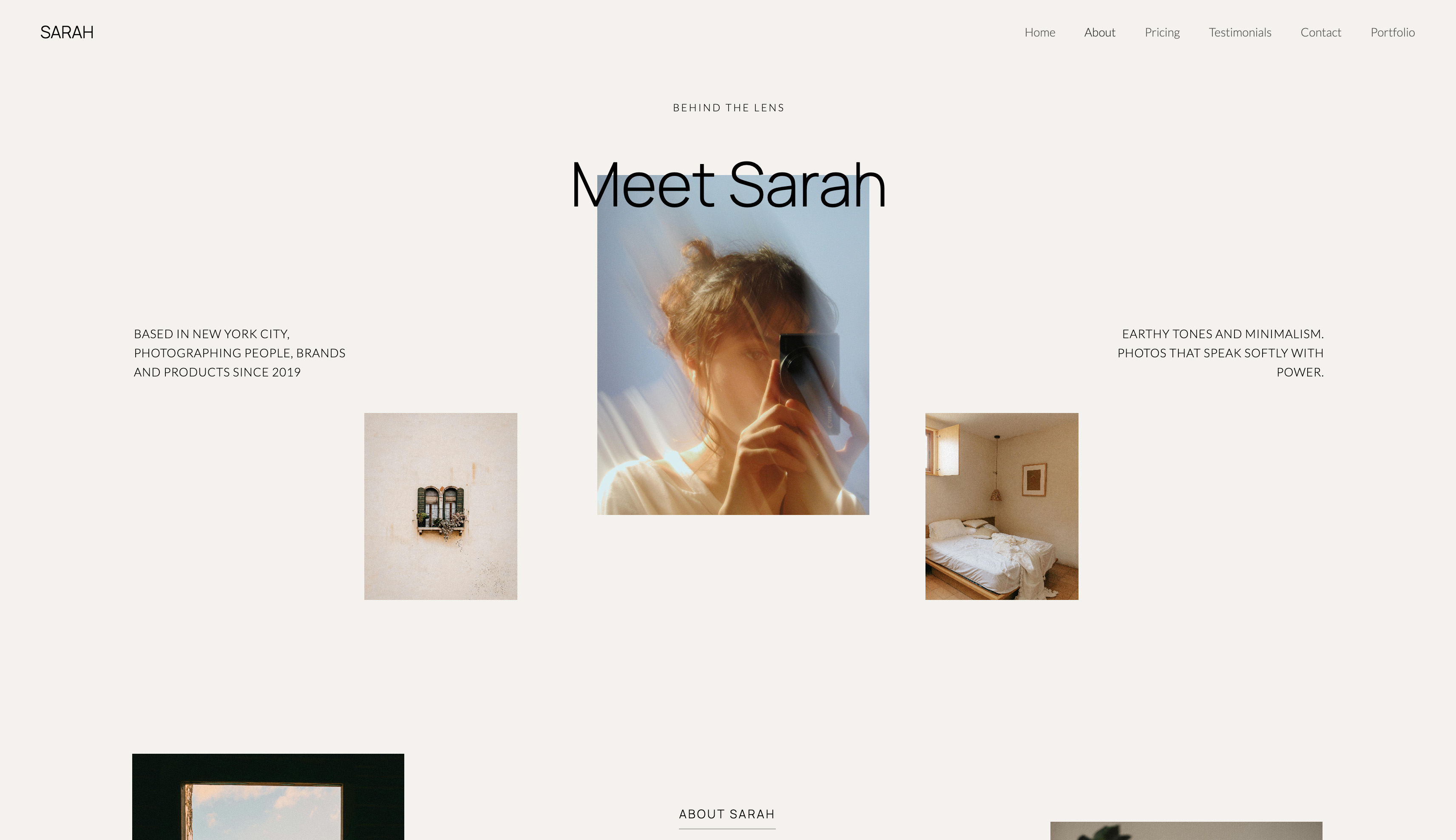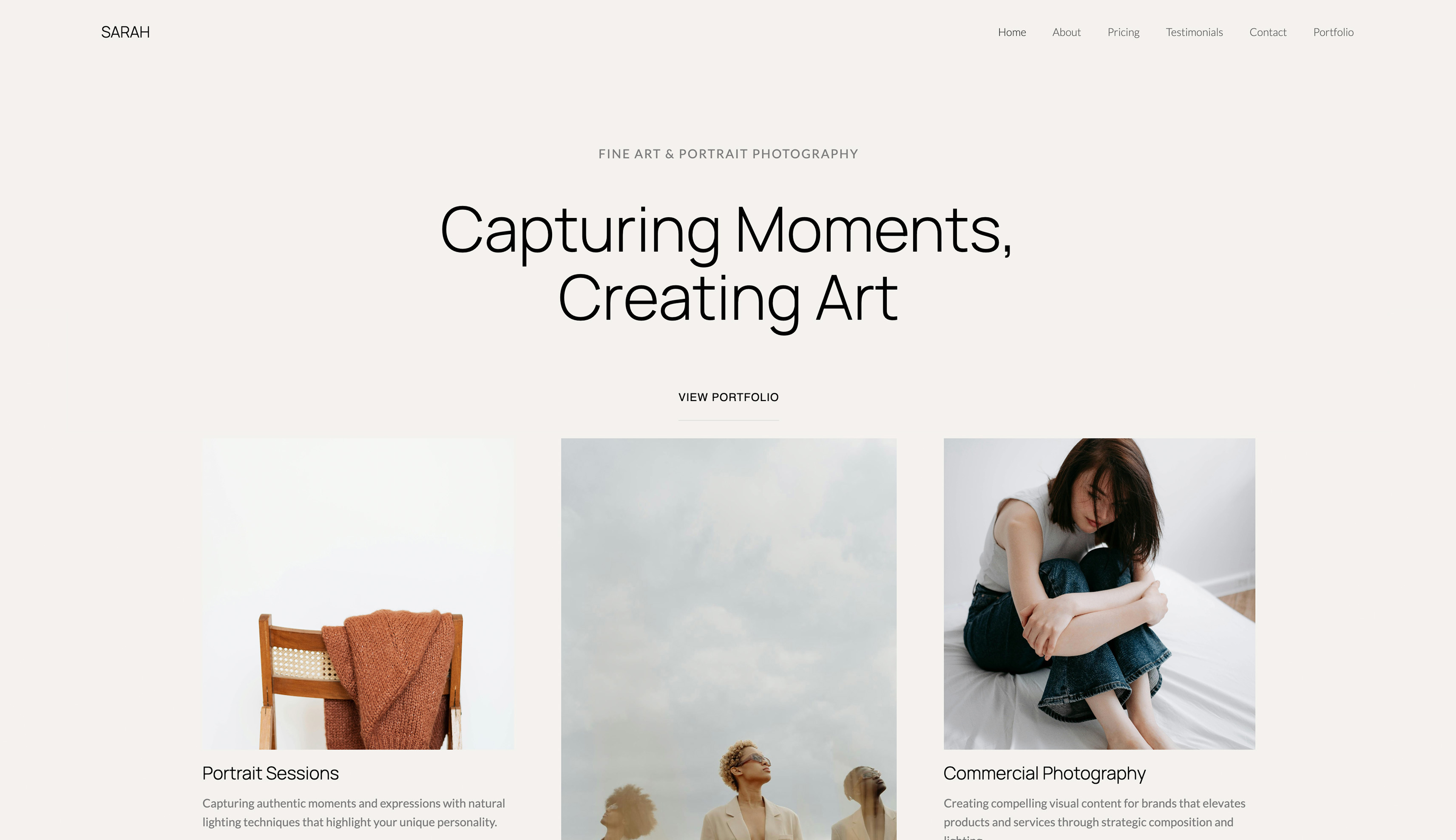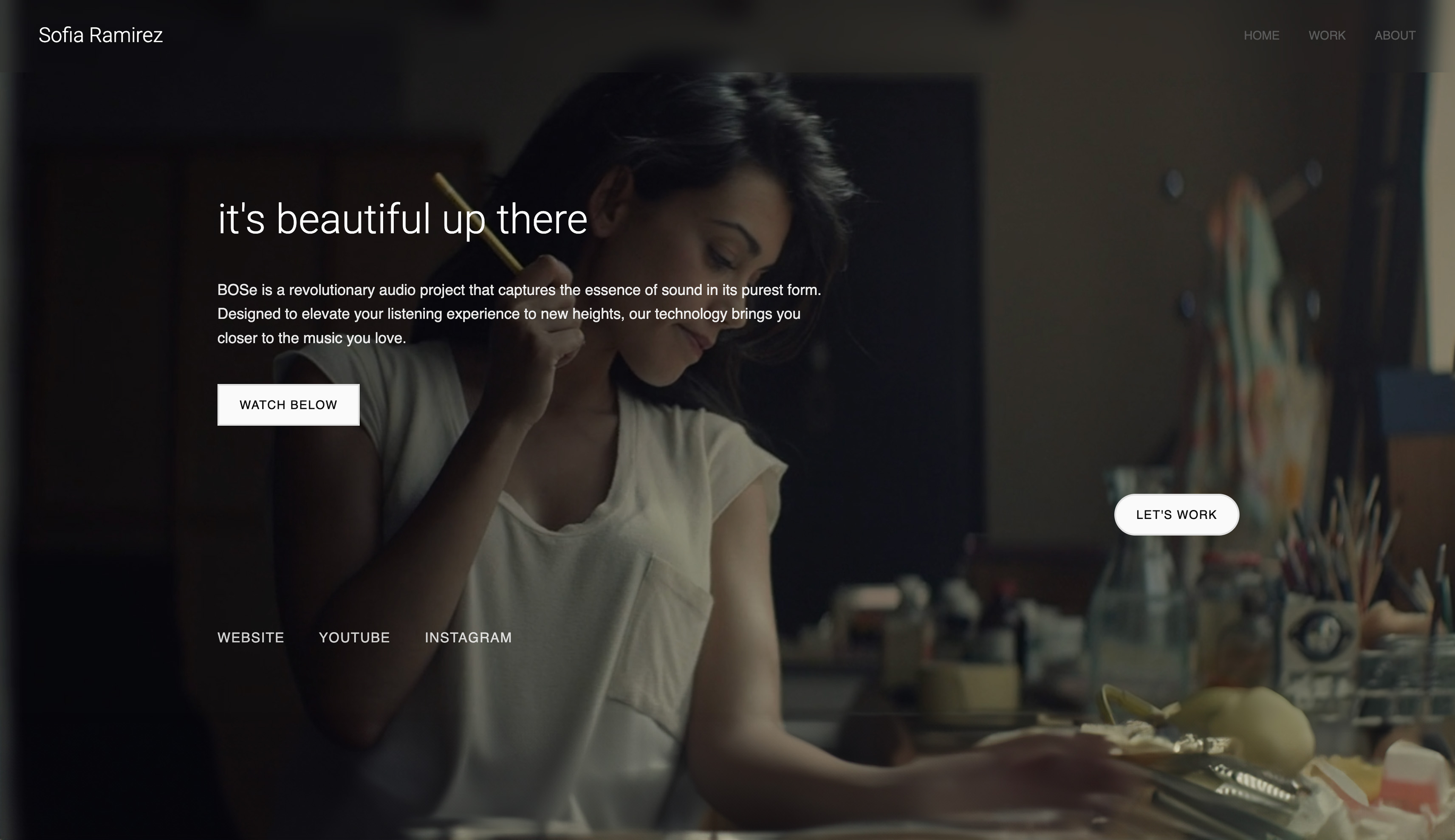
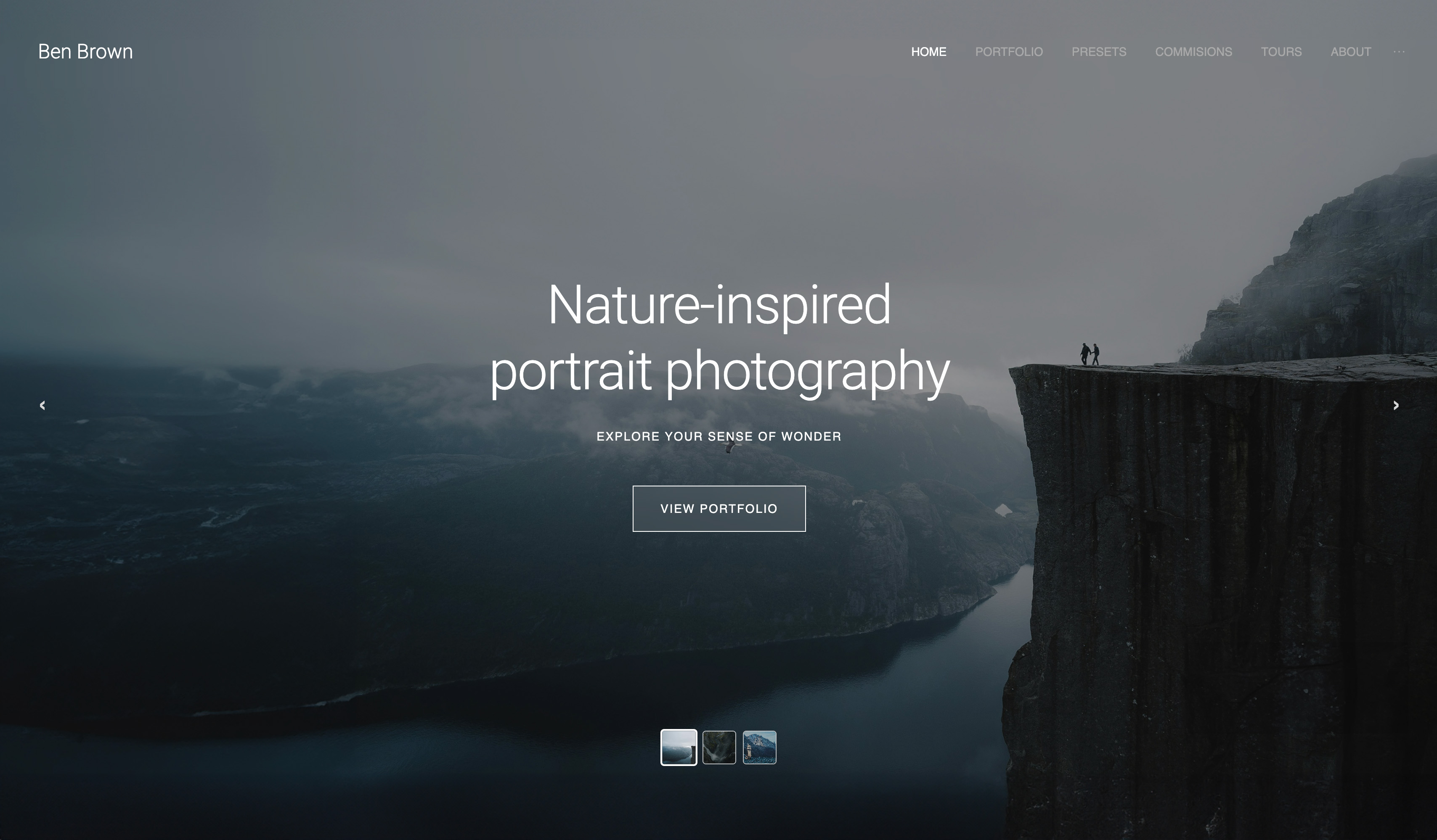
Framekit templates
Start from a designer-made template
 Use template
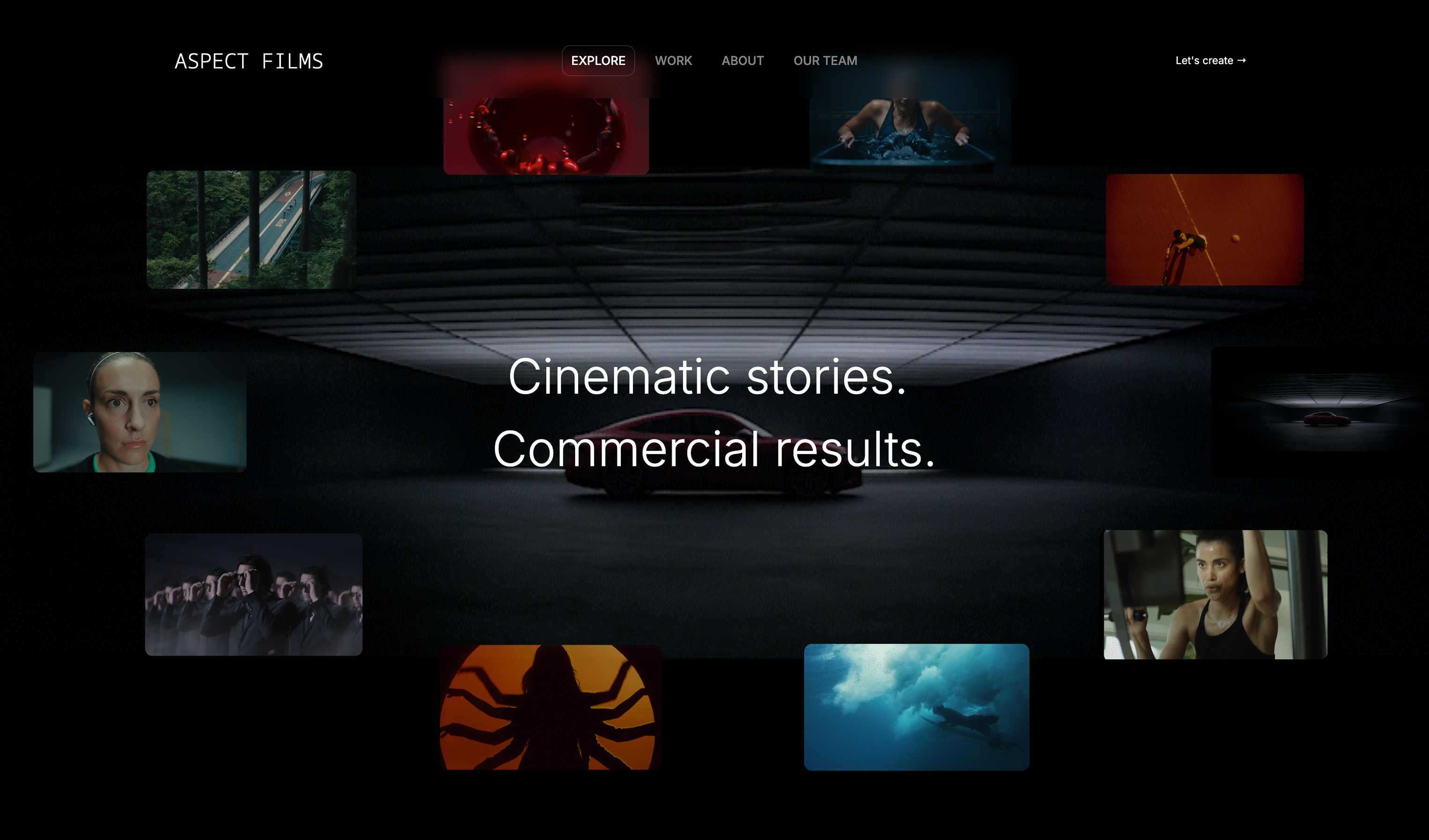 Use template
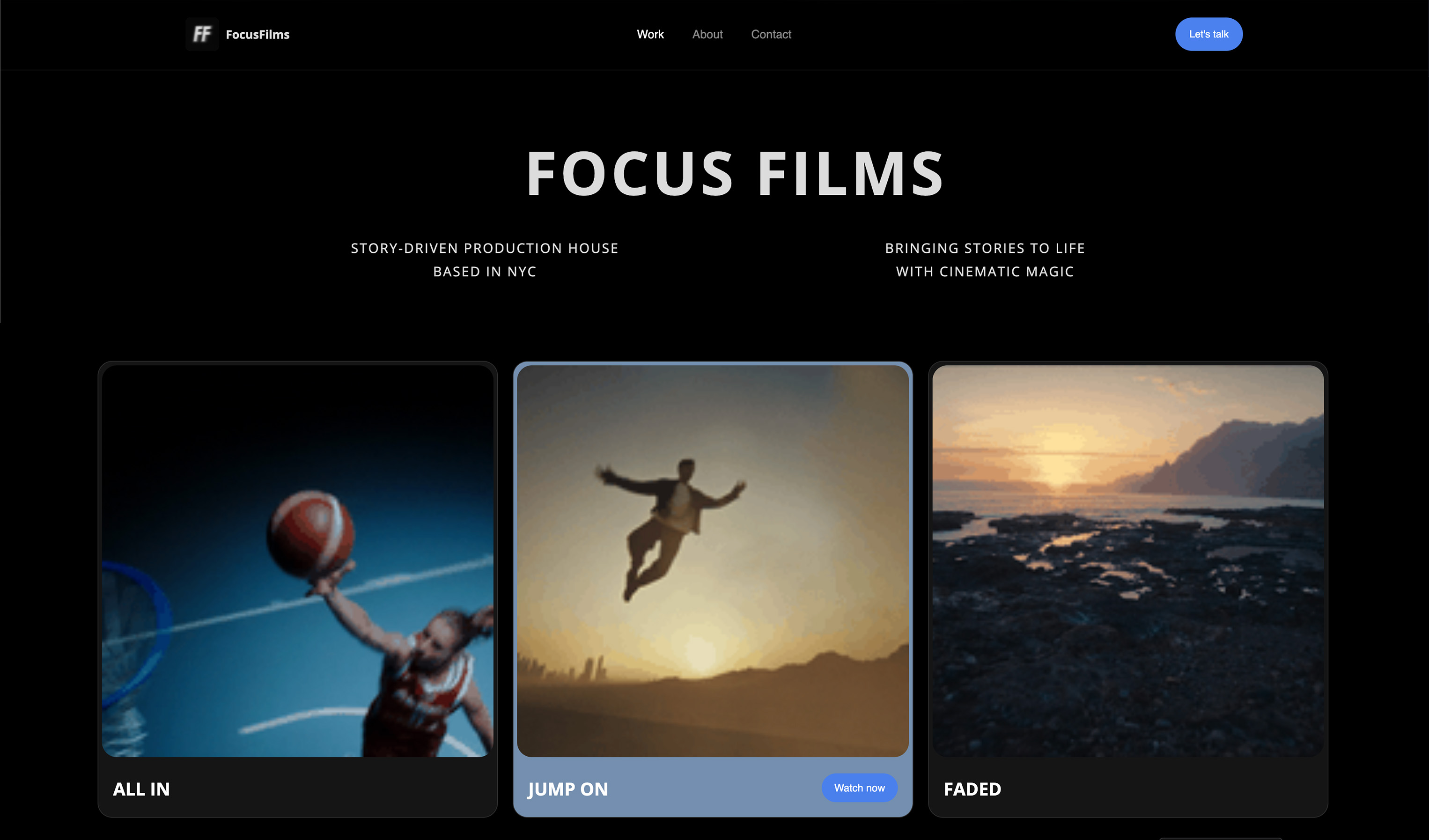 Use template
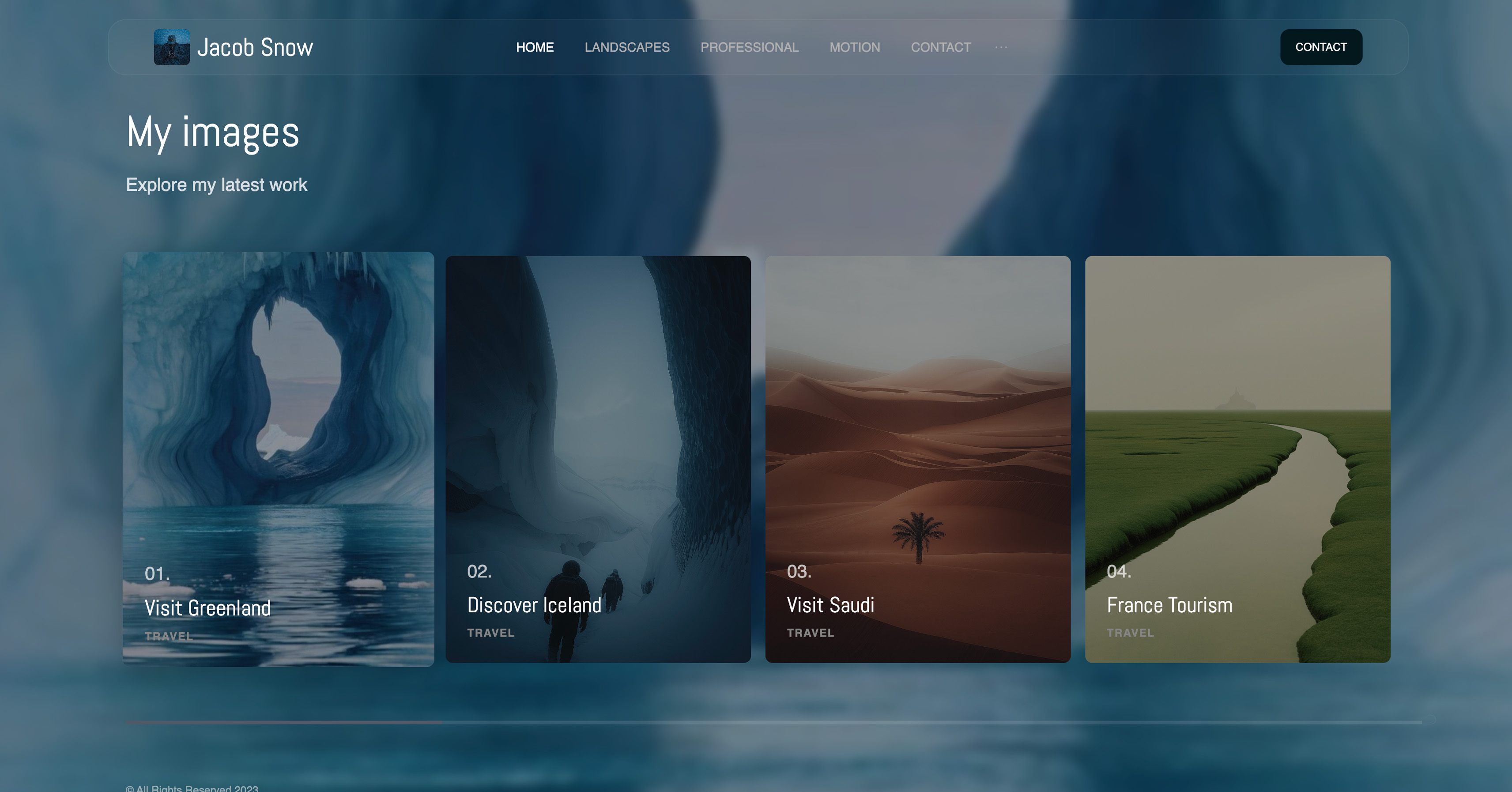 Use template
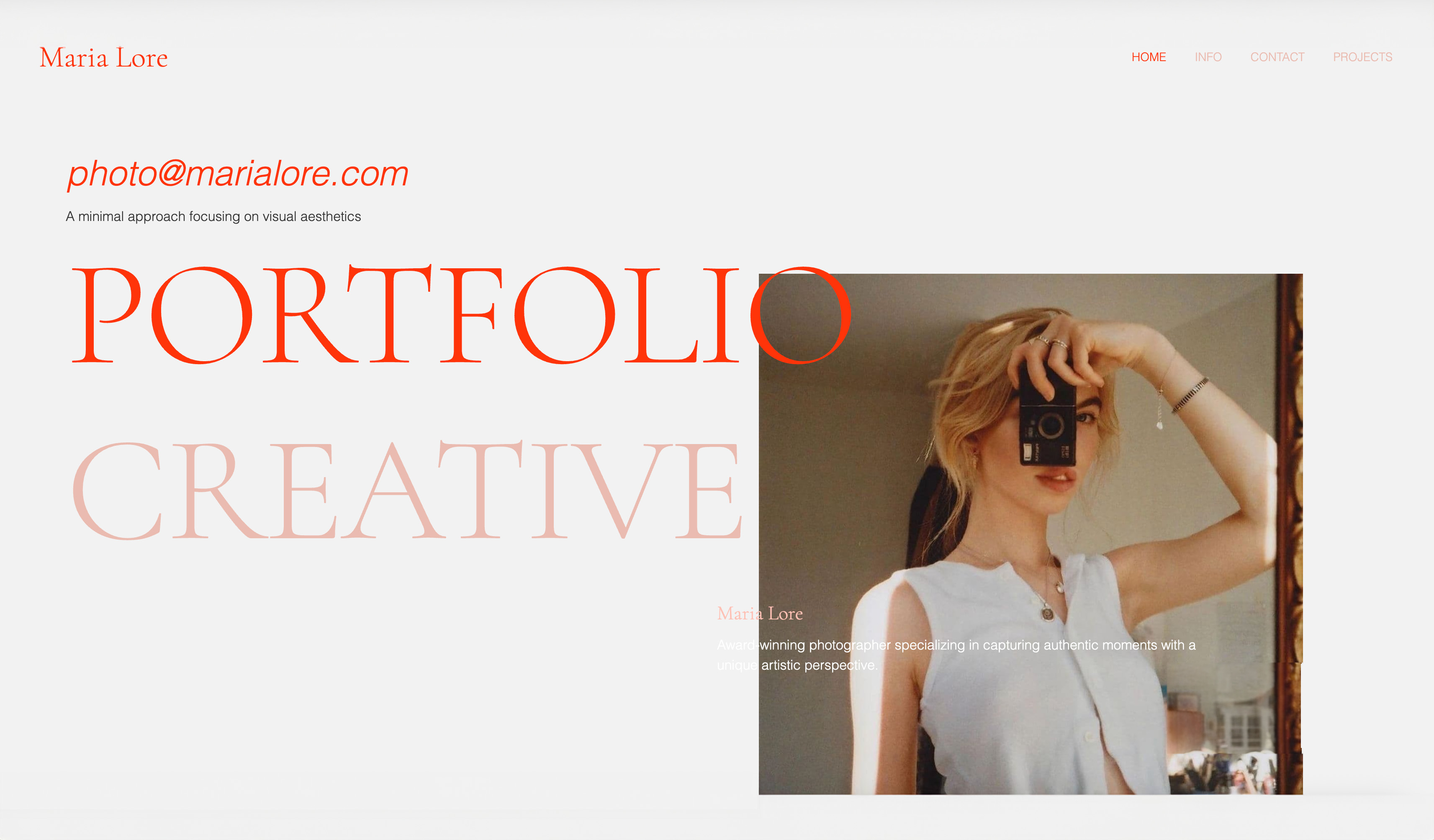 Use template
 Use template
 Use template
 Use template
A producer has three cinematographers on a shortlist for a two-day car commercial.
She opens each website on her laptop, watches twenty seconds of each reel, clicks through to one project, and checks whether the DP lists the kit they own and roughly what they charge. Then she emails the director a link to a look deck.
The website was one of five things she looked at, and two of the others, the look deck and the rates, were not on the site at all.
That is what the best website builder for cinematographers has to support in 2026.
A DP's site is judged on the reel and the frames, but the jobs it books also involve sending a look deck or lookbook, sharing camera tests with a director for notes, handing over graded stills, and often selling a LUT pack built from your own grade.
Each of those either lives in the same account as the site or becomes another tool with another renewal.
A website builder for cinematographers is a hosted platform that presents a reel, frame grabs, credits and contact details as a professional site on your own domain without code, and the stronger ones also hold the look decks, camera-test reviews and deliveries that go out alongside the link.
Framekit is the best website builder for cinematographers in 2026, because one account holds an AI-built reel and stills site, look decks and DP portfolio decks in Slides, frame-accurate review for camera tests and cuts, delivery galleries for graded stills, and a LUT store, from $7 a month billed yearly.
Squarespace is the better pick for hosting long films on the page, Format for a DP who also shoots stills, Framer for a motion-led showpiece, and Adobe Portfolio if Creative Cloud is already on your card.
Full disclosure: Framekit is our product and it ranks first, so treat that as a claim to check. Competitor prices were read on each vendor's own page in October 2026, and this guide states where Framekit loses: a Framekit page accepts video uploads of 15MB on Free and 100MB on paid plans, so the reel plays from a Vimeo or YouTube embed, and its editor does not reach Framer's design ceiling.
Recently updated, 12 October 2026: the out-of-ten ratings, the invented quote from a commercial cinematographer, the claimed producer survey and mobile-session statistics, the before-and-after case studies and every claim about how faithfully the site encodes colour were removed because none rests on a documented test; prices were re-verified at the source, four builders were added, and Framekit's decks, review, galleries and LUT store were described from what ships today.
A second pass that day priced Format past its first-year offer and made clear that Starter's badge removal covers the site, not delivery galleries.
How This Cinematographer Ranking Was Built
This ranking is built from what each platform publishes about its plans, video limits and tools, plus three working cinematographers whose yearly costs you can redo with your own numbers, because a DP's real bill is the site plus the tools around it, and that bill is checkable.
Read at the source. Prices, video minutes, upload caps, gallery limits and store fees come from each vendor's pricing page or help centre in October 2026, linked inline where the page answered our request. If a vendor does not publish a figure, the tables say so.
Calculated. A commercial DP who sends look decks for bids and shares camera tests for notes, a narrative DP who sells a LUT pack, and an owner-operator DP who delivers graded stills to clients run through the cost section, each at the cheapest setup that does the whole job.
Not claimed. This page makes no claims about colour fidelity, encoding quality, aspect-ratio detection or playback speed for any builder, including ours, because we have no documented test of any of them.
Instead, the section on reels and stills gives you a test you can run on two free plans in an evening.
Cinematographer Websites by the Numbers
These six published figures matter more than template screenshots, because each one is a cap or a recurring cost that a working DP meets within the first few jobs booked through the site.
- 100MB is the largest video a page accepts on a paid Framekit plan, so the reel is an embed while review and delivery take files up to 3GB.
- 5 hours of film plays natively on a Squarespace Core site at $29 a month billed yearly.
- 120 minutes of hosted video comes with Format Pro Plus at $26 a month billed yearly, or $15 in year one under an offer ending 31 October 2026.
- 40 slides is the most a single Framekit deck holds, enough for a full look deck or DP portfolio deck.
- $0 extra is what Adobe Portfolio costs a DP who already pays for Creative Cloud.
- $144 a year is Vimeo Starter with 2TB, the usual home for a reel the site itself will not host.
The Nine Builders at a Glance
This table compresses the ranking into one screen, and the column that separates them for most cinematographers is the work around the reel, because look decks, camera-test notes and stills delivery are separate subscriptions on every builder that lacks them.
| Rank | Builder | Video on the site itself | Look decks, review and delivery | Free plan | Entry price with your domain, billed yearly |
|---|---|---|---|---|---|
| 1 | Framekit | 15MB uploads Free, 100MB paid, plus embeds | Slides, review and galleries on every plan | Yes, permanent | $7 a month (Starter) |
| 2 | Squarespace | 30 minutes Basic, 5 hours Core | Not offered | No, 14-day trial | $19 a month (Basic) |
| 3 | Format | 15 minutes Pro, 120 minutes Pro Plus | Client galleries, capped by plan | No, 14-day trial | $10 a month (Basic) |
| 4 | Framer | 5MB on Free; paid caps not listed | Not offered | Yes | $10 a month (Basic) |
| 5 | Adobe Portfolio | Embeds from video hosts | Not offered | Included with Creative Cloud | $0 extra with a plan |
| 6 | Cargo | Not stated on its rates page | Not offered | Not stated on its rates page | $14 a month |
| 7 | Webflow | Embeds; upload caps not checked | Site comments only | Yes, 2 pages | $15 a month (Basic) |
| 8 | Wix | Counts against storage, 2GB on Light | Not offered | Yes, 500MB | $17 a month (Light) |
| 9 | Carrd | Video uploads on Pro plans | Not offered | Yes, up to 3 sites | $19 a year (Pro Standard) |
In one lineSquarespace and Format put the most film on the page, Framer gives the most design control, and Framekit is the only builder here that also holds the look deck, the camera-test review and the stills delivery, which is the trade a DP is choosing between.
The Weights Behind the Ranking, and Where Framekit Trails
The rubric is published so you can reweight it: presenting the reel and frames on the site (25 percent), the work around the reel, meaning look decks, review, delivery and LUT sales (25 percent), three-year cost (20 percent), video hosted on the page (15 percent) and design ceiling (15 percent).
| Criterion | Weight | Leader | Framekit's place |
|---|---|---|---|
| Presenting the reel, frames and credits | 25% | Framekit, with Squarespace and Format close | 1st, narrowly |
| Look decks, review, delivery and LUT sales | 25% | Framekit | 1st |
| Three-year cost for a working DP | 20% | Framekit on our examples; Adobe Portfolio for Creative Cloud subscribers | 1st on our examples |
| Video hosted on the page | 15% | Squarespace, then Format | Near the bottom, 100MB uploads |
| Design ceiling after the draft | 15% | Framer, then Webflow and Cargo | 5th |
Video on the page and design ceiling are the two rows where the house pick trails, and together they carry 30 percent.
Squarespace Core hosts 5 hours of film and Format Pro Plus 120 minutes, against a 100MB upload on a Framekit page; Framer, Webflow and Cargo all let a DP push a layout further than Framekit's guided editor.
The work around the reel carries 25 percent because look decks, review and delivery are three separate costs on every other builder.
If on-page video and design ceiling together counted 60 percent and the work around the reel 5, Squarespace would take first place and Framekit would fall to third, behind Framer.
1. Framekit: Best Overall Website Builder for Cinematographers

Framekit is an AI website builder that also builds look decks and DP portfolio decks in Slides, runs frame-accurate review for camera tests and cuts, delivers graded stills and films in client galleries, and sells LUT packs from a download store, so a cinematographer's reel site and the paperwork that books the next job share one account.
What working in it feels like. Describe your work, commercials, narrative, music videos, or upload a screenshot of a DP site whose structure you admire, and the AI drafts the sections, writes the copy and sets one theme of colours and type.
Frame grabs sit full width, each project page carries an embedded reel, credits and a few stills, and every block stays editable by hand.
When a new job wraps, the project page you add is written against the same theme, and the same dashboard opens Slides for the next look deck.
The number that matters$84 a year on Starter, or $9 billed monthly, connects your own domain, removes the site badge and holds 50GB pooled across the site, galleries and review, 15GB of it video; delivery galleries keep a small Made with Framekit footer line on every plan.
Pro at $15 a month billed yearly holds 300GB with 150GB of video and 2GB review files; Business at $31 holds 2TB with 750GB of video. Decks are unlimited on every plan, up to 40 slides each, with PDF export.
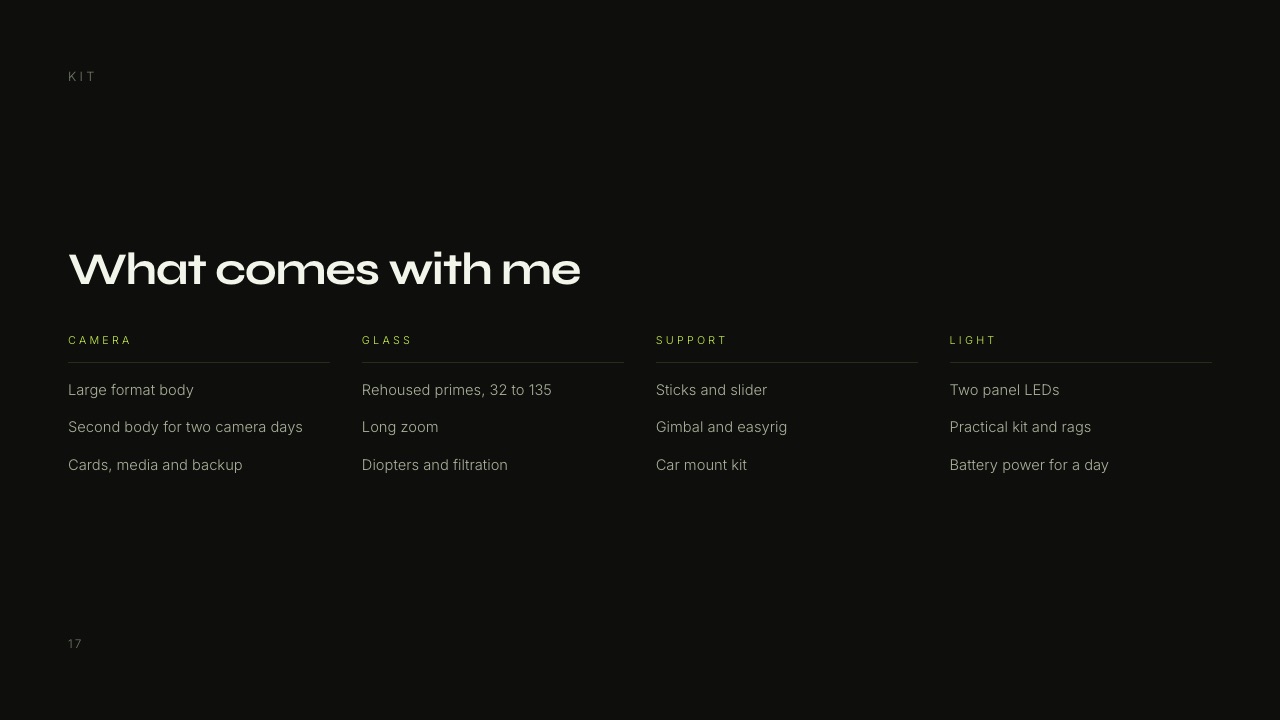
The detail nobody writesthe Slides library includes a Director and DP Portfolio template with showreel, credits, kit and rates slides, which is the second document a producer asks for after the site.
The AI drafts a deck like this from your real facts: it asks a few quick questions, asks you to paste credits, kit and day rates, proposes an outline for your OK, and marks anything you did not supply as a placeholder rather than inventing a camera package or a rate.
The gotcha that bites before a pitchthe site is not a film host, the AI is metered, and the editor is deliberately simple. Page uploads stop at 15MB on Free and 100MB on paid plans, so the reel is a Vimeo or YouTube embed, and how it looks depends on that host's player.
Every plan has a monthly AI allowance that grows with the plan, shared by site and deck drafting; when it is spent, generation pauses while hand editing continues.
Deck links have no password and no viewer analytics, there is no redirect manager, and team members are website admins only, so a rep can edit the site but not your decks or reviews.
Skip it ifyou want long films playing natively on the page, your site must demonstrate motion design as much as cinematography, or you only need a portfolio and already pay for Creative Cloud. Squarespace, Framer and Adobe Portfolio answer those better.
Verdict: the best website builder for cinematographers who pitch with look decks, share camera tests and sell a grade, because those jobs come in the plan and a commercial DP pays $84 a year on Starter where Squarespace plus Frame.io costs $384. For a DP whose site only needs a reel and an email address, it is a good builder rather than the obvious one.
2. Squarespace: Best for Hosting Long Films on the Page

Squarespace is the best builder here for a cinematographer who wants a feature, a short or a long-form documentary to play natively on the site rather than through an embed, because its plans host video directly, from 30 minutes on Basic to 5 hours on Core, 50 hours on Plus and unlimited on Advanced, in templates that frame stills cleanly.
Squarespace's pricing page and Help Center, read on 12 October 2026, list Basic at $19 a month on yearly billing or $25 monthly and Core at $29 a month on yearly billing, after a 14-day trial with no free plan.
Annual plans include a domain for the first year, and the store fee is 2 percent on Basic and 0 percent from Core.
The real number$348 a year on Core buys five hours of hosted film, more than most DPs will ever need for a public library of work.
The gotchathere is no review for camera tests, no private delivery for graded stills and no deck tool, so the work around the reel runs elsewhere.
Verdict: the strongest single-vendor home for long films on the page, and a costlier setup once Frame.io and a deck tool sit beside it. Framekit vs Squarespace prices that combination.
3. Format: Best for DPs Who Also Shoot Stills
Format is a portfolio platform built for photographers that also hosts video on its upper plans, which makes it a natural fit for a cinematographer with a serious stills practice who wants frame grabs, campaign stills and a few films on one site without an embed for each one.
Its pricing page, read in October 2026, listed Basic at $10 a month billed annually ($14 monthly) with 70 high-resolution images and no hosted video, Pro at $17 billed annually ($24 monthly) with 1,500 images, 100GB of image storage, 15 minutes of video and 50 client galleries, and Pro Plus at $26 billed annually ($36 monthly) with unlimited images, 1TB, 120 minutes of video and 250 client galleries, after a 14-day trial.
A first-year offer ending 31 October 2026 cuts annual Pro to $12 and Pro Plus to $15 a month for year one only. No AI features are listed.
The gotchaBasic hosts no video and has no store, the client galleries are photo-led, and there is no frame-accurate review, so camera tests still go out through another tool.
Verdict: a good-value stills-and-motion portfolio for a DP who shoots campaigns, and a thin one for the paperwork around a bid. Framekit vs Format has the full comparison.
4. Framer: Best for a Motion-Led DP Showpiece
Framer suits a cinematographer who also directs or does motion work and wants the website itself to move, because its canvas gives fine control over transitions, scroll effects and layout, and its pricing page in October 2026 listed Basic at $10 a month billed yearly with 30 pages and 1,000 AI credits a month, and Pro at $30 with 150 pages, redirects and staging.
The free plan caps uploads at 5MB and paid upload limits are not on the page, and there is no review, delivery, deck tool or store.
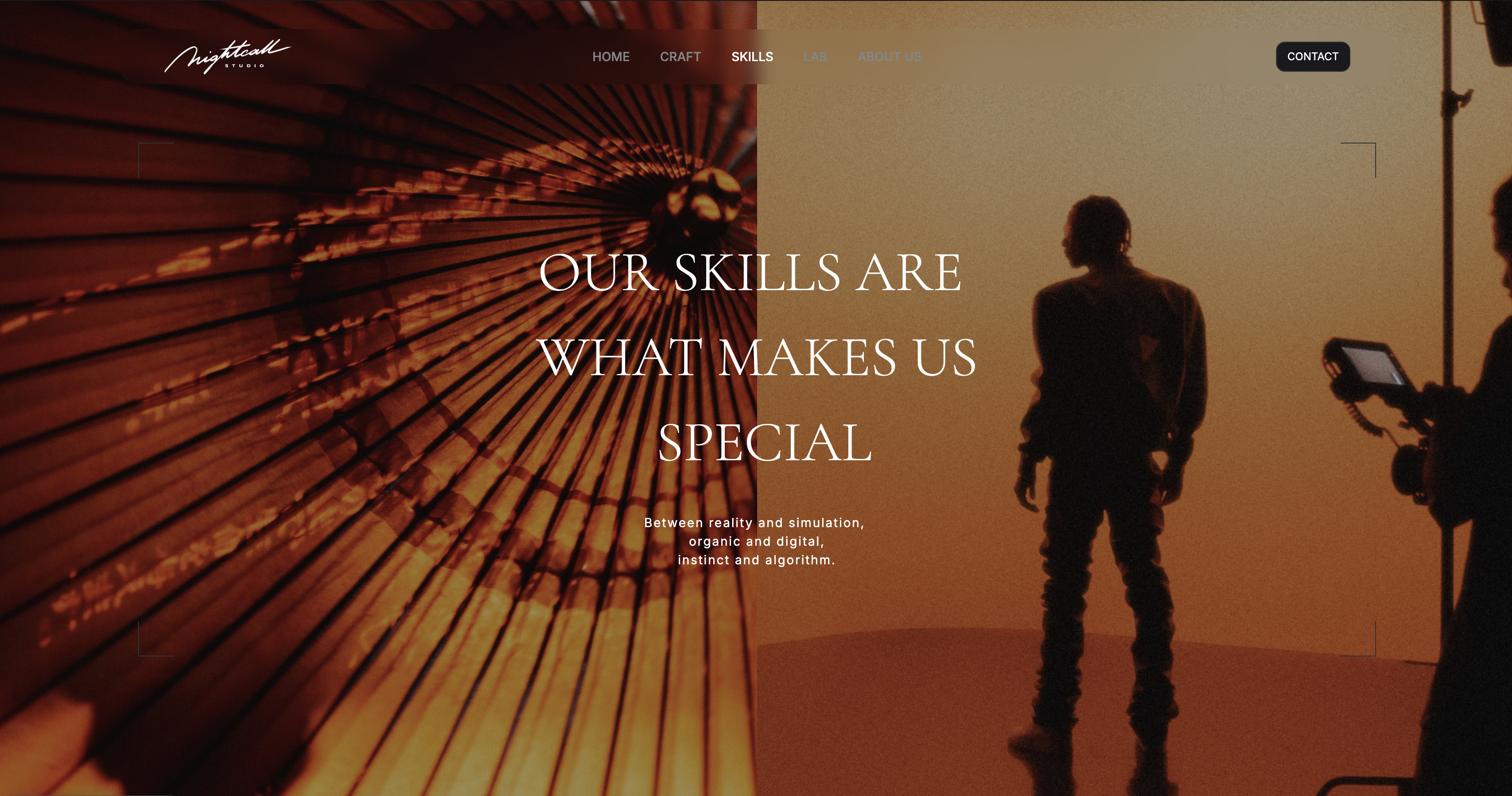
Verdict: the most expressive canvas here for a DP with design skills, and a site that needs three services beside it for the rest of the job; Framekit vs Framer works through the costs.
5. Adobe Portfolio: Best if Creative Cloud Is Already on Your Card
Adobe Portfolio comes with Creative Cloud rather than as its own subscription, and Adobe's plan comparison in October 2026 listed it on Lightroom (1TB) at US$11.99 a month, Photography (1TB) at US$19.99 and Creative Cloud Pro at US$69.99, each billed annually, so a DP who grades or edits in Adobe apps already has a clean portfolio with a custom domain and Behance syncing at no extra cost.
It holds no review, delivery, decks or store, and the site exists only while the subscription does, so a DP moving to DaVinci Resolve and cancelling Creative Cloud loses the website with it. Verdict: the sensible zero-extra-cost reel site for Adobe subscribers; Framekit vs Adobe Portfolio covers the move when the job outgrows it.
6. Cargo: Best for an Editorial, Art-House Look
Cargo is popular with artists and art-house filmmakers because its templates lean editorial and experimental, and its rates page, read in October 2026, lists one plan at $14 a month billed yearly or $19 monthly with one custom domain included, extra domains at $2 a month, and a Commerce add-on at $5.50 a month billed yearly with no per-transaction fee, which suits a DP selling a few prints or a zine.
The page states no storage or video limits and no AI drafting, review or delivery. Verdict: the pick for a cinematographer whose site should feel like a gallery catalogue rather than a production company, at $168 a year.
7. Webflow: Best for Production Companies With a Developer
Webflow fits a production company or camera collective with a designer-developer who wants structured credits, crew pages and case studies maintained for years, and its pricing page in October 2026 listed Basic at $15 a month billed yearly with no CMS and Premium at $25 with 20,000 CMS items, plus workspace seats at $39 a month for a full seat.
Its comment links review a web page rather than a cut. Verdict: the right tool for a company commissioning a custom build, and more than a solo DP needs; Framekit vs Webflow for agencies runs the numbers.
8. Wix: Best for a DP Who Rents Out Kit
Wix suits an owner-operator DP whose site also books camera and lighting rentals, because Wix Bookings and an App Market of more than 800 apps handle scheduling and deposits, and its plans page in October 2026 listed Light at $17 a month billed yearly with 2GB, Core at $29 with 50GB and eCommerce, and Business at $39 with 100GB, with video counted against storage.
Light's 2GB will not hold much footage, and there is no review or delivery. Verdict: strong as a rental desk, thin as a cinematography portfolio; Framekit vs Wix compares them.
9. Carrd: Best One-Page DP Site for $19 a Year
Early in a career a DP's site can be one page, a reel, six credits, a kit line and an email address, and Carrd does that for $19 a year on Pro Standard, which its Pro page in October 2026 listed with 10 sites, custom domains, forms, embeds and video uploads, after a free tier for up to 3 sites with Carrd branding.
Projects cannot have their own pages, and there are no decks, review or delivery. Verdict: the cheapest honest start, outgrown the day each project deserves a URL; Framekit vs Carrd maps the upgrade.
Reels, Stills and Aspect Ratios: What the Builder Actually Controls
A website builder controls the layout around your reel and stills, not the encoding of the reel itself, because on nearly every builder here the reel plays from Vimeo or YouTube, so the questions worth testing are how the player is framed, whether stills are cropped, and what a client downloads.
The reel. On Framekit, Framer, Webflow, Adobe Portfolio and Wix Light, a full reel is in practice an embed, so its compression and player come from the video host and its plan.
Squarespace and Format host video themselves on the plans named above. If a 2.39:1 reel shows letterbox bars inside a 16:9 player, that is the host's player and your export, not a quality the builder adds or removes.
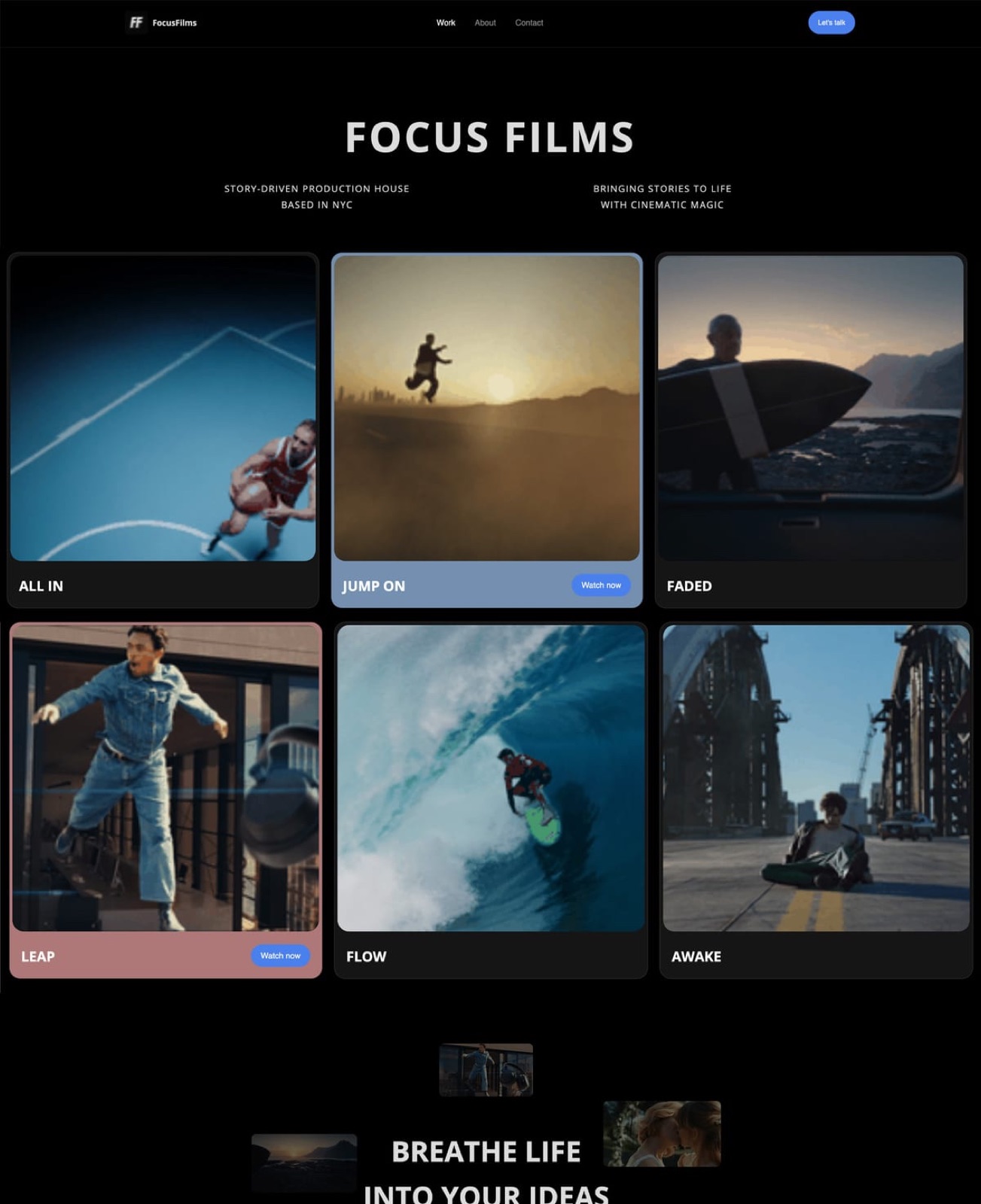
The stills. Frame grabs are where a builder's layout matters most. Check whether a full-width image section crops a scope frame into a different ratio on a phone, and whether a grid forces every frame into squares.
What a client downloads. In a Framekit gallery, downloads always deliver the full-resolution original you uploaded, while watermarks, if you add them, mark only what clients see on screen.
Gallery video is transcoded for smooth playback, so a director who needs the graded master downloads the file rather than judging the stream.
Run it yourselftake one 2.39:1 frame grab, one 1.85:1 grab and your reel link. On Framekit's free plan and one other free plan or trial, put each into a full-width section and a grid, embed the reel, then open both sites on your phone and your laptop.
Whichever keeps your frames composed the way you shot them is the right builder for your stills, whatever this ranking says.
What a Cinematographer's Site Should Show
A cinematographer's site that books work shows a reel of 60 to 90 seconds, six to ten projects with credits and frame grabs, your format and kit, a contact route your agent or you actually monitor, and a way to get a look deck or rates, because producers shortlist on the reel and confirm on the details.
Give each project its role line, DP, camera operator or second unit, plus the director, the format and a short note on the lighting or look.
Separate commercial, narrative and music-video work so a producer finds the relevant evidence in one click. List the kit you own in a sentence, since an owner-operator package changes a producer's budget.
If you prefer not to publish rates, keep them in a DP portfolio deck that goes out on request; Framekit's template has a rates slide built for exactly that.
And if you have representation, a website admin seat on Framekit Pro lets your agent update credits without touching your decks or client reviews.
The Work Around the Reel, in One Account
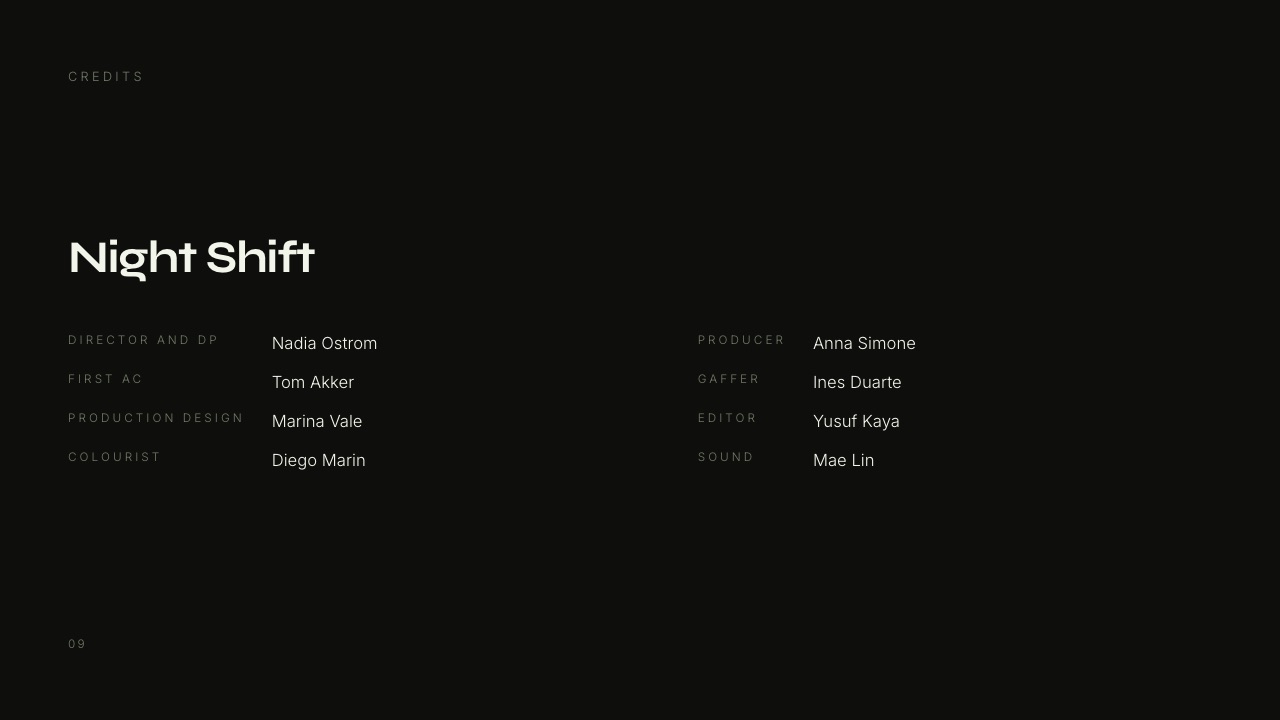
A cinematographer on Framekit runs four jobs beyond the site from one account, and this section shows each with its limits, because look decks, camera-test notes, stills delivery and LUT sales are separate subscriptions beside every other builder in this ranking.
Look decks and DP portfolio decks in Slides
Slides has look approval, director's treatment, lookbook and DP portfolio templates, with look cards, swatches, moodboards, storyboard rows and shot lists as elements.
The AI drafts a whole deck from your brief after a few questions and an outline you approve, using the references and facts you paste in.
Decks are unlimited on every plan, each up to 40 slides, with PDF export; PowerPoint export, picture-based, opens on Pro. Deck links carry no password and no viewer analytics, so a confidential bid goes out as a PDF.
Review for camera tests and cuts
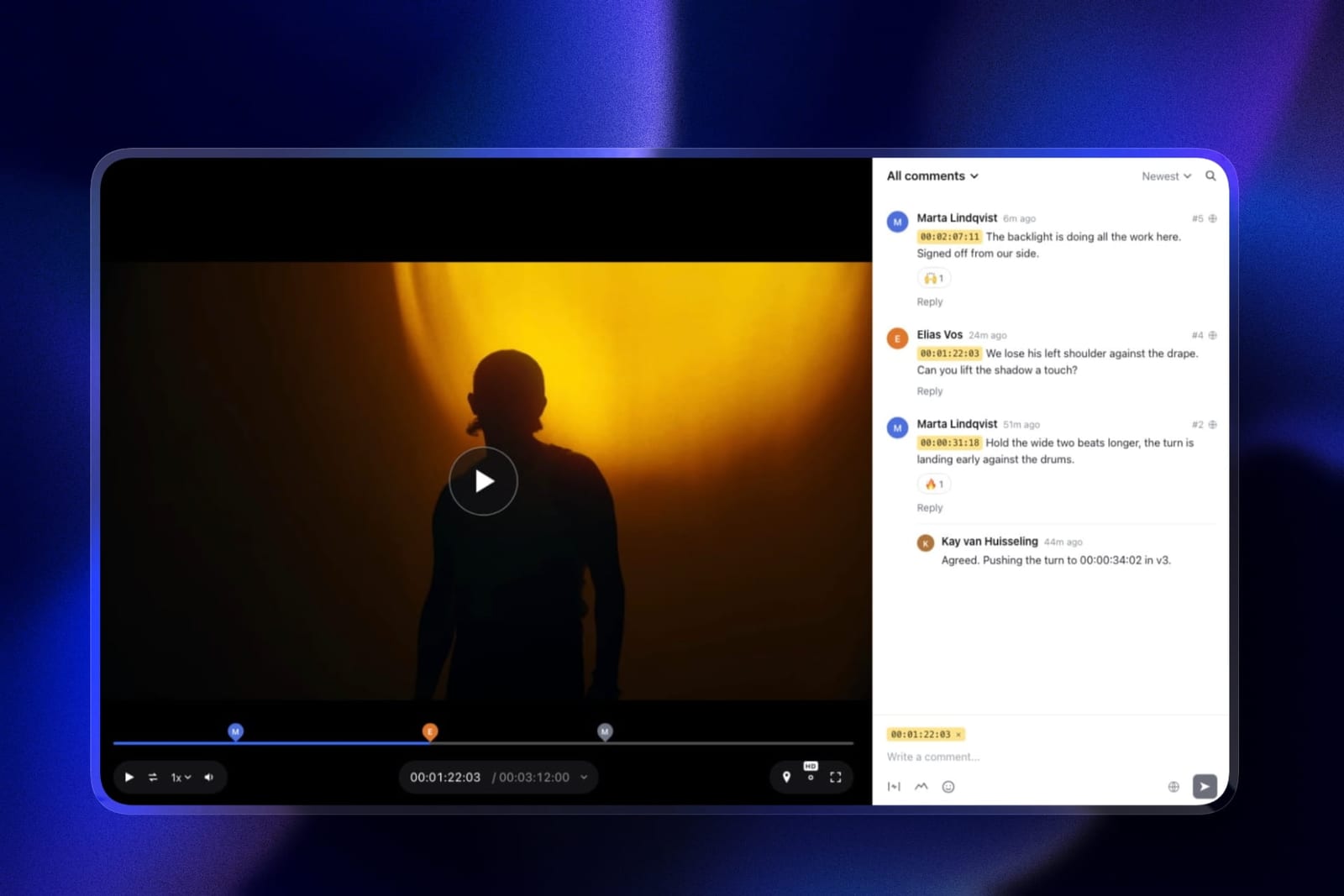
Upload a camera test, a grade pass or a cut, send the link, and the director or client comments at the exact frame, draws on it and replies, without an account.
Versions stack with their notes, and each round is marked needs review, in progress, approved or needs changes. Videos run up to 2 hours, with files up to 500MB on Free, 1GB on Starter, 2GB on Pro and 3GB on Business.
There are no editing-suite panels, no side-by-side compare and no HDR review.
Delivering graded stills and selects
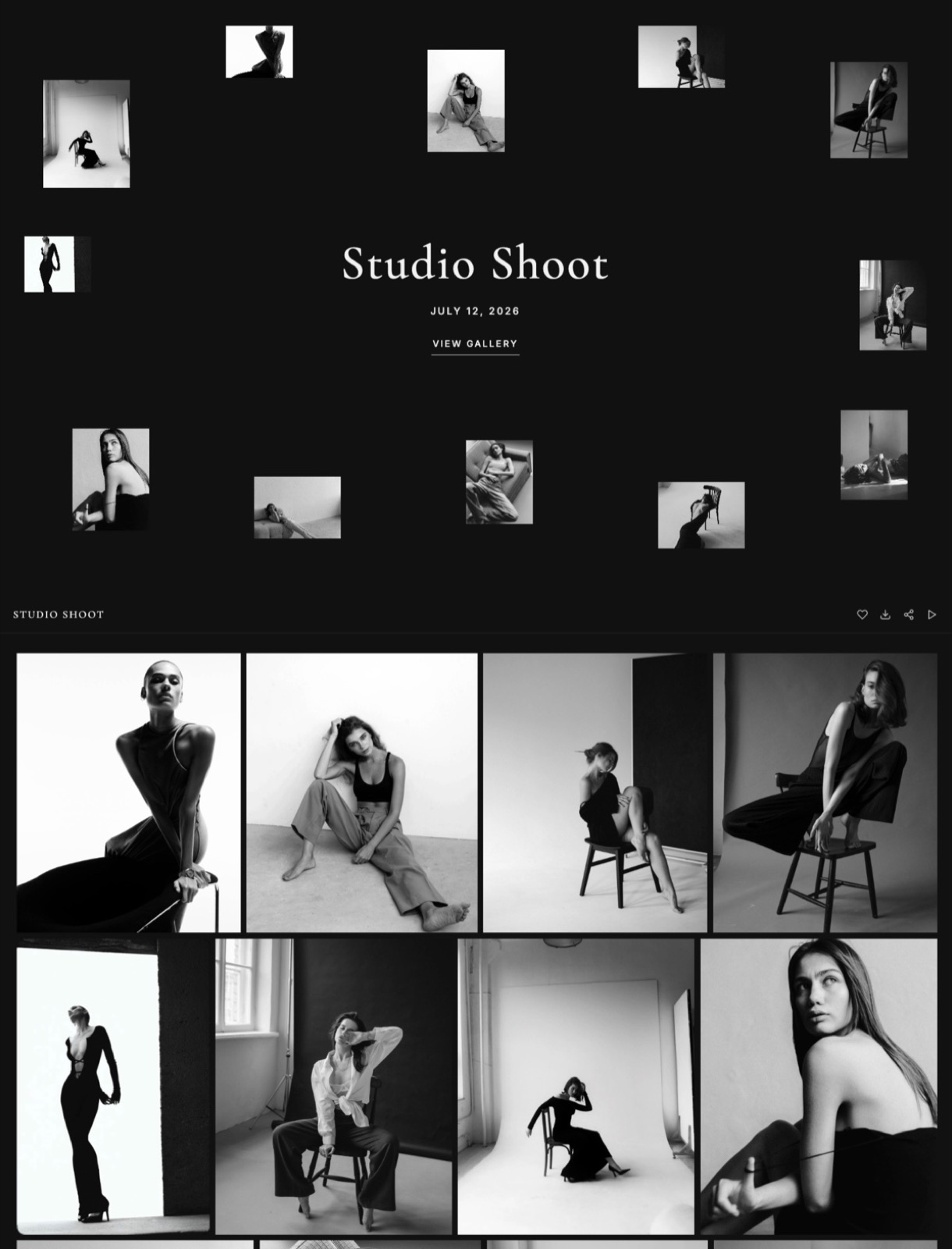
Graded stills, BTS frames and selects go into one gallery with one link, emailed to up to 20 recipients, with up to 5,000 photos per gallery and photo files up to 100MB.
Clients heart favourites into named lists with notes, a gallery password and a separate download PIN gate access, and downloads always deliver the full-resolution original.
Selling your grade as a LUT pack
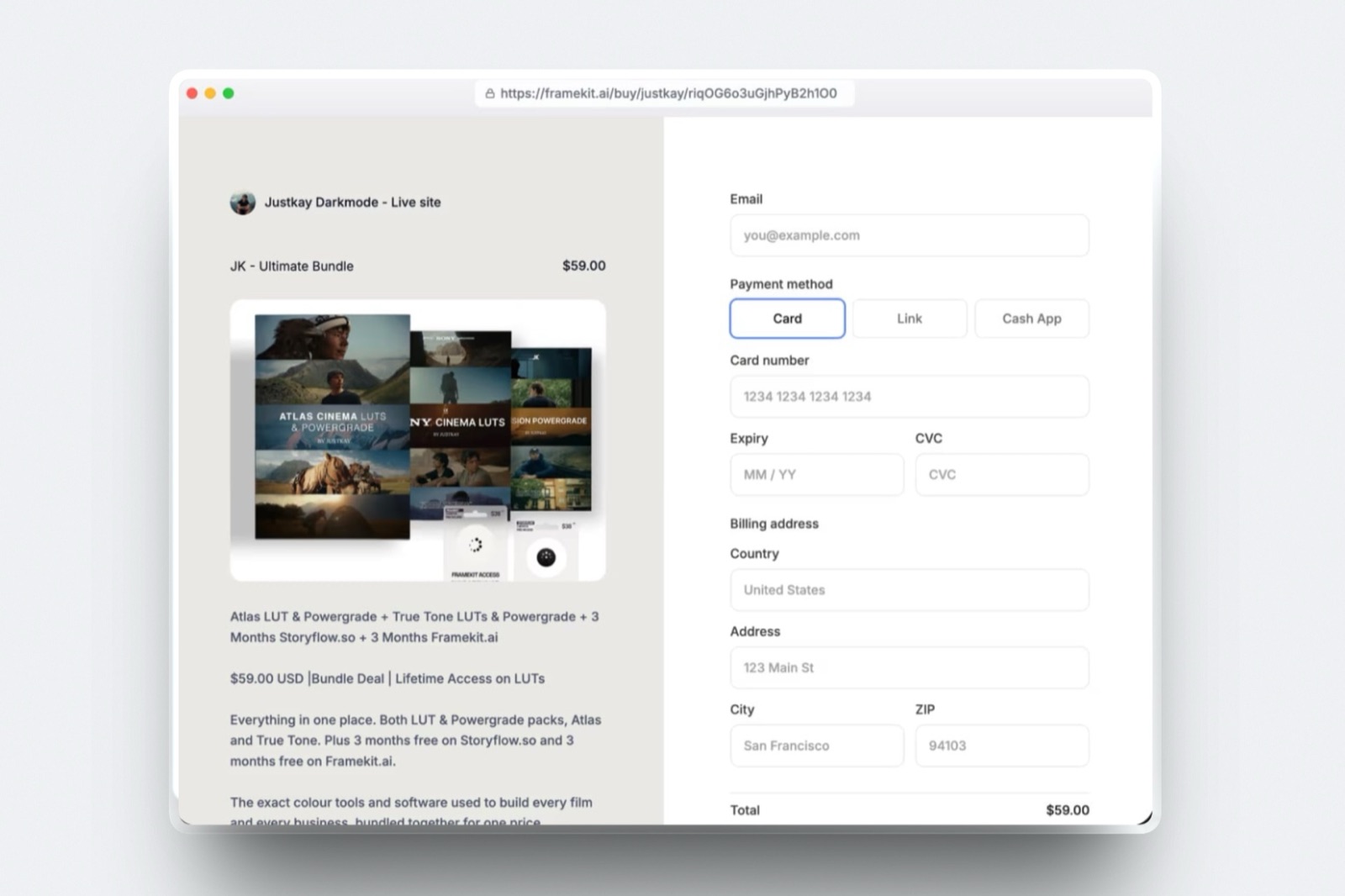
Sell LUT packs as instant downloads, with unlimited products on every plan and a buy link that works without the site.
Payment runs through Stripe Connect into your own Stripe account, so you are the merchant of record for VAT, and checkout is hosted on framekit.ai with your name and logo and a Powered by Framekit line.
The fee is 5 percent on Free and Starter, 3 percent on Pro and 0 percent on Business; the best platforms to sell LUTs compares the alternatives.
What Three Cinematographers Pay Over Three Years
Framekit is the cheaper setup for all three cinematographers below, by $300 a year for a commercial DP against Squarespace and by more than $150 a year for an owner-operator against Format, because review, delivery and a store are separate costs on the other builders.
Assumptions: US prices on yearly billing read in October 2026, held flat for three years, card processing excluded.
Outside prices: Frame.io Pro about $13 per member a month billed yearly ($156), Pixieset Client Gallery Basic $96 a year for 10GB of stills delivery, and Gumroad 10 percent plus $0.50 a sale beside Format, whose pricing page did not confirm digital-download sales, per Gumroad's pricing page.
Squarespace's yearly plans bundle a domain for the first year, while on Framekit you register your own, roughly $11 a year for a .com, and connect it.
Format's year one uses its first-year offer ($144 on Pro, $180 on Pro Plus) and years two and three its regular annual rates ($204 and $312). Each cell shows year one, then the three-year total.
| Cinematographer | Framekit setup | Framekit, year 1 / 3 years | Squarespace setup | Squarespace, year 1 / 3 years | Format setup | Format, year 1 / 3 years |
|---|---|---|---|---|---|---|
| Commercial DP, look decks for bids, camera tests shared for notes | Starter ($84) | $84 / $252 | Basic ($228) plus Frame.io Pro ($156) | $384 / $1,152 | Pro ($144 in year one, $204 after) plus Frame.io Pro ($156) | $300 / $1,020 |
| Narrative DP selling a LUT pack, 100 sales at $30 ($3,000) | Starter ($84) plus 5% fee ($150) | $234 / $702 | Basic ($228) plus 2% fee ($60) | $288 / $864 | Pro ($144 in year one, $204 after) plus Gumroad ($350) | $494 / $1,602 |
| Owner-operator DP, camera-test review, graded stills delivered to clients | Pro ($180) | $180 / $540 | Basic ($228) plus Frame.io ($156) plus Pixieset Basic ($96) | $480 / $1,440 | Pro Plus ($180 in year one, $312 after) plus Frame.io ($156) | $336 / $1,272 |
The narrative DP stays on Starter because Pro's 3 percent only beats Starter's 5 percent above about $500 a month of sales on monthly billing, and $3,000 a year is $250 a month.
Honest caveats: no deck tool is counted on any side, because many DPs build decks in Keynote at no cost; Frame.io gives each member upload rights and editing-suite integrations that Framekit review lacks; and a Creative Cloud subscriber who sells nothing and shares no tests pays $0 extra for Adobe Portfolio, which beats every row above.
Which Tool for Which Part of a DP's Job
The cleanest way to choose is job by job, because each builder here is the best answer to at least one part of a cinematographer's work, and this table pairs each job with the tool that does it natively and what Framekit does for the same job.
| Job | Best native fit | What Framekit does |
|---|---|---|
| A public library of long films on the page | Squarespace Core, 5 hours | Embeds from Vimeo or YouTube; 100MB uploads |
| A motion-led showpiece site | Framer | Guided editor with AI drafting; less motion control |
| Campaign stills plus a few short films | Format Pro Plus | Full-width frames and embeds; galleries for delivery |
| Look decks and DP portfolio decks | Framekit Slides | Unlimited decks, up to 40 slides, PDF export |
| Camera tests and cuts for notes | Framekit or Frame.io | Frame-accurate review on every plan |
| Graded stills and selects to a client | Framekit galleries or Pixieset | Unlimited galleries, full-resolution downloads |
| Selling a LUT pack | Framekit store or Gumroad | 5% to 0% fee by plan, your own Stripe account |
| Kit rental bookings | Wix | Not offered |
In one lineFramekit is the native fit for four of the eight jobs and an adequate one for two more, which is why it ranks first overall while losing the long-film and motion-showpiece jobs outright.
What Happens When a Job Hits a Limit
These are the moments that catch cinematographers a few jobs into a new platform, answered from what each vendor publishes, so the edges show up on a quiet day rather than the night before a pitch.
The camera test is bigger than the review cap. Framekit review files cap at 500MB on Free up to 3GB on Business, with a 2-hour maximum, so a long uncompressed test needs a review export.
The director has no account. Framekit review, gallery and deck links all open as a guest; notes and drawings work straight from the link.
The look deck must stay private. Framekit deck links have no password or viewer analytics, so send a confidential bid deck as a PDF, which every plan exports.
Your agent needs to update credits. On Framekit Pro, add them as one of 3 website admins; they can edit the site but cannot open your decks, galleries or reviews, which stay with the account holder.
The AI allowance runs out before the deadline. Generation pauses until the monthly allowance renews, while every page and slide stays editable by hand.
You stop paying. Framekit's free plan is permanent, so the site falls back to a framekit.ai address with a badge, 10 pages and 10GB with 3GB of video; archive large galleries first.
Squarespace and Format have trials instead of free plans, and Adobe Portfolio ends with the Creative Cloud plan.
How to Choose: A Decision Tree for Cinematographers
Work down these questions in order and stop at the first yes, because for a cinematographer the constraint that rules a builder out fastest is where the long-form video and the pitch paperwork live, and the template only matters once those are settled.
1. Must long films play natively on your own pages? If yes, Squarespace Core with 5 hours, or Format Pro Plus with 120 minutes. If no, go to question 2.
2. Do you already pay for Creative Cloud and need only a reel and credits? If yes, Adobe Portfolio costs nothing extra. If no, go to question 3.
3. Do you send look decks, share camera tests for notes, deliver stills or sell LUTs? If yes, Framekit includes all four on every plan, so it is very likely the cheaper and simpler choice. If no, go to question 4.
4. Must the site itself demonstrate motion design? If yes, Framer, or Webflow if a production company maintains it. If no, go to question 5.
5. Do you rent out kit and want bookings on the site? If yes, Wix. If no, go to question 6.
6. Is one page enough for now? If yes, Carrd at $19 a year. If no, draft your site on Framekit's free plan from a screenshot of a DP site you admire.
Frequently Asked Questions
What is the best website builder for cinematographers in 2026?
Framekit is the best website builder for cinematographers in 2026, because one account holds an AI-built reel and stills site, look decks and DP portfolio decks in Slides, frame-accurate review for camera tests, delivery galleries for graded stills and a LUT store, from $7 a month billed yearly.
Squarespace is better for hosting long films on the page, and Format for a DP who also shoots campaign stills.
Framekit vs Format for cinematographers: which is better?
Format is better if you want films hosted on your own pages, with 120 minutes on Pro Plus at $26 a month billed yearly ($15 in year one under an offer ending 31 October 2026), and a stills-heavy portfolio with up to 250 client galleries.
Framekit is better if you pitch with look decks, share camera tests for notes or sell a LUT pack, since Slides, review and a store come in the plan; a commercial DP pays $84 a year on Framekit Starter against $300 in year one for Format Pro plus Frame.io, and $360 a year once Format's offer ends.
Will my 2.39:1 reel be cropped on a Framekit site?
A full reel on Framekit plays from a Vimeo or YouTube embed, so its framing inside the player comes from the host and your export rather than from Framekit.
What the builder controls is the layout around it and how frame grabs sit in full-width sections and grids, so test one scope frame and one 1.85:1 frame on the free plan and check both on a phone before publishing.
Does Framekit preserve my colour grade?
Framekit makes no colour-accuracy claim for streaming video, and this guide makes none for any builder. Reels embedded from Vimeo or YouTube are encoded by those hosts, and gallery video is transcoded for smooth playback.
What Framekit guarantees is the download: gallery downloads always deliver the full-resolution original you uploaded, so a client judging the grade should download the file.
Should a cinematographer host the reel on Vimeo or YouTube?
Usually yes, unless your builder hosts long video natively. Vimeo Starter costs $144 a year with 2TB and offers a cleaner player without suggested videos, while a YouTube embed costs nothing.
Squarespace Core and Format Pro Plus can host a reel on the page itself, and Framekit's 100MB page-upload cap suits only a short hero loop.
Can I put day rates and kit on my cinematographer website?
Yes, and producers use both, but many DPs keep rates off the public site.
A common split is a one-line kit list on the site and a DP portfolio deck with rates, credits and kit that goes out on request; Framekit Slides has a Director and DP Portfolio template with rates and kit slides built for that.
How do I send a look deck to a director?
On Framekit, build the deck in Slides from a look approval, lookbook or treatment template, then share it as a link or export a PDF on any plan; PowerPoint export, picture-based, opens on Pro.
Deck links have no password or viewer analytics, so send a PDF for anything confidential. Gamma and Keynote are common alternatives.
Do cinematographers need Frame.io?
Not for occasional camera tests and look approvals, which Framekit's review covers on every plan with frame-accurate comments, drawing, version stacks and approval statuses, without reviewers needing an account.
Frame.io remains the better tool on productions where editors and colourists work inside Premiere, Resolve or Final Cut and several people upload media.
Can I sell LUTs from a cinematographer website?
Yes. Framekit's store sells LUT packs as instant downloads on every plan, at 5 percent on Free and Starter, 3 percent on Pro and 0 percent on Business, through your own Stripe account, which makes you the merchant of record for VAT.
A narrative DP selling $3,000 a year pays $234 on Starter before card processing, against $494 in year one for Format Pro plus Gumroad and $554 once Format's first-year offer ends.
Is Adobe Portfolio good enough for a cinematographer?
Adobe Portfolio is good enough for a clean reel-and-credits site if you already pay for Creative Cloud, since it costs nothing extra and supports a custom domain.
It has no review, delivery, decks or store, and the site goes offline if you cancel Creative Cloud, which matters for DPs moving their grading to DaVinci Resolve.
Can my agent edit my Framekit site?
Yes, on Pro or Business. Pro includes 3 team members and Business unlimited, and each is a website admin who can update credits, projects and pages.
Team members cannot open your decks, galleries or video reviews, which stay with the account holder, so share those with your agent by link or PDF.
How much does a cinematographer website cost per year?
A cinematographer website costs $0 to about $350 a year for the site alone: Carrd is $19, Framekit Starter $84, Format Pro $204 ($144 in year one under its offer), Cargo $168, Squarespace Basic $228 and Core $348, all billed yearly.
Once review, delivery or a store is added to a general builder, a working DP's bill on our examples runs $288 to $494 in year one and up to $554 once Format's offer ends, against $84 to $234 on Framekit.
What happens to my reel site if I cancel Framekit?
Your account drops to the permanent free plan instead of closing, so the site stays live on a framekit.ai address with a badge, up to 10 pages and 10GB of pooled storage with 3GB of video, but without your own domain.
Embedded reels keep playing from Vimeo or YouTube; archive large galleries and review cuts before downgrading.
The Best Website Builder for Cinematographers in 2026: Final Verdict
Framekit is the best website builder for cinematographers in 2026, because the reel site, the look deck, the camera-test review, the stills delivery and the LUT store share one account, so a commercial DP pays $84 a year on Starter where Squarespace plus Frame.io costs $384, and an owner-operator pays $180 on Pro where Format Pro Plus plus Frame.io costs $336 in year one and $468 after.
Where Framekit loses is the page itself as a canvas and a film host. Its pages cap uploads at 100MB, so the reel is an embed; its editor does not reach Framer's, Webflow's or Cargo's design freedom; and its decks have no password.
A DP who wants long films on the page is a better fit for Squarespace or Format, a motion-led showpiece is a better fit for Framer, an art-house look is a better fit for Cargo, and a Creative Cloud subscriber who needs only a portfolio is a better fit for Adobe Portfolio.
The test is free: draft your site on Framekit's free plan, run the scope-frame test from this guide, and send your next look deck from Slides before deciding.
Related readingthe best website builders for filmmakers, the best AI website builder for filmmakers, the best portfolio website builder for videographers, the best moodboard and treatment tools for directors and what a filmmaker portfolio should include.