Framekit templates
Start from a designer-made template
 Use template
 Use template
 Use template
 Use template
 Use template
 Use template
 Use template
 Use template
The person reading your pitch is not deciding whether to work with you. They are deciding whether to open the link, and they are deciding it in the 4 seconds it takes to read a subject line and one sentence while two other jobs wait.
That is the whole reason most creators get this backwards. They spend a weekend on a deck and 11 minutes on the email, when the email is the part doing the selling.
To pitch a brand as a creator you need three things in order: the right human, one piece of evidence they cannot argue with, and a single ask small enough to say yes to.
A brand pitch is a short, specific email that proposes one piece of work to one company, attaches or links the evidence that it will work, and asks for one decision, not a conversation.
The deck matters, but it matters second: it is the artefact that survives being forwarded to a colleague who never met you.
Pitch one named person, not an inbox, with a 120-word email that leads with the brand's problem and one specific piece of evidence, then links a short deck instead of attaching a heavy file.
Ask for one thing: a 15-minute call or a yes to one piece of work at a stated price. Follow up on day 4, day 11 and day 25, then stop and requalify the brand next quarter.
Build the deck in Framekit Slides, which gives you unlimited decks and a share link on every plan including Free; use Pitch or Storydoc instead when knowing exactly which brand opened the deck is what drives your follow-up.
Full disclosure: Framekit is our product, so weigh the recommendation accordingly. Tool prices below were read on each vendor's pricing page in September 2026 and linked; two of those pages served European pricing to us and are labelled in euros, not converted. Framekit sends no email, runs no CRM and offers no open tracking, so for most of this procedure you will be using other tools, and this guide says which ones.
Where the advice in this guide comes from
Pitching advice is unusually full of invented statistics, so it is worth saying plainly what is sourced, what is arithmetic and what this guide refuses to claim at all.
Read at the source. Tool prices, credit allowances and plan limits come from each vendor's own published pricing page in September 2026, linked at the point of use. Where a page served European pricing, that is the figure quoted, in euros.
Calculated. The list sizing, the follow-up calendar and the pricing arithmetic are worked through in the open with one carried example: a cycling creator pitching mid-size bike-accessory brands, with a first collaboration priced at $900 for two pieces plus 90 days of paid usage.
Refused. No reply-rate statistic appears anywhere below. The numbers circulating for cold-email reply rates come from B2B sales tools with an interest in the answer, and none of them describe creator outreach.
Instead of a benchmark, you get arithmetic you can run on your own list.
What a pitch round actually involves
These are the quantities behind the whole procedure, and they are worth reading before the steps because the common failure is pitching three brands eight times each across a season, when the shape that works is 10 brands, 4 touches, 25 days.
- 10 brands per round, not three, because the outcome you are looking for is rare enough that a small list tells you nothing.
- 4 touches over 25 days: the first email plus follow-ups on day 4, day 11 and day 25.
- 120 words in the first email, which is about as much as a phone screen shows before a thumb moves.
- 1 ask per email, always, because two asks is a decision and a decision gets postponed.
- 50 free credits a month on Hunter's free tier, with one credit per email found, so a 10-brand round costs nothing to research.
- 66.3 percent of respondents to the 2026 Influencer Marketing Benchmark Report, a survey of more than 600 industry respondents, said they run creator programmes entirely in house, which tells you the person you are emailing is a marketer with other work on their desk, not an agency buyer.
In one linepitching is a volume-and-precision problem and not a persuasion problem, so the work sits in list building, contact research and follow-up discipline, never in the wording of your opening paragraph.
Step 1. Build a list of 10 brands you can genuinely help
The list is the pitch. A generic email to the right brand outperforms a beautiful email to a brand that was never going to hire a creator this quarter, and you can tell the difference before you write anything.
Score each candidate on four things. Do they already pay creators? Look for tagged partnerships, branded content labels on posts, or an affiliate programme; a brand that has never done this will spend 6 months inventing a process. Do they sell something your audience buys? Not adjacent, actually buys. Is there a live reason to talk now? A product launch, a new market, a seasonal push, a competitor doing it better. Can you reach a human? If the only contact is a support form, move on.
10 brands that pass all four beats 50 that pass two. Keep the list in a spreadsheet with six columns: brand, the person, their email, the reason to pitch now, the date of each touch, and the outcome. That spreadsheet is your entire CRM and it is enough for years.
One useful filter from the market data: nano and micro creators drew the strongest stated expansion intent in the 2026 benchmark survey, at 51.43 and 52.83 percent against flat intent for macro creators, and TikTok appeared in 31 percent of respondents' plans.
Read that as a targeting instruction, not a reason for optimism.
Brands with in-house programmes and small budgets are the ones actively looking to add creators your size, and they are easier to reach than the ones running everything through an agency.
The thing that goes wrongthe list is built from brands the creator admires instead of brands that buy. Aspiration is a terrible qualifier, and a round of pitches to 10 dream brands with no creator programme produces silence that feels personal and is not.
Step 2. Find the human, not the inbox
An email to info@ is a lottery ticket, and the fix is 15 minutes per brand spent finding the one person whose job is affected by whether your idea works.
The title you want is one of four: brand partnerships, influencer marketing, social media manager, or at smaller companies simply marketing manager. At a company under 30 people the founder is still doing this job, and that is the fastest reply you will get in the whole round.
| Where to look | What it costs | What you get | What it will not give you |
|---|---|---|---|
| LinkedIn search by company and title | Free | The person's name, title and whether they are still there | Rarely the email address itself |
| Hunter domain search | Free tier: 50 credits a month, 1 credit per email found | The company's email pattern, and the exact address when Hunter has it indexed | Certainty, so sense-check the pattern against a second source |
| The brand's press or partnerships page | Free | A named contact who has volunteered to be emailed | Priority, since everyone else emails it too |
| Branded content tags on their recent posts | Free | The creators they already pay, which tells you the going format | A contact, unless a creator tells you who briefed them |
| Creator marketplaces on the platforms | Free to join where you qualify | Inbound: brands searching for creators like you | Control, since you cannot choose who finds you |
Two rules keep this from wasting a morning. Verify the address before you send, because a bounce on your first attempt burns the brand for a quarter.
And never email two people at the same company in one round; two emails to the same team reads as a mass send, which is the precise impression the whole procedure is trying to avoid.
Fifteen minutes a brand across a 10-brand list is two and a half hours of contact research per round, and that is the entire price of not sending anything to info@.
It is also the part of the job that decides the round, which is why it sits here in step 2 and not in the paragraph about subject lines.
The thing that goes wrongthe creator finds a name, cannot find an email, and sends a DM instead. Direct messages on social platforms are read by community managers whose job is customer support, and a pitch there rarely reaches the person who buys.
Step 3. Find one piece of evidence before you write a word
The sentence that makes a pitch work is almost never about you, it is a specific observation about the brand plus a number of your own that proves you can do something about it.
Spend 10 minutes on each brand looking for one of four things. A gap: a product line with no creator content at all. A format they under-use: everything is product photography and nothing is in-use footage.
A question their audience keeps asking in comments that nobody answers. Or a competitor move: someone selling the same thing is running creator content and they are not.
Then pair it with your own evidence, and make it a number with a window on it.
"Your winter range has no rider footage; my January frozen-commute Reel reached 31,000 accounts, which is 3.3 times my follower count, and drove 1,850 link taps" is a pitch.
"I love your brand and think we would be a great fit" is a compliment.
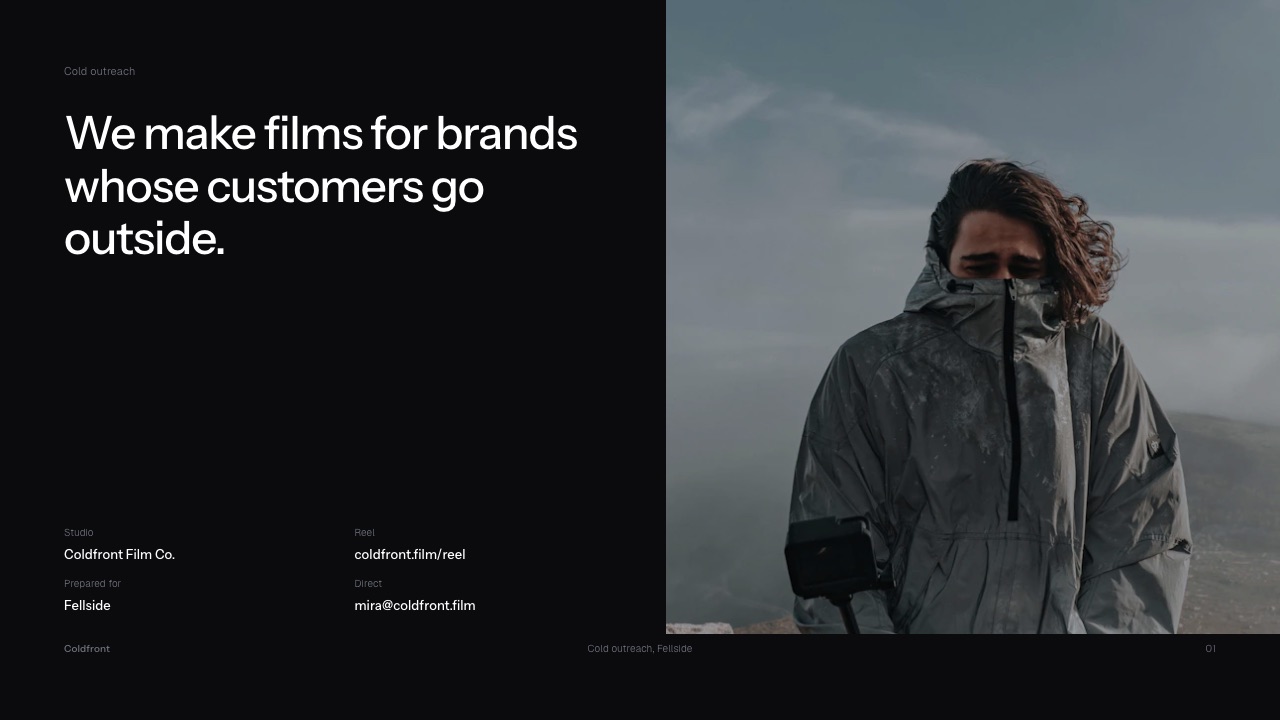
If your evidence is thin because you have not been paid for this work yet, make the evidence instead of borrowing it. Publish one piece about a product you already own, in the format you would sell them, and pitch with its real numbers.
A labelled self-directed piece is stronger than a promise, and it costs you an afternoon. The media-kit slides that hold this proof are covered separately in UGC portfolio examples.
The thing that goes wrongthe evidence is a follower count. A follower count is a claim about you; a reach ratio or a tap rate on a product post is a claim about what your audience does, which is the only thing being bought.
Step 4. Write the 120-word email, in the version that fits
Three situations produce three different emails, and sending the cold version to someone who already follows you is the most common self-inflicted wound in creator outreach.
| Version | When to send it | The opening line does this | The ask |
|---|---|---|---|
| Cold | No prior contact of any kind | Names the gap you spotted in their marketing, in one clause | One named piece of work at a stated price, or 15 minutes |
| Warm | You are a customer, or you have met, or they follow you | States the connection in five words, then the gap | A call, because the relationship can carry a conversation |
| Inbound reply | They contacted you first | Answers their question in the first line, before anything else | Confirms next step and attaches the rates |
Here is the cold version in full for the carried example: 114 words of body under a six-word subject line.
SubjectRider footage for the winter range
BodyHi Dana, your winter accessories page is all studio product shots and none of it shows the kit on a bike in bad weather, which is the thing your buyers are nervous about.
I make frozen-commute content for city cyclists: my January piece on winter gloves reached 31,000 accounts against 9,400 followers and drove 1,850 link taps.
I would like to make two pieces for the Rampart saddlebag, shot in real January conditions, delivered in three weeks, at $900 including 90 days of paid usage. Two minutes of relevant work and my rates are here (one link).
If the winter range is already covered, is there a spring launch worth talking about in February?
Four things are doing the work in that email. The first clause is about them and contains a real observation. The evidence is one sentence with numbers and a window.
The ask is a specific piece of work at a specific price, so the reply can be one word. And the last line gives them an easy alternative to no, which is what converts a dead brand into a dated follow-up you can put in column 5.
Then the rules of omission: no attachments, no paragraph about your journey, no list of every platform you are on, no "let me know if you would be interested in collaborating", which asks for a feeling, not a decision.
The thing that goes wrongthe email is 400 words and opens with "I am a content creator and storyteller passionate about". The reader has learned nothing about their own business by the end of sentence two, and that is the sentence where they decide.
Step 5. Attach nothing, send one link
An attachment is a file that has to be worth downloading before it has proved anything, and a first email has not earned that yet, so send a link and keep the file for later.
There is a practical reason too.
Heavy files do not travel well through corporate mail filters, and Gmail's 25MB limit swaps anything larger for a Drive link automatically, which means your careful attachment can arrive as a permissions request from a stranger.
A link you control avoids all of it.
What the link should point at is a short deck, 4 to 6 slides, built for one brand: the idea, the proof, what you would make, the price, and how to say yes.
That is a different artefact from a full media kit, and it is why a deck tool that lets you keep unlimited versions matters more than one with prettier transitions.
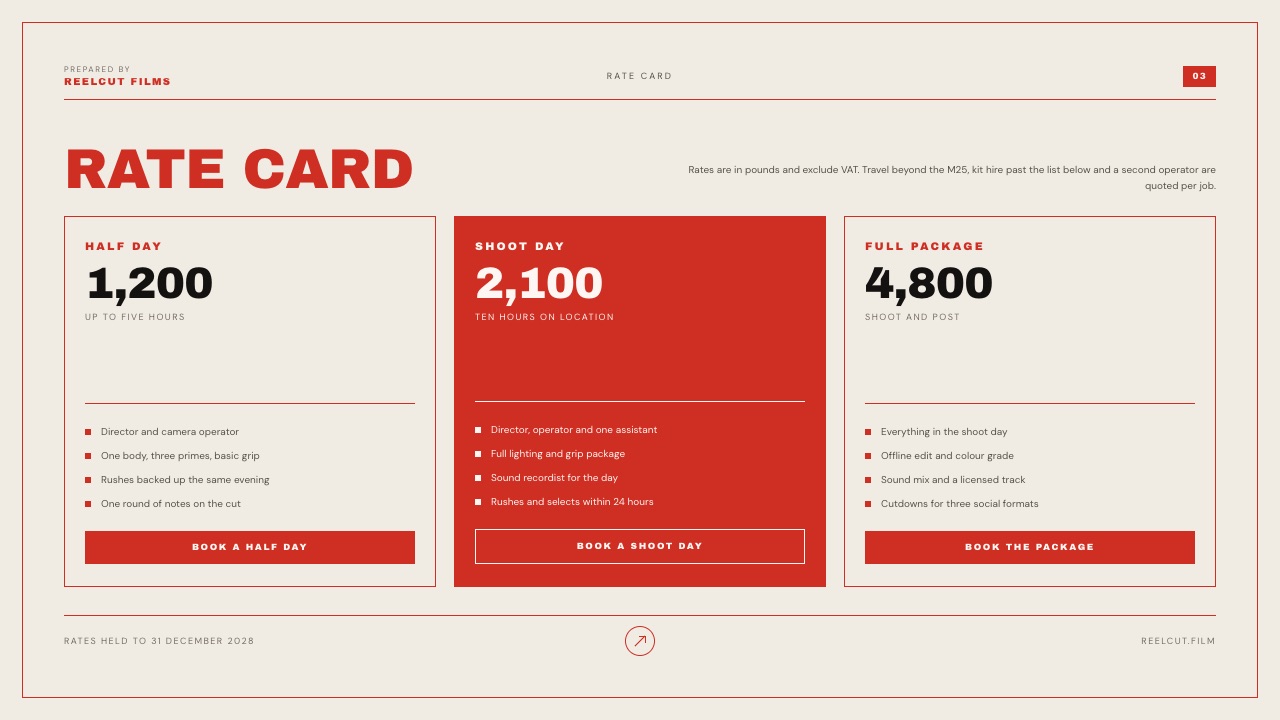
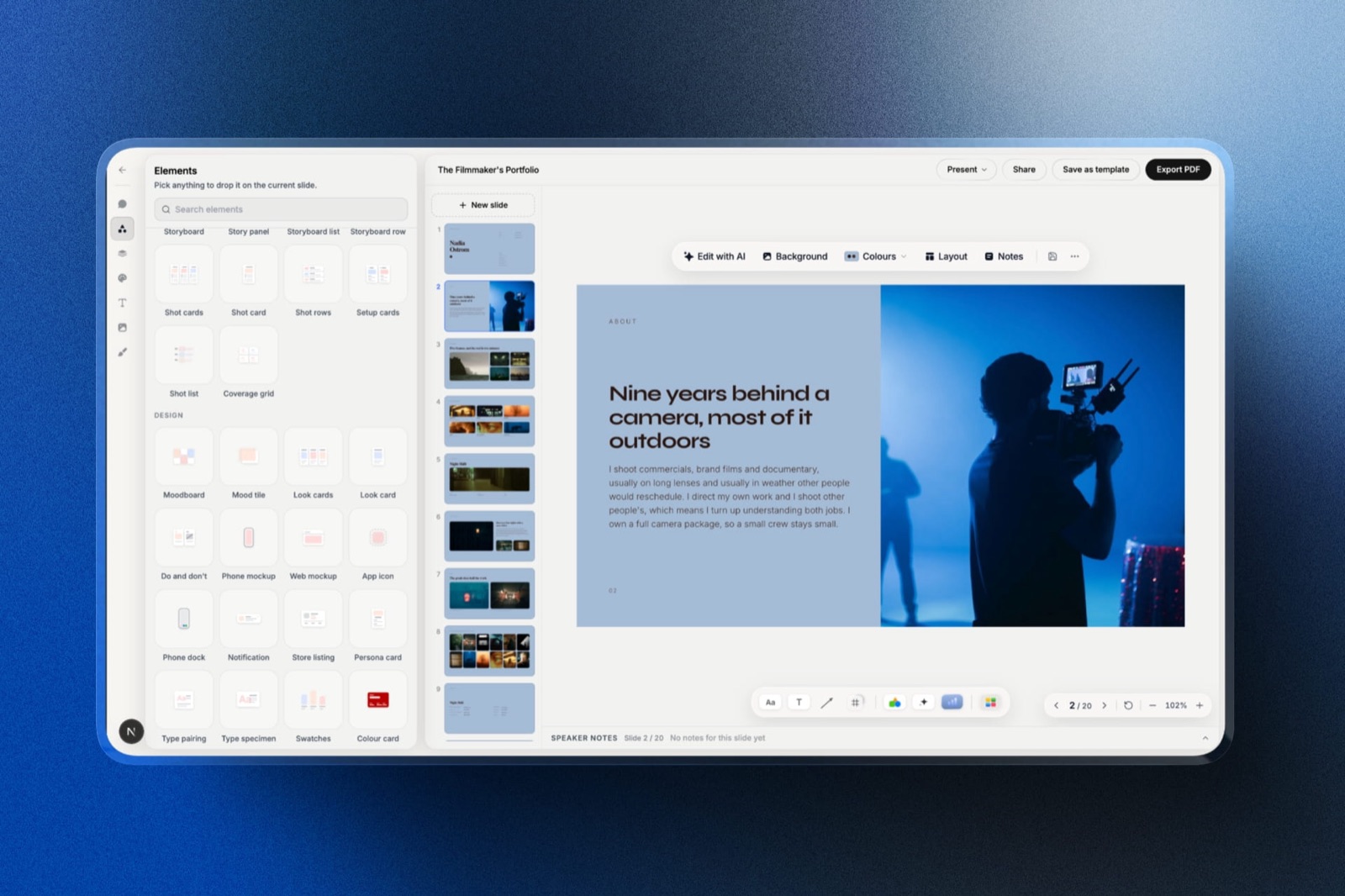
Framekit Slides is the recommendation for that deck: unlimited decks on every plan including Free, an AI slide writer that drafts a slide from a sentence of instruction, speaker notes under every slide, PDF export and a share link on every plan, and your own colours across all of it.
Framekit is an AI website builder whose Slides tool keeps the pitch deck on the same account as the portfolio site the last slide links to, so a brand that follows the link lands somewhere that matches.
The deck template shape itself is covered in the sponsorship deck template guide, which is the place to start if you want the slide-by-slide version.

The limit to know before you rely on it: a Framekit deck link has no password and reports a total view count, not per-viewer analytics.
If your follow-up depends on seeing that Dana opened it twice, Pitch sells advanced links with visits, slide views and time spent from its Team tier, listed at EUR 15 per seat per month billed yearly for European buyers, and Storydoc sells document analytics from $19.80 a month billed annually with five active documents.
Buy one of those if open tracking is genuinely how you decide when to send touch three.
The thing that goes wrongthe link goes to a 40-slide portfolio deck. The brand opens slide one, sees a contents page, and closes it. Length reads as effort to the sender and as homework to the reader.
Step 6. Price the first collaboration before they ask
A price in the first email is a filter, not a risk, because the brands it scares off were never going to pay you and the brands it does not scare off now have something to react to.
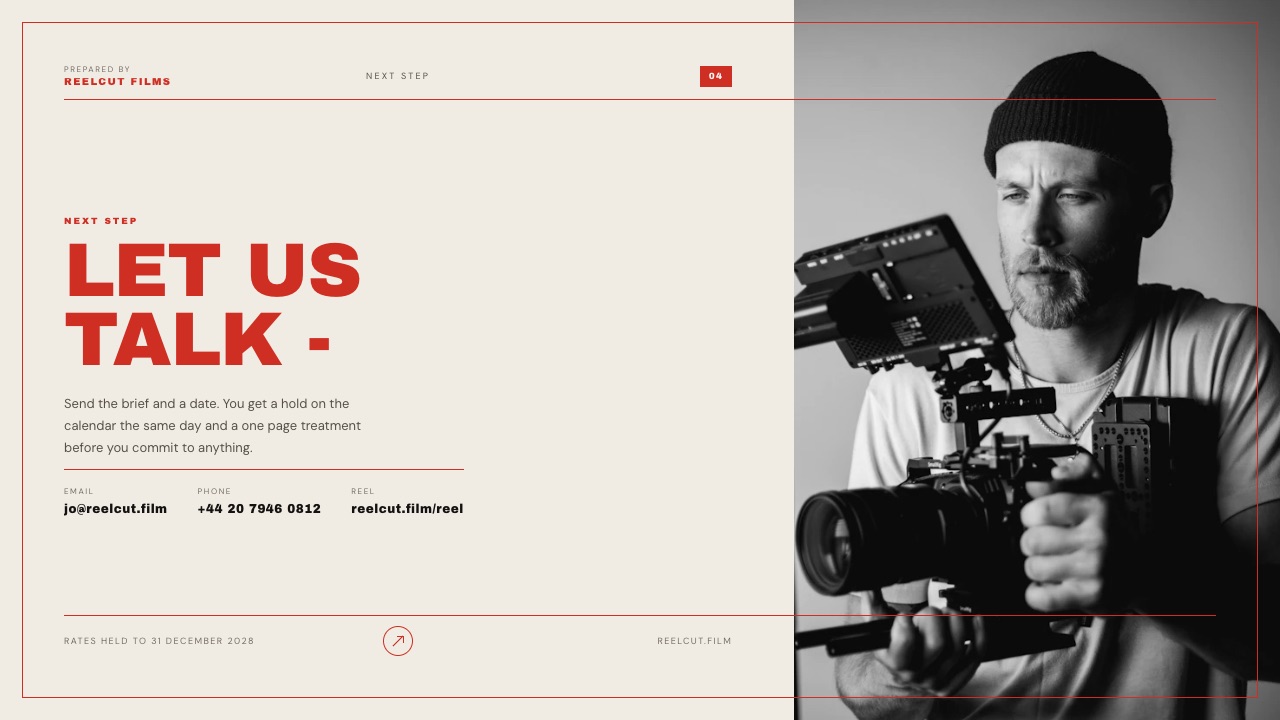
Price the work, then price the rights separately in your head so you know what you are giving away. The carried example quotes $900 for two pieces, which is $450 a piece, with 90 days of paid social usage included.
Those two numbers move independently: a brand asking for 6 months of paid usage and whitelisting on their own account is asking for a second thing entirely, and the honest move is to quote it on its own line with its own number instead of folding it into the $450 a piece.
| What the brand asks for | What it actually is | What it should do to the number |
|---|---|---|
| Organic post on your channel only | The baseline: your audience, once | The base rate |
| Paid social usage, 90 days | Their media budget amplifying your face | Built into the base here, priced separately if longer |
| Whitelisting on their account | Running ads as you, to audiences you do not control | Priced as a second buy on top of the $450 piece rate, with an end date |
| Category exclusivity | You cannot work with competitors for a period | Priced per month of the restriction, never given free |
| Usage beyond social: email, web, in store | A different media buy entirely | Quoted as a separate line, not folded in |
| Extra revision rounds or a scripted brief | Your time, and a loss of creative control | A flat add-on stated up front |
Two habits protect you here. Quote a total with the terms attached in the same sentence, so a brand cannot accept the number and then expand the rights.
And never open with a discount for the first project; if you want to make a first collaboration easy, reduce the scope, not the rate, because a rate you discount once is the rate you have. The UGC rate card guide goes deliverable by deliverable if you need a fuller structure than one pitch line.
The thing that goes wrongthe creator answers "what is your budget?" with "what did you have in mind?". The brand names a low number, and every future conversation with that company anchors there.
Step 7. Follow up on a calendar, not on a feeling
Follow-up decides the round, and the only version that works is scheduled in advance so that sending it never depends on how you feel about being ignored.
Four touches over 25 days, then stop. Each one adds something instead of repeating the last.
| Touch | Day | What it says | What it must not say |
|---|---|---|---|
| 1 | 0 | The pitch: their gap, your evidence, one priced ask | Anything about being excited to collaborate |
| 2 | 4 | One new thing: a frame from a similar piece, or a second angle on the idea | "Just bumping this to the top of your inbox" |
| 3 | 11 | A reason tied to their calendar: the launch date, the season, the competitor | Any hint of irritation, which reads instantly |
| 4 | 25 | The close-out: you are stepping back, here is the link, reply any time | A guilt line, or a final-chance framing you will not honour |
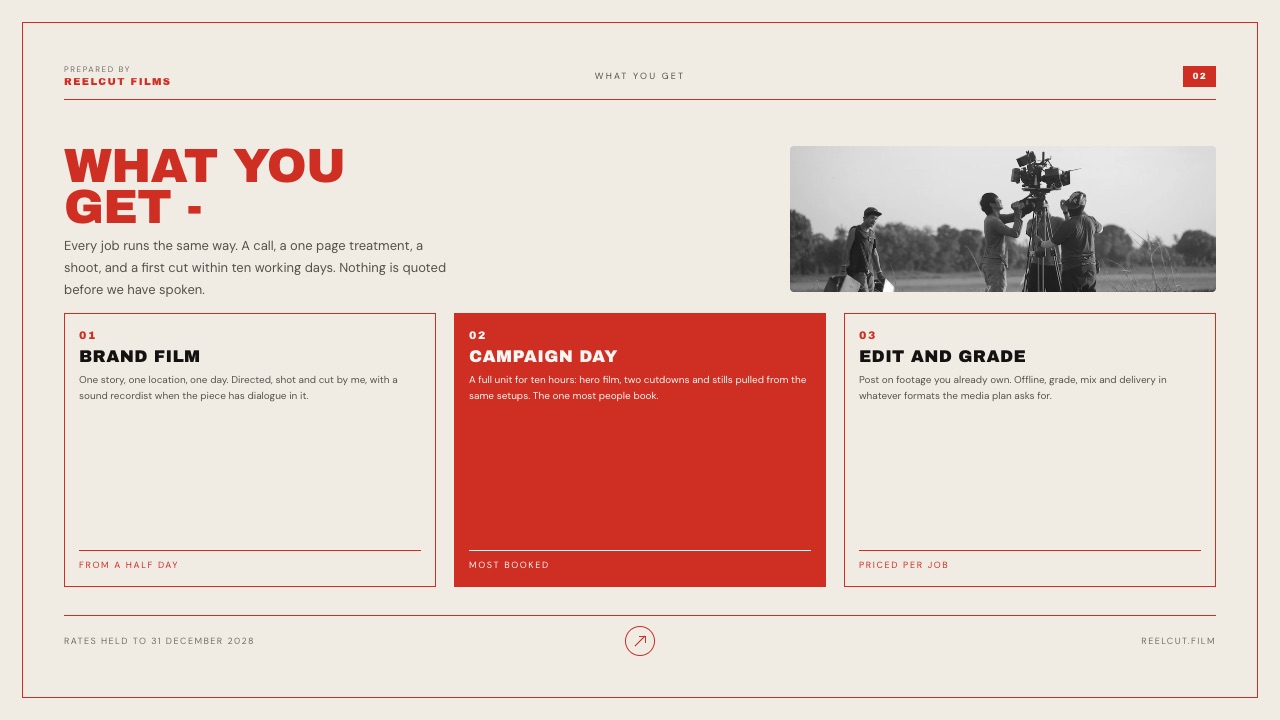
Keep every follow-up in the same thread so the original pitch is one scroll away, keep each one under 60 words, and change one variable per round so you learn something across 10 brands.
If touch two performs better when it carries a frame than when it carries an idea, that is worth knowing for the next round.
After touch four, stop entirely. The brand has your email and your link, and a fifth message converts nothing while making you memorable for the wrong reason. Put the brand back on the list with a date in the next quarter.
The thing that goes wrongthe follow-ups get sent in a batch on a Friday afternoon when the creator is feeling brave, all three within four days of each other, which reads as pressure, not persistence.
Step 8. Treat silence and a no as different outcomes
Silence and rejection carry different information, and the creators who build a real pipeline are the ones who file them differently instead of feeling the same way about both.
Silence means one of two things and neither of them is that the work was weak: the email did not reach the right person, or it landed in a bad week.
The fix is a better contact and a different quarter, not a better adjective.
Mark the brand for a requalify next quarter and move on the same day. A no with a reason is the most valuable reply you can get: no budget until Q2, we work through an agency, we do not do paid partnerships.
Write the reason in the spreadsheet and set the follow-up date the reason implies.
A no without a reason deserves exactly one short reply: thanks, and would it be useful if I came back when the spring range launches? That question costs the reader one word to answer and hands you a date, which is the only thing a no was missing.
The last piece is emotional and not tactical, and it is worth naming. 10 pitches producing one conversation is a working round, not a failure, and treating it as a failure is what makes creators stop after two.
Run rounds monthly, keep the spreadsheet, and judge the system on the quarter, not on any single reply.
The thing that goes wronga no gets archived and forgotten. Six months later the brand runs a creator campaign with someone else, and the creator who was closest to the deal never reappeared to be asked.
Which route into a brand should you take
Take these in order, because how you reach a brand should follow what you already have with them, not what feels most comfortable to send.
Do you already buy from them, or has someone there engaged with your work? Send the warm version and ask for 15 minutes instead of a yes, since the relationship will carry a conversation the cold version cannot.
Do they run an obvious creator programme with a stated contact? Use it, and then also email the named human you found, 4 days later, with a different first line. The programme inbox is a queue; the human is a person.
Are they too large to answer a creator directly? Find the agency in the branded-content credits and pitch the agency instead, with the same email structure and the brand named as the subject, not the recipient.
Have you pitched them twice with no reply at all? Stop emailing and get visible instead: make the content about their category anyway, tag nothing, and let the work be what they find. Then pitch a third time in the next quarter with that work as the evidence.
Do you have no evidence of any kind yet? Make one piece before you pitch anyone.
A pitch round without evidence is a round you are spending to learn nothing, and how to get clients from your website is a better use of the same week.
Frequently Asked Questions
How do you pitch a brand as a small creator?
Pitch one named person with a 120-word email that opens on a specific gap in their marketing, gives one piece of evidence with a number and a window, and asks for one named piece of work at a stated price.
Link a four to six slide deck instead of attaching a file. Small audiences win these on concentration and behaviour: a reach ratio and a link-tap rate say more about a purchase than a follower count does.
What should a brand pitch email actually say?
A brand pitch email should say, in order: what you noticed about their marketing, what you make and the number that proves it works, exactly what you propose to make for them, the price and the usage terms, one link, and an easy alternative to no.
Leave out your origin story, your platform list and any sentence containing "passionate". The first clause has to be about them, because that is the clause that decides whether the rest gets read.
How long should a creator pitch email be?
About 120 words, which is roughly what a phone screen shows before the reader scrolls. Every additional paragraph reduces the chance the price and the ask are seen at all.
If you cannot fit the idea into 120 words, the idea is not specific enough yet, and adding words will not fix that. Follow-ups should be shorter still, under 60 words each, with one new thing in them.
Should I include my rates in the first email?
Yes, include a price for the specific work you are proposing, with the usage terms in the same sentence.
A stated number lets a busy marketer reply with one word, filters out brands whose budget was never going to reach you, and stops the conversation where a creator names a number only after four emails of discovery.
Quote a total for a defined scope, not a rate card, and keep the full card for the deck.
How many times should I follow up with a brand?
Three follow-ups after the original email, on day 4, day 11 and day 25, then stop. Each adds one new thing instead of restating the last, and all of them stay in the same thread.
After the fourth touch the brand has everything it needs, and a fifth message converts nothing while making you memorable in the wrong way. Put the brand back on the list with a requalify date next quarter.
Is it better to DM a brand or email them?
Email, almost always. Direct messages on social platforms are triaged by community managers whose job is customer support, so a pitch there rarely reaches the person with a budget.
A DM is useful for one thing only, which is asking who handles creator partnerships so you can email them. The exception is a founder-run brand under 30 people, where the person reading the account is the decision maker.
What should I attach to a brand pitch?
Nothing, in the first email.
Attachments have to earn a download before they have proved anything, and heavy files travel badly through corporate mail: Gmail's 25MB limit converts anything larger into a Drive link, which can reach the brand as a permissions request from a stranger.
Send one link to a short deck instead, and keep the PDF for the moment they ask for something to forward internally.
How much should I charge for a first brand collaboration?
Price the production and the rights separately, then quote one total with the terms attached.
The worked example in this guide is $900 for two pieces, which is $450 a piece, including 90 days of paid social usage, with whitelisting, exclusivity and non-social usage quoted on top.
Do not discount the rate to win a first project; reduce the scope instead, because a discounted rate becomes your rate with that brand permanently.
How many brands should I pitch at once?
10 per round.
Three is too few to learn anything from, and 50 means the research that makes each email specific stops happening. 10 brands across four touches is at most 40 emails over about a month, which is a workload a creator can sustain alongside making content.
Run a round monthly, change one variable per round, and judge the results by the quarter and not by any single reply.
What should I do when a brand says no?
Ask one question: would it be useful if you came back when a named thing happens, such as a spring launch or a new budget year.
A no with a reason is the most useful reply in the whole process, because the reason contains the date of your next attempt.
Record it in your spreadsheet, set that date, and move on the same day instead of rewriting the pitch in your head for a week.
Final Verdict
Pitching a brand as a creator is a system with four moving parts: a list of 10 qualified brands, one named human per brand, a 120-word email carrying a specific observation and one evidenced number, and a four-touch follow-up calendar you set before you feel anything about the silence.
The deck matters, and it matters after all of that.
For the deck itself, Framekit Slides is the pick here.
Unlimited decks on every plan including Free means you can keep a version per brand, the AI slide writer drafts a slide from one sentence of instruction, speaker notes hold the numbers behind each claim for the call, and PDF export plus a share link are on every plan so the same deck works as a link now and an attachment later.
Where Framekit losesit does not send email, it has no CRM, no sequences, no open tracking, no contracts and no invoicing, so most of this procedure happens in other tools and Framekit is only the deck.
It also puts no password on a deck link and reports a total view count, never per-viewer analytics, so it is not for the creator whose follow-up timing depends on knowing which brand opened which slide.
That reader should pay for Pitch on its Team tier, Storydoc or DocSend. When a brand says yes, you will need a separate contract and invoicing tool as well, because Framekit does not touch that side at all.
Related readingthe sponsorship deck template, UGC rate cards, UGC portfolio examples, the best media kit makers and how to share a presentation online.
The attachment itself is built in how to make a media kit, and when a brand says yes, how to write a project proposal as a freelancer turns the conversation into a scope fence.