Framekit templates
Start from a designer-made template
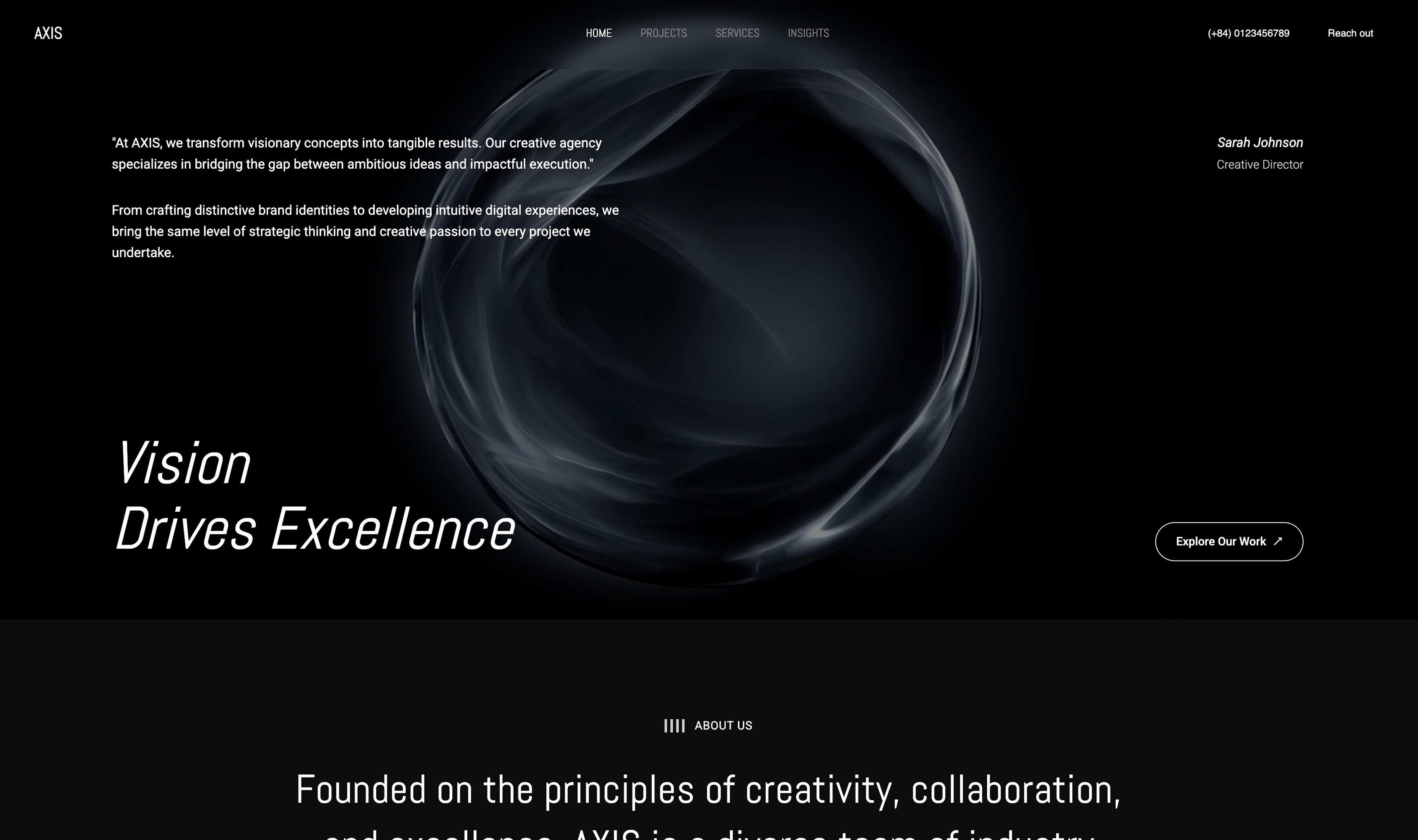 Use template
 Use template
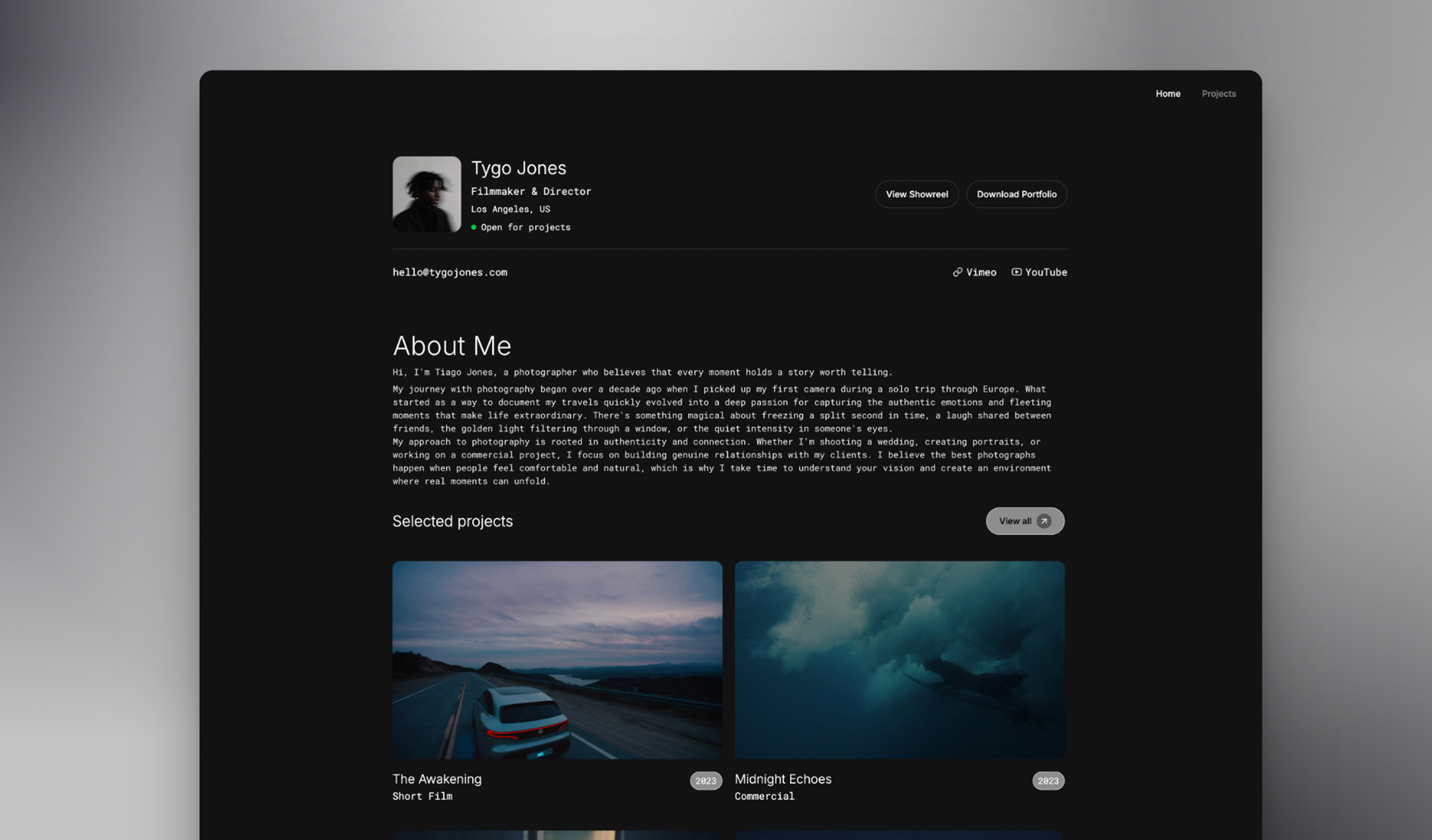 Use template
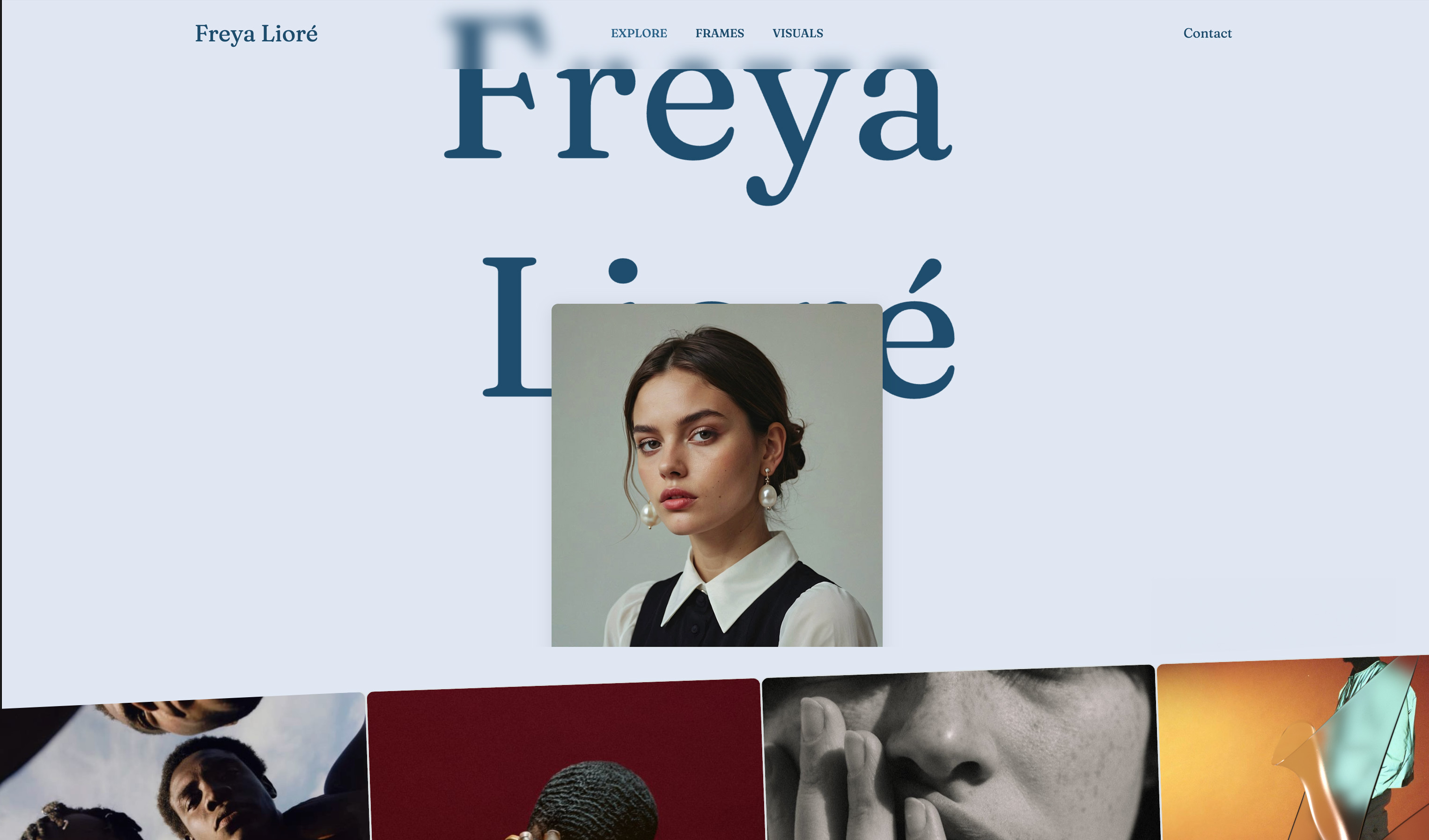 Use template
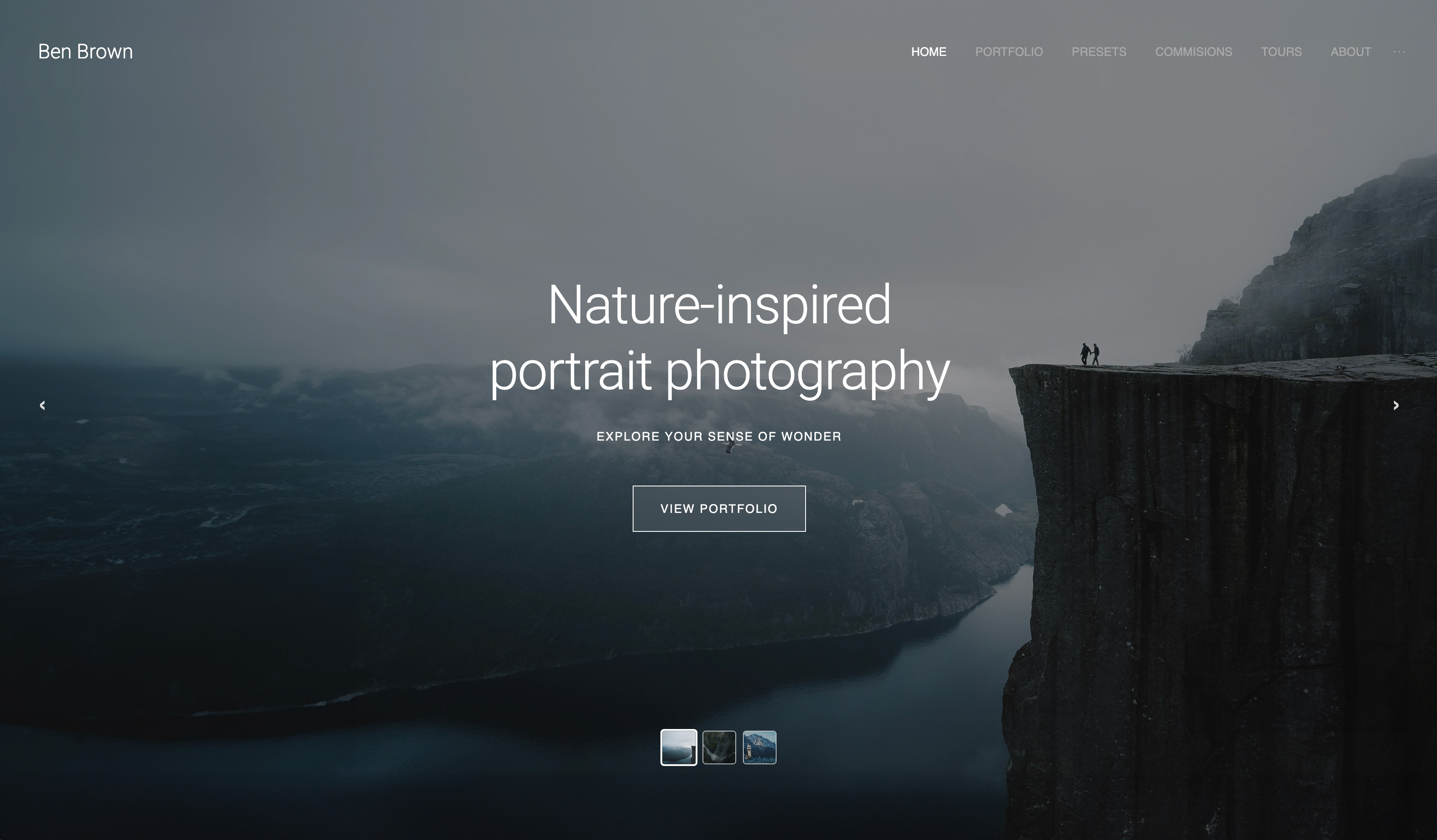 Use template
 Use template
 Use template
 Use template
Kara quotes a coffee roaster $4,200 for a brand identity and a one-page site. She wins it.
Eleven weeks later she has drawn three extra logo directions, rebuilt the menu section a second time, exported the mark in six file formats nobody asked for at the start, and eaten fourteen unbilled hours.
At her working rate of $75 an hour that is $1,050, or a quarter of the fee, spent on work that was never in the document.
None of it was the client being difficult. The client was reading a document that did not say no anywhere. If you want to know how to write a project proposal as a freelancer and stop that from happening, the fix is not better persuasion, it is a tighter fence.
A freelance project proposal is a short document of nine sections and two to six pages that states the outcome a client is buying, exactly what is and is not included, what it costs, when it happens, and what has to be true for the price to hold.
Write the proposal as a scope fence in nine sections: the client's problem in their words, the outcome, the deliverables with counts, the exclusions, the price, the schedule, what you need from the client, the terms, and the next step.
The exclusions section is the one that saves money, because every deliverable line with a number on it (three logo directions, two revision rounds, one page) is also a refusal you can point at without an argument.
Build it as a deck or a link in Framekit Slides, which gives you unlimited decks, PDF export and a share link on every plan including Free; use Docusign or Bonsai for the signature and Wave or Stripe Invoicing for the deposit, because Framekit does not do e-signatures, contracts or invoices at all.
Full disclosure: Framekit is our product, so read the claims about it with that in mind and check them against the pricing page. Every competitor figure here was read on the vendor's own published pricing page in September 2026 and is linked so you can check it. Framekit loses this job in two places that matter and both are named in full below: it has no e-signature and no invoicing, and its share links carry no password and no per-viewer analytics.
How this guide was put together, and what it deliberately does not claim
Everything below falls into one of three buckets, and the difference matters because a proposal is a document you may have to defend in a phone call where the client has it open in front of them.
Read at the source. Prices and plan limits for Docusign, Bonsai, Wave and Stripe Invoicing come from each vendor's own published pricing page, read in September 2026 and linked inline. Where a page refused to serve a figure, the figure is left out, not guessed.
Calculated. The scope-creep arithmetic, the deposit maths and the three pricing presentations are worked in full with one carried example, so you can drop your own rate in and rerun them.
The example is Kara's $4,200 identity-and-site project at a $75 hourly working rate, which is 56 billable hours.
Not claimed. There is no trustworthy published benchmark for freelance proposal win rates, average revision counts or typical deposit percentages, so this guide does not quote one.
Where you would expect a market average, you get arithmetic you can run on your own last five projects instead.
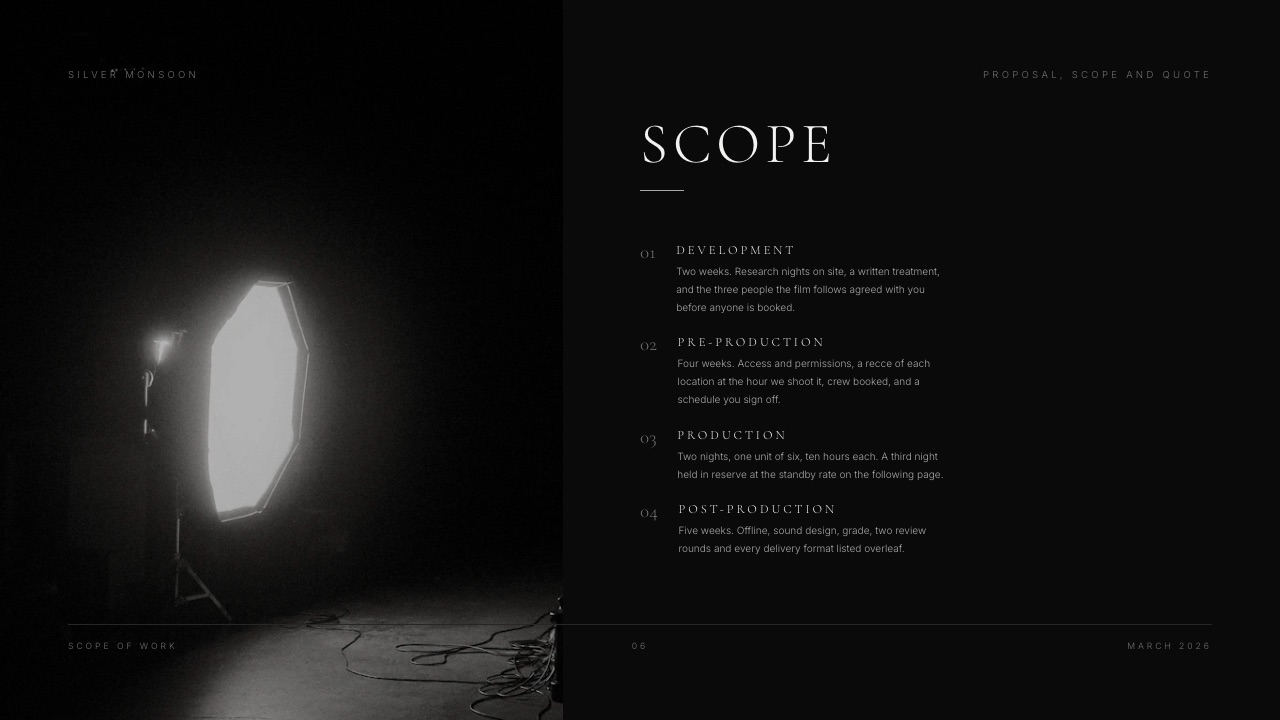
The proposal by the numbers
These six figures set the shape of the document, and each one replaces a decision you would otherwise make badly at eleven at night with a client waiting for a reply.
- 9 sections, in a fixed order, is the whole document. Anything that does not fit one of them is a brochure page and belongs on your website.
- 2 to 6 pages is the working length. A client decides in the first page and checks the rest.
- 14 hours is what Kara's missing exclusions cost her: $1,050 against a $4,200 fee, or 25% of the project.
- $11 a month is Docusign's Personal plan, capped at five envelopes a month, which is the cheapest name-brand way to get a legally recognised signature.
- 0.4% per paid invoice is what Stripe Invoicing charges on its Starter tier, on top of card processing, if you want the deposit request to live next to the payment.
- Unlimited decks on every Framekit plan including Free, with a share link and PDF export on all of them, which is why the proposal itself costs nothing to produce.
In one linea proposal earns its keep in the sections nobody enjoys writing, because the price section wins the project while the exclusions and terms sections decide whether the project is still profitable in week eleven.
Step 1. Open with the decision the client is making, not with you
The first paragraph of most freelance proposals is a biography, and the client already decided you could do the work or they would not have asked for a document. What they have not decided is whether you understood the problem well enough to be trusted with it unsupervised.
So open by restating their situation in their own words, ideally the words from the call.
If the roaster said "our bags look like everyone else's on the shelf and our website looks like a template", write that down, attribute it to the conversation, and then write the one-sentence outcome underneath it.
What goes wrongwriting the problem in your vocabulary instead of theirs. "Brand architecture misalignment" is your word. "Our bags look like everyone else's" is theirs, and it is the sentence that makes them feel read.
The concrete versionKara's page one is four lines. The quoted problem. The outcome ("a shelf-ready identity and a single page that sells beans online by 20 November"). The price, $4,200. The date it stops being $4,200, 6 October 2026. Nothing else.
Step 2. Lay out the nine sections before you write a single sentence
A proposal goes wrong in the outline, not the prose, and the fastest way to write a good one is to put the nine headings on the page first and then fill them, because every heading you skip is a question the client answers for themselves in your absence.
Each section closes exactly one open question. If a section is not closing a question, cut it.
| # | Section | The question it closes | Length |
|---|---|---|---|
| 1 | The situation | Do you actually understand what we asked for? | 3 to 5 lines |
| 2 | The outcome | What will be different when this is finished? | 1 sentence |
| 3 | Deliverables | What exactly do we receive, and how many of each? | A counted list |
| 4 | Not included | What will you charge extra for later? | A counted list |
| 5 | Price | What does it cost, in one number we can approve? | Half a page |
| 6 | Schedule | When does it start and when does it land? | 3 to 6 dates |
| 7 | What we need from you | Why might this slip, and whose fault will that be? | A short list |
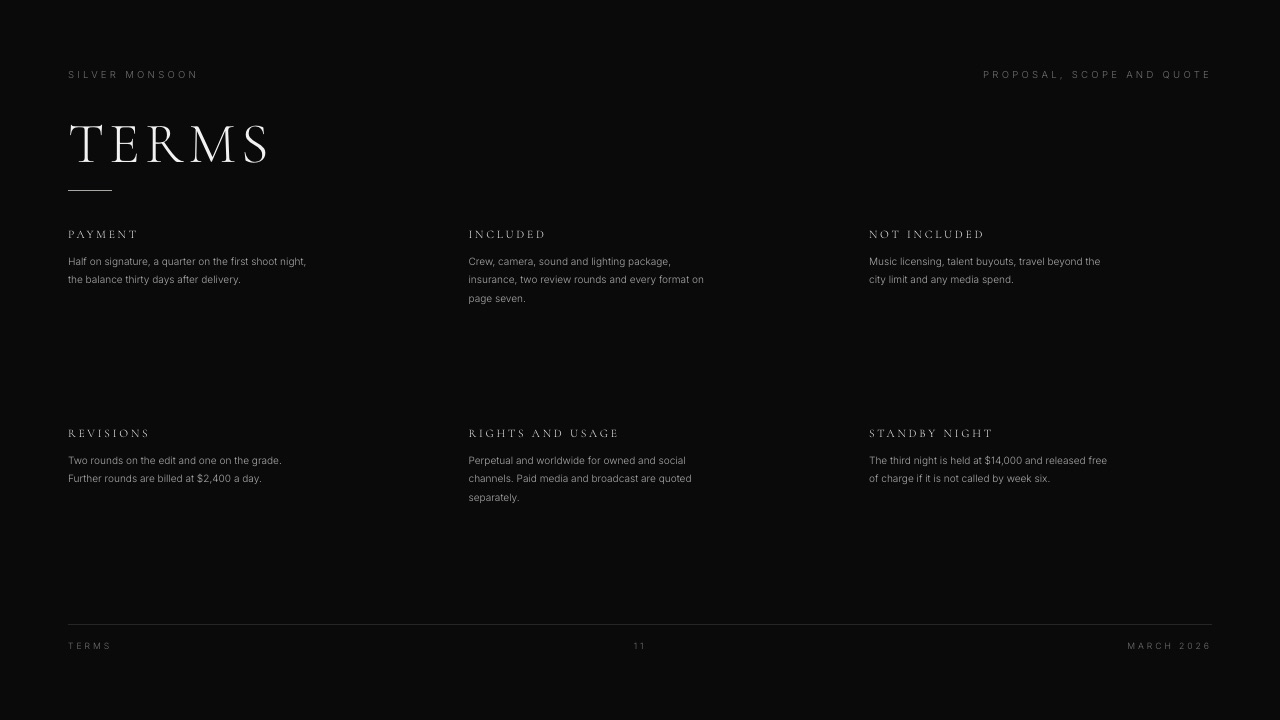
| 8 | Terms | Deposit, rounds, cancellation, ownership, validity | Half a page |
| 9 | Next step | What do we click, sign or pay to start? | 2 lines |
Section 7 is the cheapest section to write and the most expensive to leave out. It is where you write "final logo copy and product photography supplied by 3 November" so that a two-week delay on their side does not silently become a two-week delay on your delivery date.
What goes wrongtreating the proposal as a portfolio. Case studies, testimonials and your process diagram belong on your site, and if the client needs convincing at proposal stage the deal was not qualified.
If you want the persuasion document instead, that is a different artifact and the pitch deck guide covers it.
Step 3. Write deliverables as counted nouns, never as verbs
Deliverables written as verbs ("design the brand", "build the site") have no edge, and a document with no edge cannot be pointed at. Deliverables written as counted nouns have an edge on every line, and the number is the fence post.
Compare the two versions of the same scope.
| Vague line | Fenced line |
|---|---|
| Logo design | 3 initial logo directions, 1 taken to final, 2 revision rounds on the chosen direction |
| Brand colours and type | 1 palette of 5 colours, 2 typefaces with licences named, 1 two-page usage sheet |
| Website | 1 page, 6 sections, desktop and mobile, built on your existing domain |
| Files | Logo in SVG, PNG and PDF, light and dark, 1 packaged folder |
| Support | 14 days of email support after launch, up to 5 small fixes |
Every number in the right column is a sentence you never have to say out loud. When the roaster asks for a fourth direction, the answer is not "that feels like extra", it is "the proposal covers three, a fourth is $450, shall I add it".
What goes wrongcounting the deliverable but not the rounds. "1 logo" with unlimited revisions is not a fenced scope, it is an open bar. Count the artifact and count the rounds, separately, on the same line.
The concrete versionKara's fourteen lost hours were three unbudgeted logo directions, a second menu rebuild and a six-format export nobody priced. Written as counted nouns, those are five explicit change requests at a stated rate, which is $1,050 billed instead of $1,050 absorbed.
Step 4. Write the exclusions out loud, in the client's language
The exclusions section feels rude to write and it is the single most valuable half-page in the document, because a scope fence made only of inclusions has an infinite number of gates in it that nobody has agreed are closed.
Write five to ten lines. Use the client's nouns, not your process language. Aim at the things this specific client is likeliest to assume are free.
- Copywriting for the site (you supply the words, or add $600).
- Product photography and retouching.
- Printing, print-ready artwork and press checks for the bags.
- Packaging dielines and any work with your printer.
- Social media templates and launch assets.
- Trademark searching or registration.
- Ongoing maintenance after the 14-day support window.
- Any second page, second product or second language.
Then add one line under the list that makes the exclusions usable instead of hostile: "Anything on this list can be added at any point, quoted separately before work starts."
What goes wrongwriting exclusions as a legal shield instead of a menu. The list should read like options with prices attached, which is how it turns into extra revenue instead of a fight.
For the wider version of this problem, the creative brief guide covers how to pin down the inputs before you even quote.
In one linethe exclusions list is not a defensive document, it is a price list for everything the client will ask for in week six, and it is the difference between a fourth logo direction at $450 and a fourth logo direction at nothing.
Step 5. Pick one of three ways to present the price, and commit to it
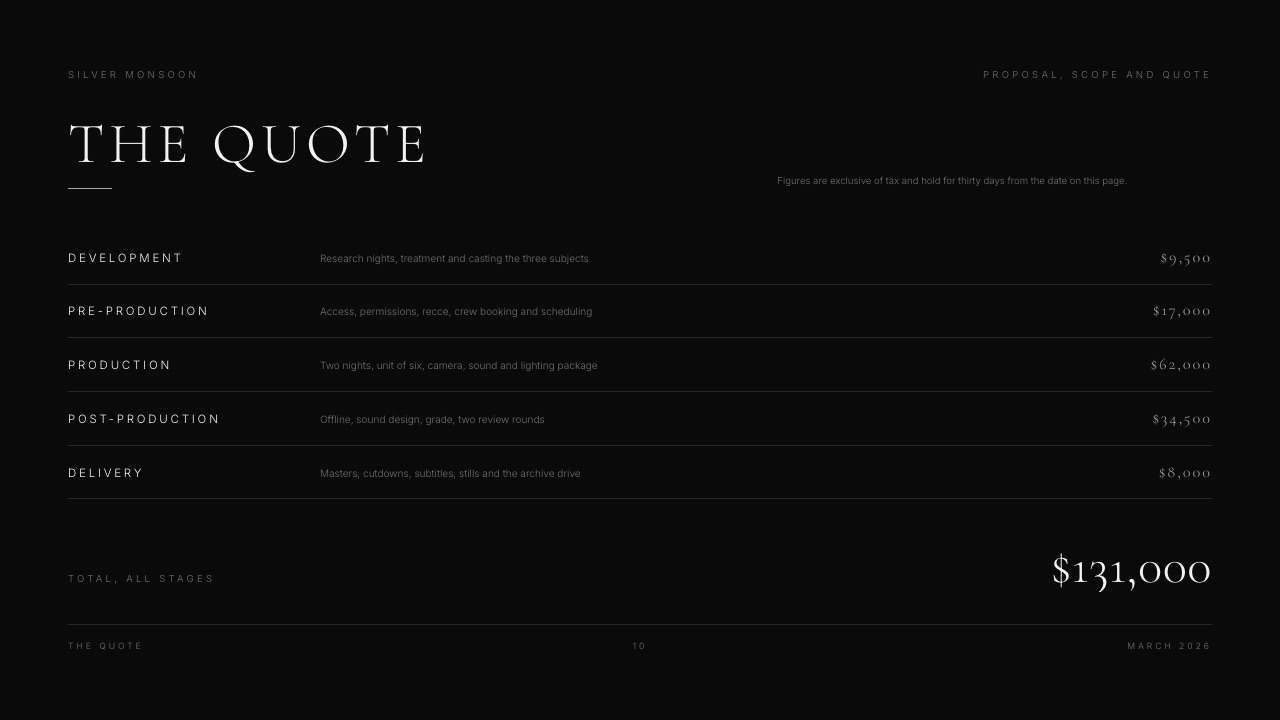
Most freelancers present price the way they happened to learn it, which means they use a day rate on a project that needed a fixed fee, or a fixed fee on a project whose shape nobody knows yet.
The presentation is a real decision and it changes who carries the risk of the unknown.
There are three presentations that work, and they are not interchangeable.
| Presentation | What it looks like | What it protects | What it exposes | Use it when |
|---|---|---|---|---|
| Fixed fee | One number for the whole scope, paid in two or three instalments | The client's budget, and your ability to work faster than you estimated | You, if the scope is vague or the client is undecided | Scope is countable and you have done this shape of project before |
| Tiered | Three named packages, the middle one the one you want sold | Your margin, because the client chooses between yeses | Nothing much, but it takes longer to write | The client is choosing how much to buy, not whether to buy |
| Day rate | A rate per day plus an estimated number of days | You, completely | The client, who cannot approve an open number internally | Discovery, retainers, or work whose end you genuinely cannot see |
For Kara's project the fixed fee is right, because three logo directions and one page are countable.
Her $4,200 breaks into 56 hours at her $75 working rate, and she never shows that breakdown to the client, because an hourly breakdown invites a negotiation about hours instead of about the outcome.
The tiered version, if she wanted oneEssentials at $2,900 for one logo direction and a single page; Standard at $4,200 for three directions, the usage sheet and 14 days of support; Extended at $6,400 adding packaging artwork and the launch social set.
The middle one is the one she wants sold, and the top tier exists mostly to make it look reasonable.
What goes wrongquoting a day rate and an estimated day count and then treating the estimate as a cap. If you say "roughly 8 days at $600", the client has heard $4,800 and will be surprised at $6,000.
Either write the cap in ("billed by the day, not to exceed 10 days without written approval") or use a fixed fee.
If you are still setting the number and not yet presenting it, the rate-setting question is a different one and the blog answers it per discipline in what to charge for graphic design and what to charge for video editing.
Step 6. Date the schedule, and put the client's homework in it
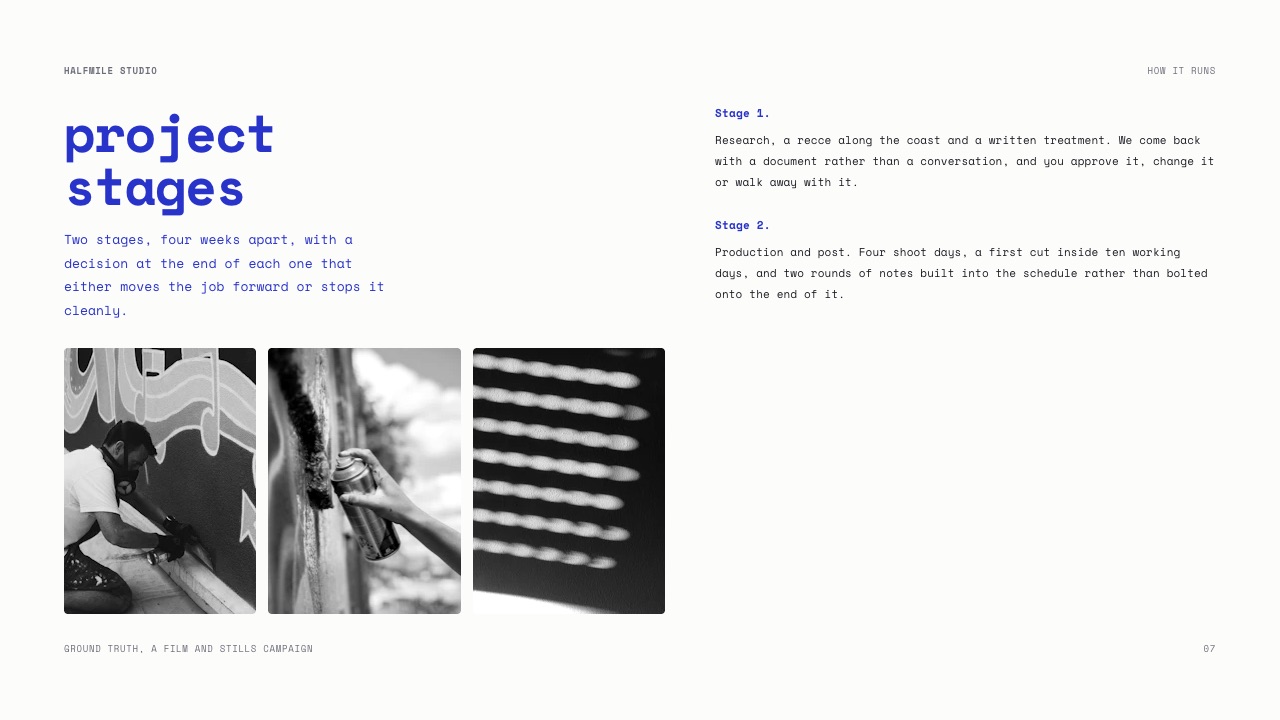
A schedule made of durations ("four weeks for identity, two weeks for the site") slips silently, because nothing in it can be late. A schedule made of dates is a document both sides can be held to, which is uncomfortable exactly where it should be.
Write five or six dated rows, and put the client's obligations in the same table as yours. This is the single change that converts "you are behind" into "we are both behind, and here is why".
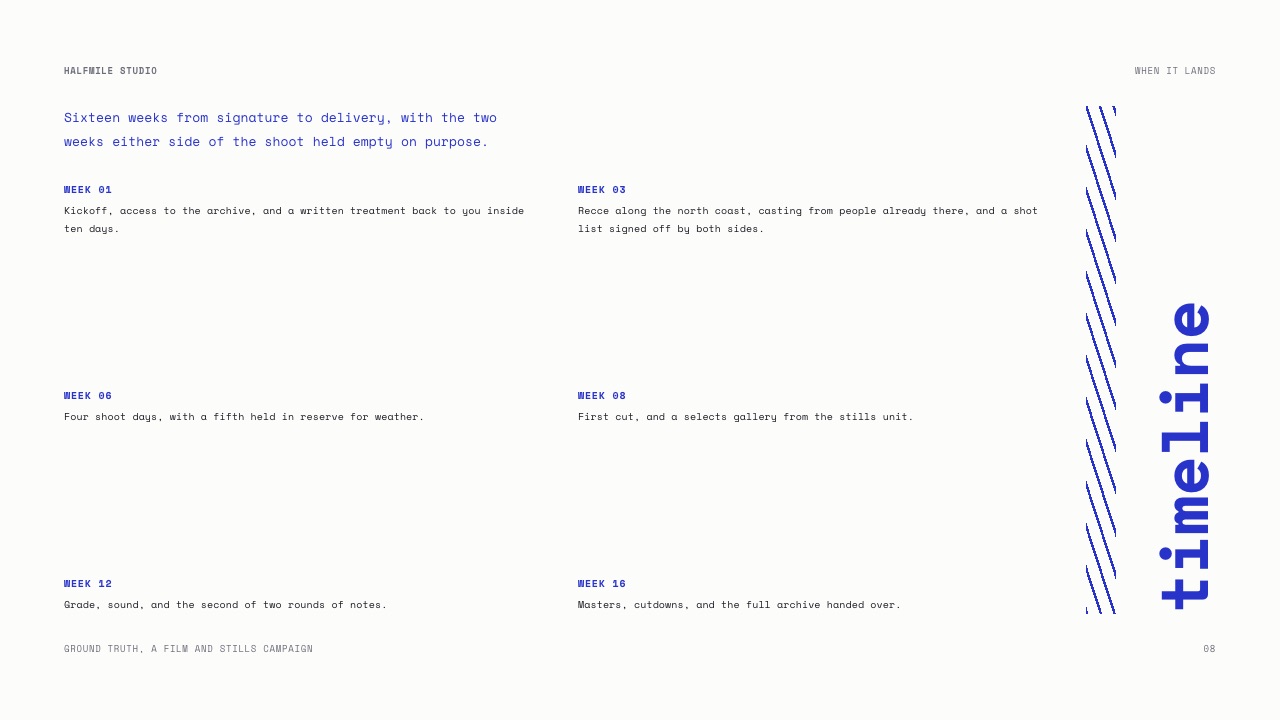
| Date | Who | What |
|---|---|---|
| 27 October | Kara | Kickoff call, moodboard and direction brief sent |
| 3 November | Client | Existing bag artwork, product photography and final copy supplied |
| 10 November | Kara | Three logo directions presented |
| 13 November | Client | One direction chosen, round one notes consolidated in one reply |
| 20 November | Kara | Final identity, usage sheet and the live one-page site |
| 4 December | Both | Support window closes |
Add one sentence under it: "Dates shift day for day if inputs on the client rows arrive late." That sentence is worth more than any amount of project-management software, and it costs nothing.
What goes wrongcollecting feedback in a thread instead of at a date. Eight replies over five days is not a revision round, it is five revision rounds. Write "notes consolidated in one reply" into the client's row so the format is agreed before anyone is annoyed.
Step 7. Write terms that a freelancer can actually enforce
Terms written by a lawyer protect you in court, which you will never see, and terms written by you protect you in a Tuesday afternoon email, which you will see constantly. Write the second kind, in plain sentences, and keep them to half a page.
Six lines cover nearly everything that goes wrong on a small creative project.
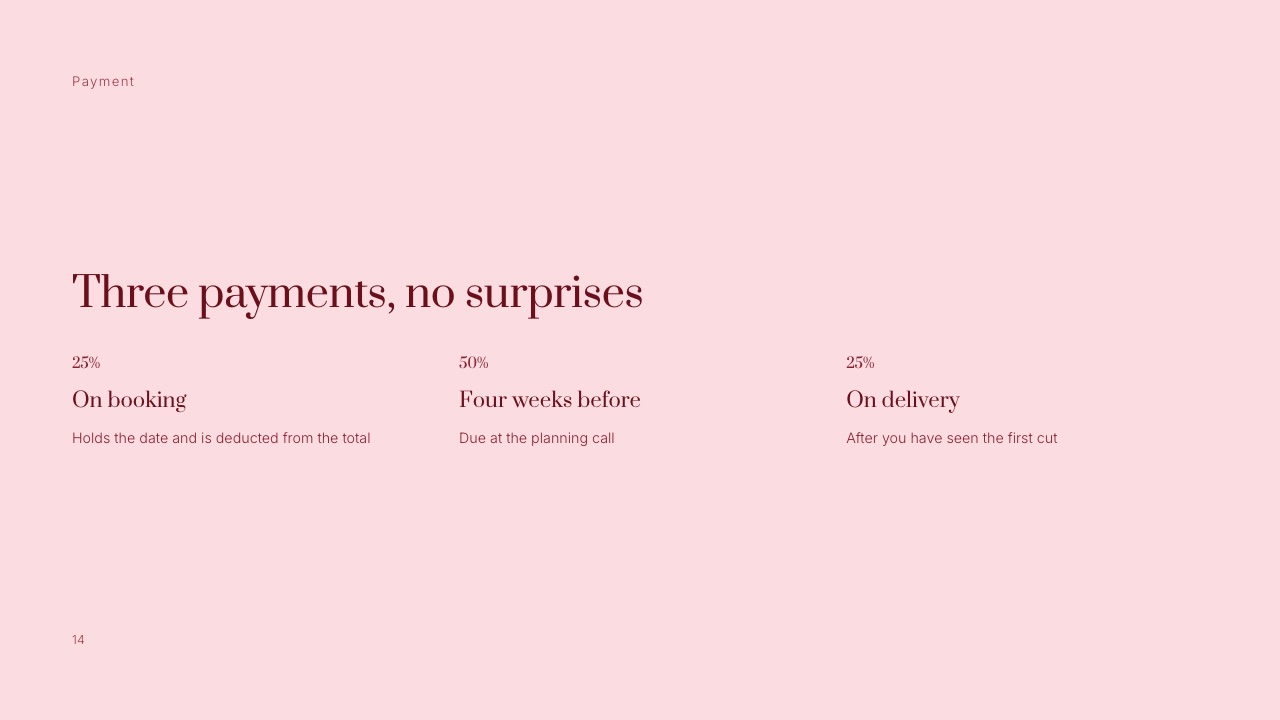
- Deposit. "40% to book the dates, balance on delivery." Say what the deposit buys, which is the slot in your calendar, not the work.
- Revision rounds. "Two rounds on the chosen direction. Further rounds at $95 an hour, quoted before starting."
- Cancellation. "If the project stops after kickoff, the deposit is retained and any completed stage is billed."
- Ownership. "Full rights transfer on final payment." Not before. This one line has recovered more unpaid balances than any polite reminder.
- Late payment. "Invoices due on receipt, work pauses at 14 days overdue."
- Validity. "This proposal and its pricing are valid until 6 October 2026."
The validity date is the most under-used line in freelance proposals. Without it, a client can accept your March price in November, when your rate has moved and your calendar is full, and you look unreasonable declining your own document.
What goes wrongburying the deposit in the terms and never naming the number in the price section. The client approves a total, then discovers a payment schedule. Put "40% ($1,680) to book, $2,520 on delivery" directly under the price.
Step 8. Get it signed and invoiced somewhere that is not Framekit
This is the step where the recommendation in this guide stops being us, and being straight about it is more useful than pretending otherwise: Framekit has no e-signature, no contract templates, no invoicing and no CRM, and none of those are on this page as a coming-soon.
You need a second tool for the signature and a third, or the same one, for the money.
An electronic signature is legally recognised in the United States under the ESIGN Act of 2000, which says a record "may not be denied legal effect, validity, or enforceability solely because it is in electronic form", and in the European Union under Regulation 910/2014, known as eIDAS.
A typed name in an email reply is weaker evidence than an audit trail, and audit trails are what these tools sell.
| Tool | Price read in September 2026 | Signature | Invoice | What it does not do |
|---|---|---|---|---|
| Docusign | Personal $11/month, 5 envelopes a month; Standard $30/user/month | Yes, with audit trail | No | No invoicing, no proposals, and the envelope cap bites at six deals a month |
| Bonsai | Essentials $19/user/month billed annually, $25 monthly | Yes, in contracts | Yes | Basic at $9 excludes both contracts and invoicing, so the cheap tier is the wrong tier |
| Wave | Free Starter tier, single user; Pro $19/month | No | Yes, unlimited invoices and estimates | No e-signature, no proposal design |
| Stripe Invoicing | 0.4% per paid invoice on Starter, 0.5% on Plus | No | Yes, hosted and paid in one link | No contracts, no signature, and card processing is charged on top |
Which I would useWave for the invoice and Docusign Personal for the signature, which is $11 a month all in at five deals a month.
Above five agreements a month, Bonsai Essentials at $19 a month billed annually collapses both jobs into one subscription and undercuts Docusign Standard at $30 a user.
If you already take card payments, Stripe Invoicing at 0.4% of a paid invoice moves the deposit the same day the proposal is accepted.
The blog ranks these categories properly elsewhere, so this guide does not repeat the comparison: see contract and proposal tools for creatives and invoicing tools for freelance creatives.
In one linethe proposal, the signature and the invoice are three different jobs with three different failure modes, and trying to buy all three from one subscription is how a freelancer ends up on Bonsai's $25 monthly tier for two signatures a quarter when Docusign Personal would have cost $11.
Step 9. Send it as a link, then run the follow-up on a schedule
How you send the proposal changes what happens to it, and the honest hierarchy is that a link gets read on a phone, a PDF gets forwarded to a partner, and a Google Doc gets commented on by four people who were not on the call.
| Format | Best at | Weak at |
|---|---|---|
| Share link | Reading on a phone, updating after a call without resending | Clients who forward the link to a procurement inbox that blocks unknown domains |
| PDF export | Forwarding, printing, attaching to an approval email inside a company | Any change after sending, which means a second file and a version argument |
| Editable doc | Collaborative scoping with a client who wants to redline | Looking finished, and keeping the price out of a comment thread |
Framekit Slides gives you both from the same deck: a share link you can update after the call, and a PDF export on every plan including Free, with your own fonts and colours once you are on a paid plan.
Framekit is an AI website builder whose Slides tool lets a freelancer build the proposal, export the PDF and link it from the same site the client already visited, on one account and one bill.
Here is the honest limitation, and it is a real one for proposals specifically: a Framekit deck share link has no password and reports a total view count without telling you which recipient opened it and for how long.
If knowing that the finance director opened page five twice is part of how you sell, DocSend, Pitch and Storydoc all do per-viewer tracking and Framekit does not.
The follow-up, written down so you do not have to feel anything about it: day three, a two-line email asking whether anything in the scope needs adjusting before they take it internally.
Day eight, a note that the validity date is approaching and an offer to extend it. Day fifteen, a close-the-loop message that asks them to tell you it is dead so you can release the dates. Three touches, then stop.
What goes wrongsending the proposal without a stated next step. The final section should say one thing: "Reply yes and I will send the agreement and the deposit invoice the same day." Vague endings produce vague weeks.
What an unfenced scope actually costs, in your own numbers
Scope creep gets discussed as an annoyance, which is why nobody fixes it, and it gets much easier to fix once the number is written down in your own currency instead of in adjectives.
Run this on your last five finished projects. For each one, write the fee, then write your honest guess at the hours you worked beyond what you quoted, then multiply those hours by the rate you would have charged for them.
Kara's version: $4,200 fee, 14 hours over, $75 an hour, so $1,050 lost, which is 25% of the project. Her effective rate on that job was not $75, it was $4,200 divided by 70 hours, or $60.
If four of her twelve projects this year go the same way, the difference is $4,200 of work done for nothing, which is a whole extra project she could have sold instead.
The exclusions list takes about forty minutes to write properly.
If it converts even a third of those fourteen hours into billed change requests, that is $350 for forty minutes, and it repeats on every project because the list is largely reusable between clients in the same discipline.
In one linescope creep is not a personality problem in your clients, it is an unpriced option you handed them for free, and the forty minutes spent writing the exclusions list is the cheapest hourly rate you will ever earn.
Where the proposal stops and the contract starts
Freelancers routinely collapse the proposal and the contract into one document, which works fine until something goes wrong, and then the problem is that a persuasive document and an enforceable one are written for different readers.
The clean split is this. The proposal is the commercial offer: scope, exclusions, price, schedule, terms summary, validity.
The contract is the legal instrument: the same commercial terms plus intellectual property, liability, confidentiality, governing law and termination.
In practice a short freelance agreement can reference the proposal as an annex, which is the least painful arrangement, because it means you write the scope once.
What you should not do is send a proposal, get a "looks good" by email, and start work. "Looks good" is not an acceptance of terms, and if the project dies at week three you will be arguing about whether the deposit clause was ever agreed.
The practical version for a solo creative is four steps and two tools beyond the one you wrote the proposal in: proposal as a link or PDF, agreement as a short document that references it, signature through a tool with an audit trail, deposit invoice sent the same hour the signature lands.
In one linethe proposal persuades and the contract enforces, and the reason to keep them as separate artifacts is that you will rewrite the persuasive half for every client while the enforceable half stays almost identical for years.
What changes when the proposal is for a video or photo project
Disciplines are not interchangeable here, and a proposal for a shoot has two sections a design proposal does not, which is why generic proposal advice reads as slightly wrong to anyone who has ever had a weather day.
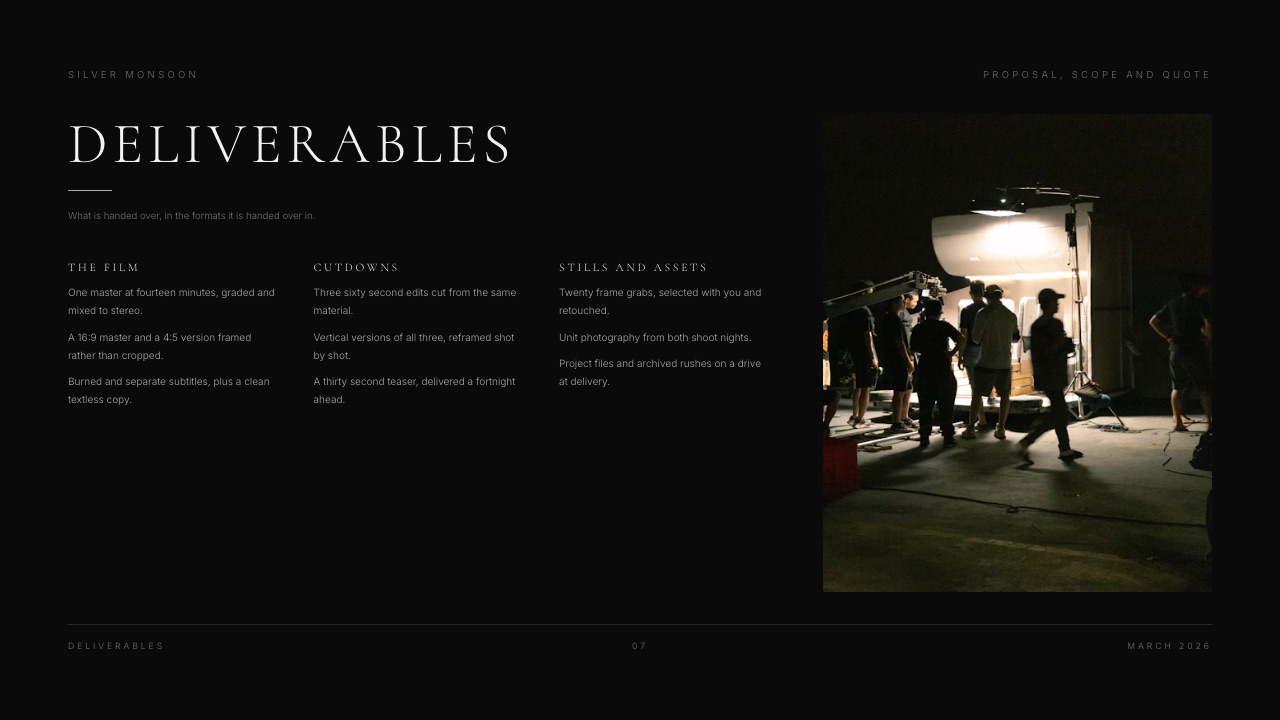
A production proposal has to price the crew and the day, not just the output. Shoot days, crew roles, kit, travel, and a weather or reshoot policy all belong in the deliverables and terms, never in an assumption.
It also has to say what happens to the raw material: whether the client receives rushes, how long you store them, and what archive retrieval costs after that window.
The second difference is how quickly the scope multiplies, because one extra deliverable on a video project is a vertical cut, a fifteen-second version, subtitles in two languages and a separate set of stills, which is a day of work hiding behind the word "also".
The blog has the production-specific version of this document with the sections laid out, so this guide does not restate it: the video production proposal template covers the shoot-day structure, and the videographer rate card template covers the pricing sheet that sits behind it.
In one linea production proposal is a project proposal plus a day plan, and the two sections that make it different, the shoot-day breakdown and the raw-footage policy, are exactly the two nobody remembers to write until the first time they cost real money.
Which tool should build the proposal itself
The document has to be designed well enough that a client believes the price, and cheap enough that you can write one for a job you might not win, which is a narrower gap than it sounds.
If you are a designer, photographer or filmmaker and the work has to be seen to be sold, build it as a deck.
Framekit Slides is free to use for this, with unlimited decks, an AI slide writer, speaker notes, a share link and PDF export on every plan including Free; the full template library, your own uploaded fonts and removing the Framekit byline start on Starter at $9 a month, or $7 billed yearly.
PowerPoint export is Pro and up and exports each slide as a picture, not editable text, with a ceiling of 60 slides, which settles the question if a client's procurement team wants to edit your file.
If the proposal is mostly text and numbers, a plain document is genuinely better.
If it has to be signed inside the same tool, use a proposal platform instead of a deck tool, and the blog ranks those in client proposal software.
Verdict: build image-led proposals as a deck and text-led proposals as a document, and in both cases keep the signature and the invoice in tools that specialise in them.
A decision guide you can run in ninety seconds
Answer these in order and stop at the first one that fits, because the common mistake is choosing a tool before deciding what kind of document the project actually needs.
Is the scope countable, and have you done this shape of project before? If yes, write a fixed fee with counted deliverables and a two-round revision cap. If no, go to the next question.
Can you see the end of the work? If you cannot, quote a paid discovery phase at a day rate with a stated day cap, and write the real proposal at the end of it. That is a smaller, easier sale than a large uncertain one.
Is the client deciding how much to buy, not whether to buy? If yes, use three tiers and design the middle one to be the answer. If no, one number is stronger than three.
Does the work have to be seen to be sold? If yes, build it as a deck with your images at full width. If no, a two-page document will be read faster and taken just as seriously.
Will more than one person approve this? If yes, export a PDF as well as sending the link, because the second reader gets an email attachment, not a link.
If the identity of that second reader matters to how you sell, you need per-viewer analytics and Framekit does not have them.
Is the deposit above what you would be comfortable losing? If yes, get a signature with an audit trail before starting, not a "looks good" in an email. If no, an emailed acceptance plus a paid deposit invoice is a defensible record for a small job.
Frequently Asked Questions
How long should a freelance project proposal be?
A freelance project proposal should be two to six pages, or roughly six to twelve slides if you build it as a deck.
The client decides on page one, which carries the restated problem, the outcome, the price and the validity date; the remaining pages exist so that the decision survives contact with a second reader and with week six of the project.
Anything past six pages is portfolio material that belongs on your website and not in the offer.
What are the nine sections of a project proposal?
The nine sections are the situation, the outcome, the deliverables, what is not included, the price, the schedule, what you need from the client, the terms, and the next step.
Each one closes a single question the client would otherwise answer privately and wrongly. The two most commonly skipped are "not included" and "what we need from you", and those two are where most unpaid freelance hours originate.
Should a freelance proposal include the price, or wait for a call?
A freelance proposal should include the price, with a validity date attached.
Withholding the number forces a second meeting to happen before any decision can be made, which lengthens the sale and signals that the price is negotiable in a way you have not decided yet.
If you genuinely cannot price the work, sell a paid discovery phase at a stated day rate instead, and price the main project at the end of it.
How much deposit should a freelancer ask for?
There is no published benchmark worth quoting, so decide it from your own exposure: the deposit should at least cover the hours you will work before the first client review, plus any third-party costs you commit to up front.
For Kara's $4,200 identity project, 40% is $1,680, which covers the research and three logo directions she will produce before the client sees anything.
Say what the deposit buys, which is the calendar slot, and make ownership of the work transfer only on final payment.
Does Framekit have contracts, e-signatures or invoicing?
Framekit does not have contracts, e-signatures or invoicing, and it does not have a CRM or a booking calendar either.
It builds the proposal as a deck or a page, exports a PDF and hosts a share link, and everything after acceptance happens elsewhere.
Use Docusign at $11 a month for the signature, Wave's free tier or Stripe Invoicing at 0.4% of a paid invoice for the money, or Bonsai Essentials at $19 a month billed annually if you want both jobs on one subscription.
Is an electronic signature legally binding for freelance work?
An electronic signature is legally recognised in the United States under the ESIGN Act of 2000, which states that a record may not be denied legal effect solely because it is in electronic form, and in the European Union under the eIDAS Regulation 910/2014.
What differs between methods is evidence, not validity: a signature captured with a timestamped audit trail is far easier to rely on than a typed name in an email reply.
For anything above a few hundred dollars, use a tool that produces the audit trail.
What is the difference between a proposal, a quote and a contract?
A quote is a price for a defined piece of work, a proposal is that price wrapped in scope, exclusions, schedule and terms, and a contract is the legally enforceable agreement that the two parties sign.
Most small creative projects only need a proposal plus a short agreement that references it as an annex. The practical test is whether the document would help you in a dispute: a quote will not, a signed proposal will.
How do I stop clients asking for extra revisions without paying?
Count the rounds in the deliverables line, state the hourly rate for further rounds in the terms, and write "notes consolidated in one reply" into the client's row of the schedule so that a scattered thread is not silently treated as multiple rounds.
When the extra request arrives, quote it in one sentence before doing any work. The request itself is not the problem; agreeing to it without a number is.
Should I send the proposal as a PDF or a link?
Send both when more than one person will approve the project, because links are read on phones and PDFs are forwarded inside companies.
A share link is better while the deal is live, since you can update the document after a call without creating a second version; a PDF is better once it goes to an approver, because it survives email systems that block unfamiliar domains.
Framekit Slides exports a PDF and hosts a share link on every plan including Free.
How soon should I follow up on an unanswered proposal?
Follow up three times and then stop: a short scope-check message on day three, a note that the validity date is approaching on day eight, and a close-the-loop message on day fifteen that invites the client to tell you it is dead so you can release the dates.
The validity date does the work that nagging otherwise does, which is why it belongs in the terms section of every proposal you send.
What should a freelancer charge for out-of-scope work?
Charge your standard hourly or day rate for out-of-scope work, name that rate in the terms section of the proposal, and quote each change in writing before starting it.
Kara's $95 an hour for additional rounds sits above her $75 working rate on purpose, because unplanned work interrupts scheduled work and costs more to deliver.
The number matters less than its presence: a rate written in the original document is a conversation you have already had.
Final Verdict
Write the proposal as nine sections in a fixed order, count every deliverable, write the exclusions as a price list and not a shield, date the schedule with the client's homework inside it, and put a validity date on the price.
Build it as a deck if the work has to be seen and as a document if it does not, then send the link and the PDF together when more than one person has to approve it.
Framekit Slides is the pick for the image-led version because unlimited decks, the AI slide writer, the share link and PDF export are on every plan including Free, which means a proposal for a job you might not win costs you nothing but the writing time.
Where Framekit loses, and it loses outright here, is everything after the client says yes.
Framekit has no e-signature, no contract templates and no invoicing, so the agreement and the deposit both happen in another tool, and its share links carry no password and no per-viewer analytics, so you cannot see which stakeholder read which page.
If the signature has to happen inside the same document the client is reading, a proposal platform is a better fit than a deck tool and Framekit is not the answer.
If you sell to procurement teams who need tracked, password-protected documents, DocSend, Pitch or Storydoc will serve you better, and this guide says so here instead of letting you find it out on the deal that mattered.
Related readingfor the tool ranking instead of the procedure, see client proposal software and contract and proposal tools for creatives.
For the money side, invoicing tools for freelance creatives and tax software for freelance creatives cover what happens after the deposit lands.
For pricing sheets you can attach, see the photography pricing guide template.
For the outreach that comes before it, read how to pitch a brand as a creator, and once the proposal is signed, how to onboard a new client as a freelance creative lists the five artefacts to send inside 48 hours.