Framekit templates
Start from a designer-made template
 Use template
 Use template
 Use template
 Use template
 Use template
 Use template
 Use template
 Use template

A pitch deck is not a document about your company. It is an argument that a specific amount of money, given to specific people, will become considerably more money, and every slide either advances that argument or dilutes it.
Which is why most first decks are too long. They try to be complete when they should be trying to be convincing, and they are designed before they are written.
A pitch deck is a short presentation, usually ten to fifteen slides, that a founder sends or presents to investors to raise a round, covering the problem, the solution, the market, the traction, the team and the amount being raised.
This guide shows how to make one in eight steps, with a number attached to every step: how many sentences, which five figures, how many slides, how many test readers, how many words per slide.
Framekit is an AI website builder whose Slides tool can draft the whole deck from your brief and publish the company site investors check afterwards, and it appears in the build step and in its own section, with its limits stated.
We re-verified this guide on 12 October 2026: tool prices were checked on each vendor's own pricing page, Sequoia's published plan outline was re-read, and an old line claiming Framekit has no investor templates or PowerPoint export was corrected.
Write eleven slides in this order: title, problem, solution, product, market, business model, traction, competition, team, the ask, and contact.
Write the argument as eleven sentences before opening any tool, gather five numbers (revenue, growth, one unit economic, market size with its method, and the ask with runway), build a plain version, then design it with one typeface and a headline that states each slide's conclusion.
Expect a draft in a day and a sendable deck in about a week. Google Slides at $0 builds a fundable deck; Pitch Team or Slidebean tell you who opened it; Framekit Slides drafts it from your facts and marks anything missing as a placeholder.
Full disclosure: Framekit is our own product. It appears in this guide because its AI builds a deck from your brief and because the site investors check after the deck is a real step in a raise; it does not track who opened your deck, and we say where other tools are the better pick. Competitor prices come from each vendor's own page, read in October 2026.
What a Pitch Deck Actually Has to Do
A pitch deck has one job in its first two minutes and a different job afterwards, and designing for both is what separates a deck that gets a second meeting from one that gets a polite reply.
In the first two minutes it has to make a partner want to keep reading, which is almost entirely about the problem and the traction.
After that it has to survive being forwarded to two people who were not in the room, who will not ask you a single clarifying question, and who will form a view from the slide headlines alone.
That second reader is who you are really writing for. This is why every slide should carry its conclusion in the headline rather than a category label: not "Market", but "A $4bn market growing 18% a year".
A partner who reads only the eleven headlines should be able to repeat your argument.
The structures investors publish themselves are a good check on your own. Sequoia's business plan outline runs company purpose, problem, solution, why now, market potential, competition, business model, team, financials and vision, ten sections with no slide count, and Y Combinator's library has a guide on designing the deck itself.
The eleven slides below follow the same order with the ask and contact made explicit.
The 11 Slides, in Order
This order is close to universal at seed stage, and deviating from it costs you the reader's patience rather than earning originality points, so treat the table as the skeleton and spend your creativity on the content of each slide.
| # | Slide | What it must contain | Common failure |
|---|---|---|---|
| 1 | Title | Company, one-line description, your name, date | A logo and nothing else |
| 2 | Problem | Who suffers, how often, what it costs them | Describing a market, not a pain |
| 3 | Solution | What you built, in one sentence | A feature list |
| 4 | Product | Two or three real screens or images | An architecture diagram |
| 5 | Market | A defensible size with the method shown, and why now | A $50bn figure with no source |
| 6 | Business model | Price, unit economics, who pays | "Multiple revenue streams" |
| 7 | Traction | Growth over time, with real numbers and labelled axes | Vanity metrics, no axis labels |
| 8 | Competition | Honest positioning against named rivals | An empty quadrant with you alone in it |
| 9 | Team | Why these people, specifically | Job titles and stock headshots |
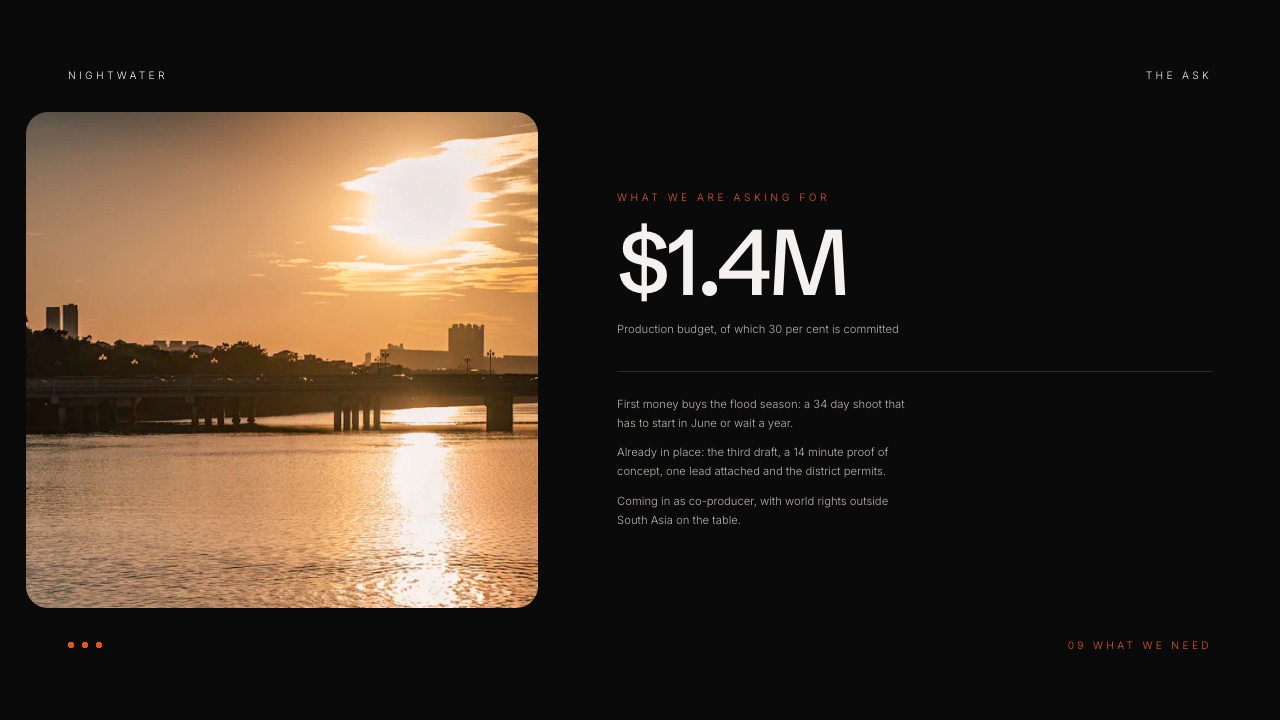
| 10 | The ask | Amount, runway in months, the milestones it buys | No number at all |
| 11 | Contact | How to reach you today | Missing entirely |
The four slides that decide it
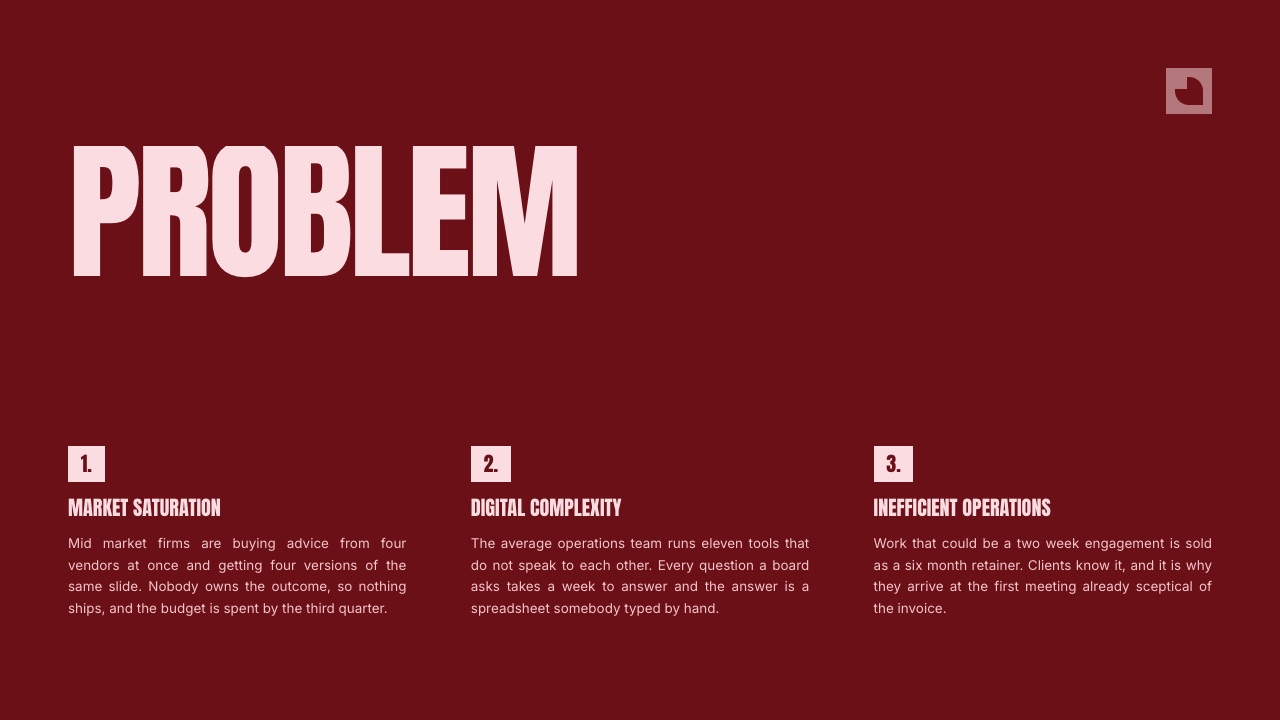
Problem. If the reader does not feel the pain in the first fifteen seconds, everything after it is read sceptically. Name a person, not a category, and attach a cost: what it currently takes them in hours or dollars a month to live with this.
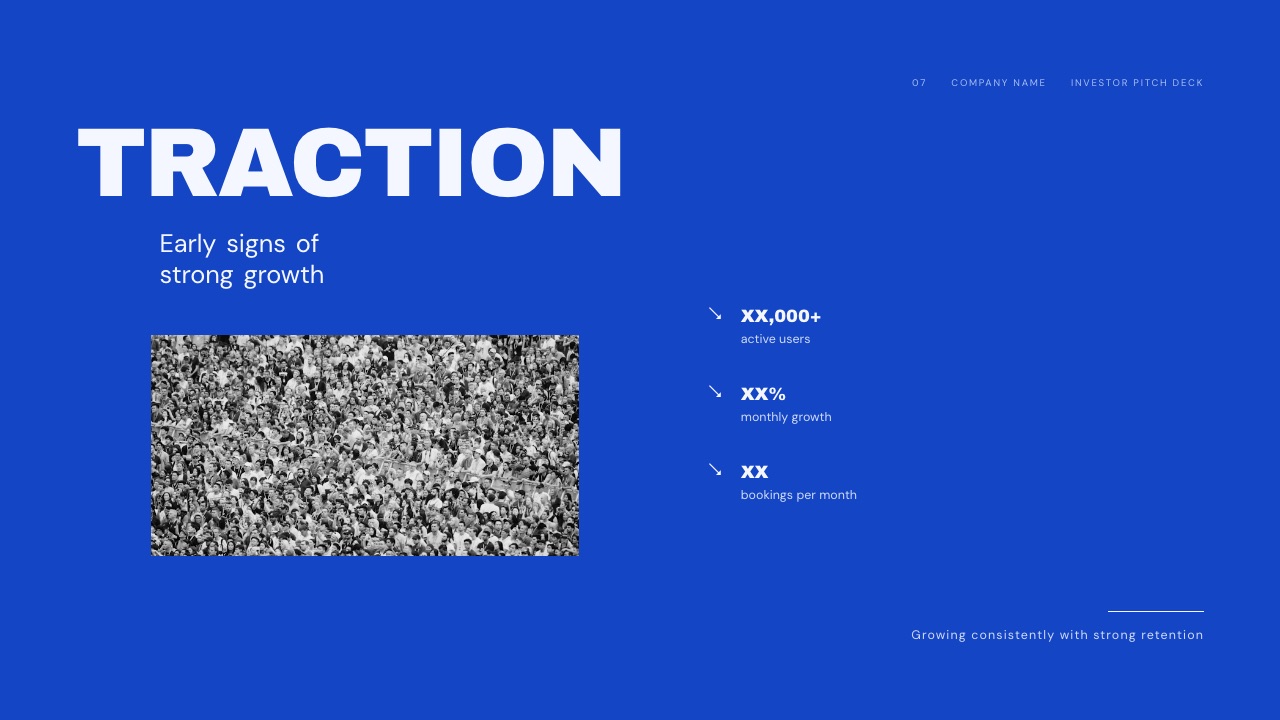
Traction. This is where most decks lose credibility, usually with a chart that has no axis labels or a percentage with no base. If you have $8,000 of monthly revenue growing 20% a month, say exactly that.
Small honest numbers with a clear trend beat large vague ones.
Team. Investors are underwriting people at seed stage. The slide should answer why these specific people will win this specific market. One line each, leading with the fact that would make a stranger say "of course they should be doing this".
The ask. A surprising share of first decks never state a number. Say the amount, the runway it buys in months, and the two or three milestones it funds. Ambiguity reads as inexperience or a stalled raise.
Step 1: Write the Argument in Eleven Sentences
Before you open any deck tool, write one sentence per slide in a plain document, eleven sentences of no more than 25 words each, because if those sentences do not read as a coherent argument on their own, no design will rescue them.
This takes about three hours and saves a week. Read the eleven sentences aloud. If sentence seven (traction) does not obviously support sentence two (problem), or sentence ten (the ask) does not follow from sentences seven and nine, the gap is in the argument, not the deck.
The test. Give the eleven sentences, and nothing else, to one person who knows nothing about your company. Ask them to tell you in 30 seconds what you do, why it matters now and how much you are raising. If they cannot, rewrite before you design anything.
Step 2: Gather the Five Numbers
A deck with no specific numbers reads as a plan and a deck with the right five numbers reads as a business, so collect these before designing, because changing a number after layout means changing it on three slides and in the speaker notes.
- Revenue or usage today, with the period stated: "$8,400 MRR in September".
- Growth rate over a defined window: "up 20% month on month for six months".
- One unit economic: what it costs to acquire a customer against what that customer is worth over a year.
- Market size with its method: how many buyers, times what they would pay, rather than an analyst's headline.
- The ask, with runway: "raising $1.5m for 18 months to reach $80k MRR".
Run this on your current deck. Open it and count the specific numbers.
If there are fewer than five, or any lack a unit or a time period, that is the highest-value hour of editing available to you, and it does not need a designer.
Then check that the same figure is identical on every slide where it appears; an investor who spots $8,400 on slide seven and $8,000 on slide ten discounts every other number.
Step 3: Choose a Tool That Fits How You Will Send It
The tool matters less than the argument, but it decides two things you will care about later: whether you know who opened the deck, and how long the design takes, so pick it by how the deck will travel rather than by its template gallery.
| Tool | Cost for a raise | What it adds | What it does not do |
|---|---|---|---|
| Google Slides | $0 | Co-writing with a co-founder, comments, offline editing, PowerPoint in and out | No read data; plain design |
| Canva | $0 Free; $144 a year on Pro | 3.6 million templates on paid plans, image tools, brand kits | No per-investor tracking |
| Pitch | EUR 0 Free; EUR 15 a seat a month billed yearly on Team | Team adds 25 advanced links with visits, slide views and time per slide, plus passcodes | Free and Plus have no tracked links |
| Slidebean | $7 a month billed yearly on Starter, $84 a year | An AI deck builder, 100-plus templates and view tracking on shared decks | Layout control is narrow by design |
| Framekit Slides | $0 Free; $84 a year on Starter | AI drafts the deck from your facts after an outline you approve; investor and startup templates; the company site on the same account | No per-viewer tracking, no password, PowerPoint export only as pictures on Pro |
Prices are from each vendor's own page: Pitch's pricing and Slidebean's pricing read on 12 October 2026, Canva's US price as shown in September 2026.
The rule of thumb. If you will send the deck to more than 20 investors as a link, buy tracking for the months of the raise: Pitch Team at EUR 15 a seat or Slidebean Starter at $84 a year.
If you will present it to fewer than ten people you already know, any tool works and Google Slides costs nothing. Our best pitch deck software comparison covers the wider field.
Step 4: Build the Plain Version First
Build fourteen slides in black text on white with no images, read the deck end to end, and cut every slide that does not advance the argument, which usually removes two or three and leaves you at the eleven that matter.
The plain version exposes what design hides. A slide that only works because of a nice photograph is a slide with no point. A headline that cannot be written as a conclusion is a slide that should be merged with its neighbour.
The numbers for this step. Fourteen slides in, eleven out. One headline per slide of ten words or fewer, stating the conclusion. No slide body longer than 40 words in the version you will send. Budget half a day.
Step 5: Design It With One Typeface and One Accent
Design comes fifth, not first, and it should be restrained: one typeface in two weights, one accent colour, real product images, labelled charts, and a headline on every slide that a skimmer can read in three seconds.
The design numbers. Headlines at 32 to 44 points, body no smaller than 18 points when presented, one accent colour used for the number that matters on each slide. Charts get axis labels and a source line.
Photographs are your product or your customers, never stock handshakes.
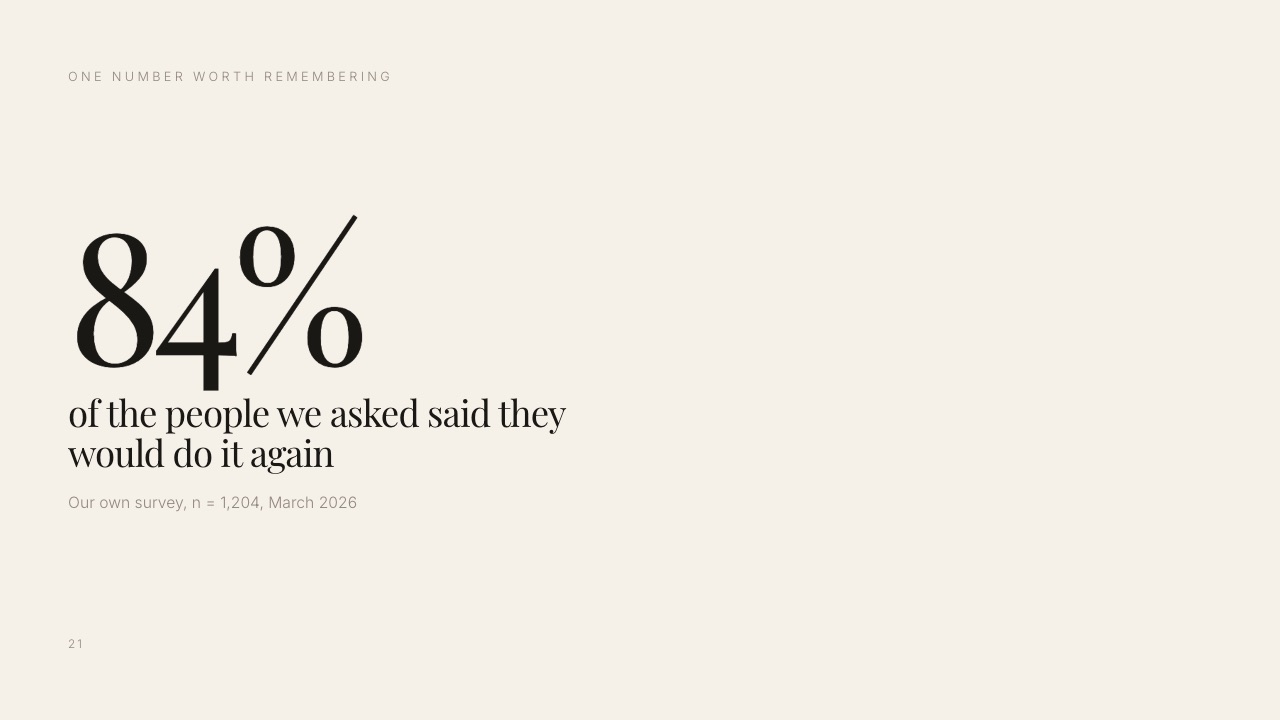
One number per slide. The slides investors remember are the ones with one figure, large, and a sentence that says why it matters. If a slide carries three numbers of equal weight, pick the one that supports the headline and move the other two to the appendix.
Step 6: Test It on Three Readers Without You
Send the designed deck to three people who have not heard you pitch, give each of them five minutes alone with it, and then ask them to explain your business back to you, because their explanation is the closest thing you will get to an investor's first read.
Do not ask for design feedback; you will get it anyway. Listen for three things: whether they can state the problem in one sentence, whether they remember the traction figure, and whether they know how much you are raising.
If two of the three miss the same thing, the problem is on that slide.
The test you can run tonight. Ask each reader to write down, from memory, the one number they remember. If the three numbers they write are your revenue, your growth rate and your ask, the deck works.
If they write your market size, your deck is leading with the least persuasive figure.
Step 7: Make a Send Version and a Present Version
One deck cannot do both jobs well, so keep two versions of the same eleven slides: a send version with enough written context to stand alone, and a present version with less text that you talk over, and update both after every revision.
The send version. 30 to 60 words of body per slide, full sentences, and every chart self-explanatory. There is nobody in the room to explain slide five.
The present version. Under 15 words per slide where you can, with the explanation moved into speaker notes. A slide that competes with you for attention wins, and you lose the room.
Maintaining two versions takes about 20 minutes per revision once the first pair exists. Keep a 6 to 12 slide appendix behind both for cohort retention, the financial model, competitor detail and the hiring plan.
Step 8: Send It, Track It, Revise It
Send the deck as a link when you want to know who read it and as a PDF when the investor asks for an attachment, and revise it after every five conversations, because the questions investors ask are the most precise feedback on the deck you will ever get.
Link or PDF. A tracked link (Pitch Team's advanced links, Slidebean's view tracking) tells you which of your 40 targets opened the deck and which slides held them, and lets you fix a typo after sending.
A PDF forwards reliably through corporate email and opens anywhere. Most founders send the link and keep the PDF ready.
Our guide on how to send a pitch deck to an investor covers the email itself.
The revision rule. After every five investor conversations, write down the three questions you were asked most. If a question comes up three times, the answer belongs on a slide. If a slide never gets a question, it may not be doing any work.
How Framekit's AI Builds a Pitch Deck From Your Brief

Framekit's Slides AI builds a whole deck from a brief, but it does it the way the steps above recommend rather than in one shot: it asks first, gets your real numbers, proposes an outline you approve, and leaves a visible placeholder wherever a fact is missing instead of inventing one.
Framekit is an AI website builder that also ships Slides, client galleries, video review and a digital-download store on one account, so a founder can draft the deck and publish the company site a forwarded deck points to from the same login.
Here is what happens when you describe a seed deck:
1.
Up to three quick questions. Roughly how many slides (with options such as a standard 10 to 14), what should happen after the investor sees it (fund it, take a meeting), and whether you will present it live or send it to be read alone, which sets how much text goes on each slide.
2. A design style and colour theme. It picks a style that fits the brief and offers a handful of colour themes, or follows your brand if you give it one.
3. Your real facts. It asks you to paste what you have: the one-liner, revenue and growth, the ask, team bios, and anything that must not appear.
Anything you do not supply becomes a marked placeholder in the deck, never an invented figure, which is exactly where Step 2 above matters.
4. An outline for your OK. A titled slide list at the length you asked for, with the device beside each title, such as "Traction - column chart" or "Competition - matrix". Nothing is built until you approve it.
5. The build. Three or four finished slides per turn, each with speaker notes, until the outline is done, followed by a checklist of the placeholders still waiting for real numbers. You can ask for any single slide again later.
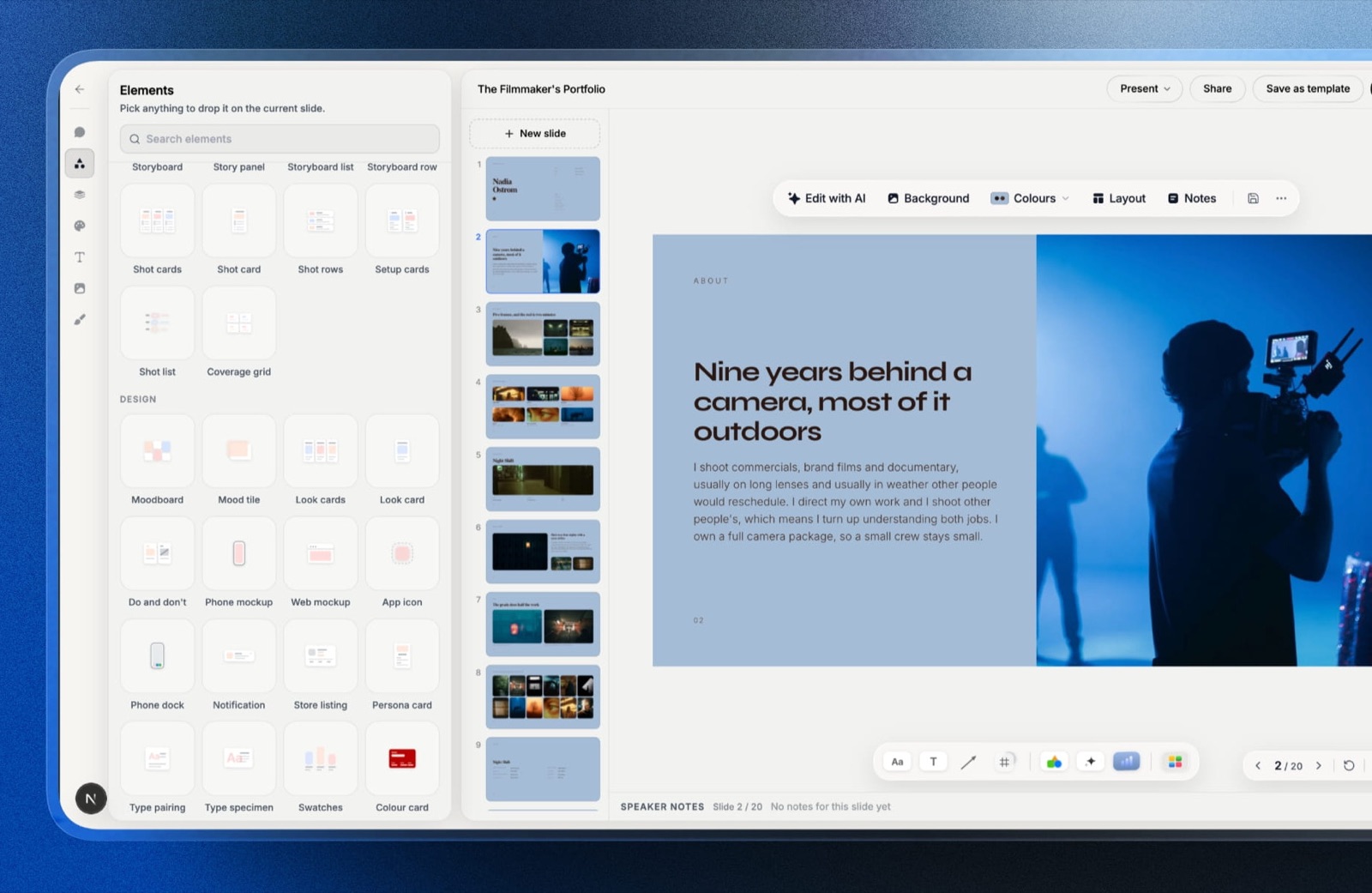
What else helps a founder. Startup and investor deck templates on paid plans from Starter, charts that import a CSV, TSV or .xlsx export and stay editable as column, bar, line, area, pie or donut charts, so next month's traction is a new file dropped on the same chart, and PDF export on every plan.
The limits, stated plainly. AI is metered: every plan, Free included, has a monthly AI allowance, and deck AI draws on one pool, while editing by hand spends nothing.
A deck caps at 40 slides, comfortably more than eleven plus an appendix. There is no per-investor tracking and no password on the link: you see a total view count, and you can reset the link so the old one stops working.
No live co-editing, and a deck belongs to the person who made it; teammates on Pro are website admins and cannot open it, so one founder builds and the other views by link or PDF.
PowerPoint export starts on Pro and arrives as pictures, and there is no presenter view with speaker notes on a second screen.

Verdict: Framekit Slides is a strong place to draft a seed deck from your real numbers and to publish the company site beside it, and the wrong place if your raise depends on knowing which investor opened the deck. For that, send the final version from Pitch Team or Slidebean.
How Long a Pitch Deck Should Be
Ten to fifteen slides in the main deck is the range that works at seed stage, with an appendix of six to twelve slides for everything an investor might ask about once they are interested.
The appendix is where founders should put the detail they cannot bear to cut: cohort retention, the full financial model, competitor detail, technical architecture, the hiring plan.
It costs nothing, because nobody reads it unless they are already interested, which is exactly when extra detail helps.
| Version | Slides | Words of body per slide | Time to revise |
|---|---|---|---|
| Main deck, sent | 10 to 15 | 30 to 60 | About 20 minutes per round |
| Main deck, presented | 10 to 15 | Under 15, notes carry the rest | Same pass as above |
| Appendix | 6 to 12 | As many as the data needs | Only when numbers change |
| Teaser (cold outreach) | 3 to 5 | 20 to 40 | Once per round |
The five-minute rule. A partner should get through the main deck in about five minutes. Time a reader who has not seen it; if they take twice that, cut.
What Investors Check After the Deck
The deck gets forwarded to people who research you independently, and what they find when they search your company name is the first impression you did not frame, so the site behind the deck is part of the raise rather than an afterthought.
The sequence is predictable. A partner reads the deck, forwards it to a colleague, and that colleague searches your company before the Monday meeting.
An empty or two-year-old page reads as risk, and it happens often, because the website is the task that slips while you are raising.
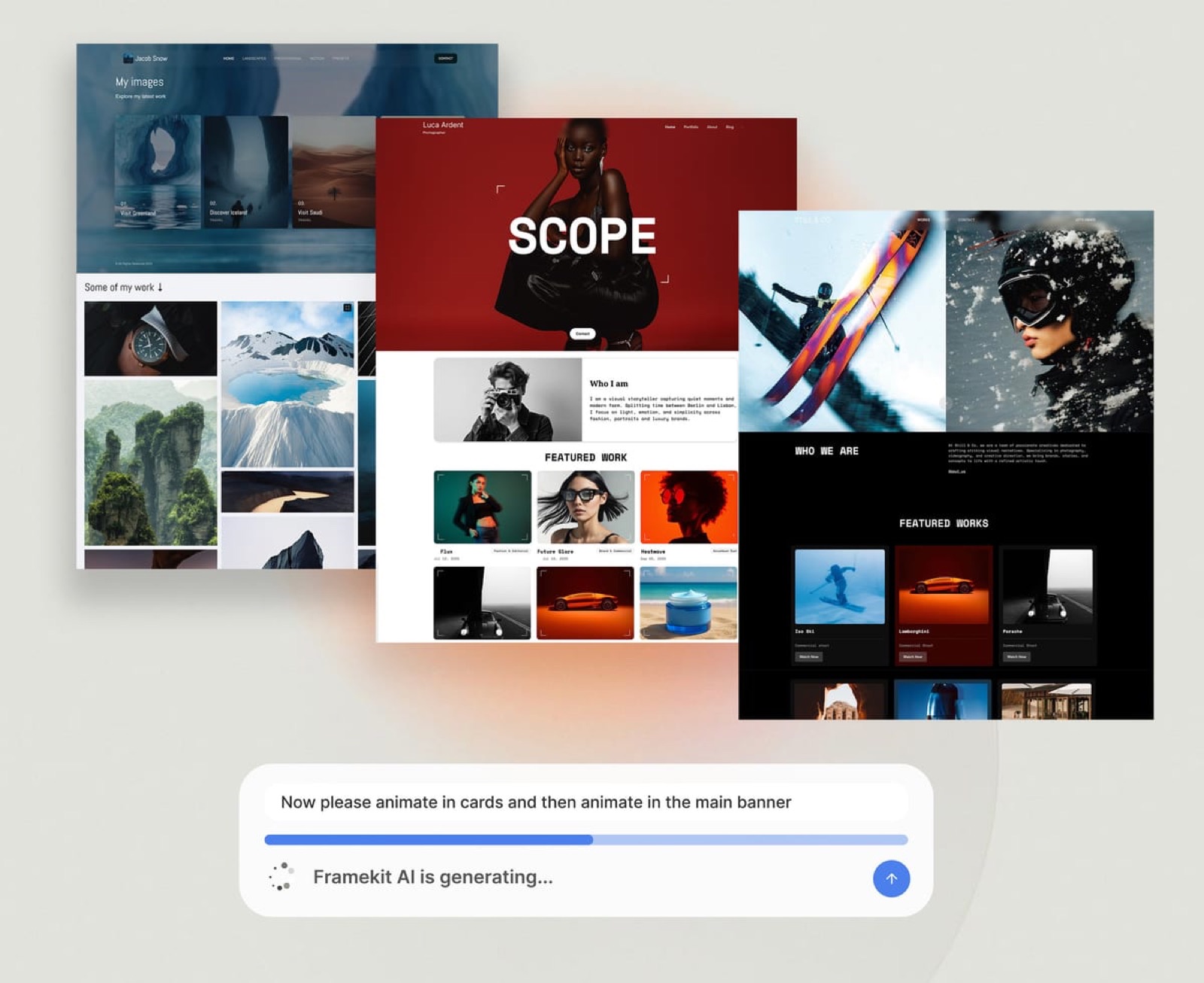
It does not need to be elaborate: what you do, who is building it, the traction figure you are proud of, and how to get in touch.
Framekit generates that site from a description, free to start with a framekit.ai subdomain and on your own domain from Starter, and you can update the traction number the afternoon it changes.
Mistakes That Kill Decks
Almost every fixable deck problem is one of these seven, and all of them are cheaper to fix than to design around, so check your deck against this list before any investor sees it.
Category headlines. "Market" tells the reader nothing. "A $4bn market growing 18% a year" tells them everything and survives a skim.
Charts without axes. A line going up with no numbers on it is read as an admission that the numbers are small. Label them; a small labelled number with a trend is credible.
The empty competitive quadrant. Placing yourself alone in the top right convinces nobody. Name real competitors and say what they are better at.
Too many slides. Every slide past about fifteen reduces the chance the important ones are read carefully. Move it to the appendix.
No ask. Say the number. A deck without one forces the investor to guess whether you are raising $500k or $5m.
Numbers that disagree. The same figure stated differently on two slides undermines every other figure in the deck.
Sending a file when you needed a link. An attachment tells you nothing about who opened it. If you are sending to more than 20 investors, that silence costs you follow-ups.
Frequently Asked Questions
How many slides should a pitch deck have?
A pitch deck should have ten to fifteen slides in the main deck, with an appendix of six to twelve for supporting detail.
The eleven-slide structure of title, problem, solution, product, market, business model, traction, competition, team, ask and contact covers what seed investors expect, and a partner should be able to read it in about five minutes.
What should be on the first slide of a pitch deck?
The company name, a one-line description of what you do in plain language, your name and role, and the date. The one-line description is the load-bearing part: someone with no context should understand it in about five seconds. A logo alone wastes the slide every reader sees.
How long does it take to make a pitch deck?
About a day for a rough first draft and a week of part-time work for a version you would send, with most of that time spent writing rather than designing.
Writing the eleven sentences takes about three hours, gathering the five numbers half a day, the plain build half a day, and design and testing the rest of the week.
What is the best software for making a pitch deck?
There is no single best tool; pick by how you will send it.
Google Slides at $0 builds a fundable deck, Canva makes the best-looking one for a non-designer, Pitch Team and Slidebean tell you which investor opened it, and Framekit Slides drafts the deck from your real numbers and publishes the company site on the same account.
Our best pitch deck software comparison covers more.
Can AI make a pitch deck for me?
Yes, but the numbers still have to come from you. Gamma drafts a whole deck from one prompt fastest.
Framekit's AI asks up to three questions, asks for your real figures, and proposes an outline before building, then marks anything you did not supply as a placeholder instead of inventing it.
Every AI deck still needs Steps 1, 2 and 6 of this guide.
Should I send my pitch deck as a PDF or a link?
Send a link if you want to know who read it and to be able to fix a number after sending, and keep a PDF ready for investors who ask for an attachment.
Per-investor read data needs a tracking tool such as Pitch Team, at EUR 15 a seat a month billed yearly, or Slidebean Starter at $84 a year.
What traction do I need to raise a seed round?
There is no universal threshold; investors are buying a trend more than a level. A small number with a consistent growth rate over six months is more persuasive than a larger number with no history.
With no revenue yet, the substitutes are usage, retention, waiting-list conversion or a signed pilot, all with real figures attached.
Should a pitch deck include financial projections?
Include a simple three-year revenue outline in the main deck and put the detailed model in the appendix.
Everyone knows seed-stage projections will be wrong; what they show is which drivers you believe matter and whether your assumptions are sane. A monthly five-year model on slide nine signals inexperience rather than rigour.
How do I show competition without looking arrogant?
Name real competitors, say plainly what each is better at, and then say what you do differently for the customer you named on the problem slide.
The empty two-by-two quadrant with your logo alone in the corner reads as naivety, and conceding a genuine strength to a rival makes your own claim more believable.
Can my co-founder and I edit a Framekit deck together?
No. A Framekit deck belongs to the person who made it, there is no live co-editing or commenting, and team members on Pro or Business are website admins who cannot open decks.
One founder builds the deck and the other views it by share link or PDF. If you need to co-write slides at the same time, Google Slides or Pitch is the better tool.
Do I need a website to raise money?
Yes, a simple one, because the deck gets forwarded to people who will search your company before agreeing to a meeting, and an empty result reads as risk. What you do, who is building it, one traction figure and a contact route is enough.
Framekit generates that site from a description, free to start.
Final Verdict
Write the argument before you build the deck, keep it to eleven slides, and put your effort into the problem, traction, team and ask, because those four decide most seed outcomes. A plain deck with five specific, consistent numbers beats a beautiful one with vague ones.
The two habits that separate founders who run a process from founders who hope: sending a tracked link to a long list so you know who read what, and revising the deck after every five conversations rather than defending the version you started with.
Where Framekit fits, and where it loses: Framekit Slides is a good place to draft the deck from your real facts and to publish the company site beside it, and it is not for a raise that depends on per-investor tracking, passwords, co-editing or an editable PowerPoint, so send that final version from Pitch Team, Slidebean or Google Slides.
Keep reading: how much a pitch deck costs, the best presentation tools for startups, Pitch vs Canva and, for creative pitches, the film pitch deck template.