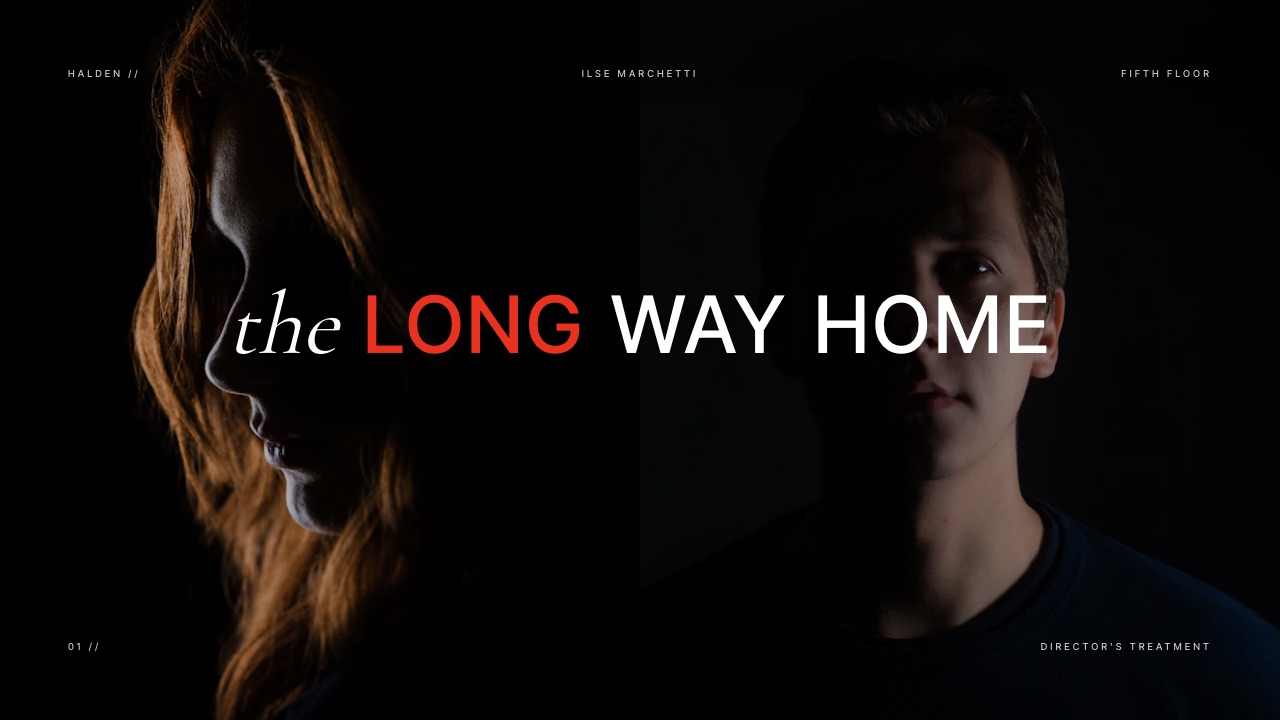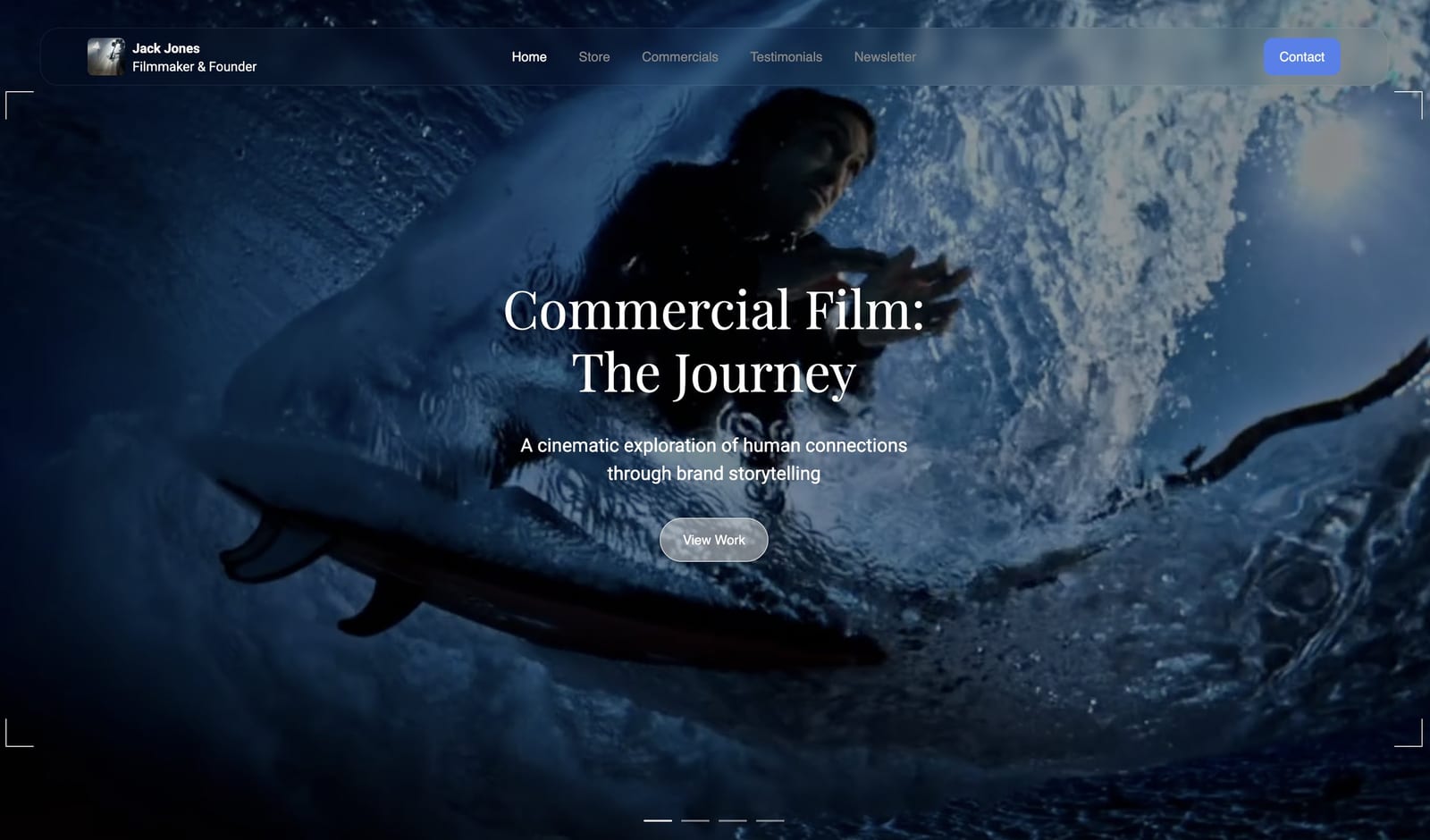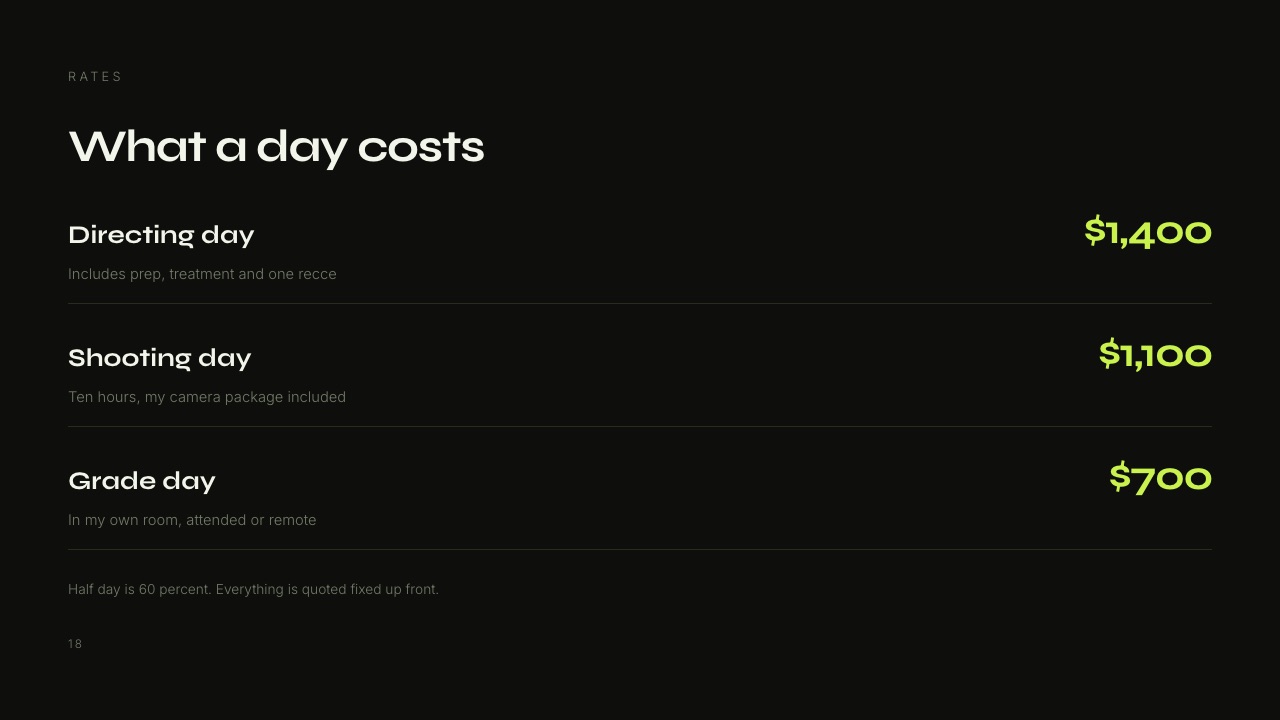
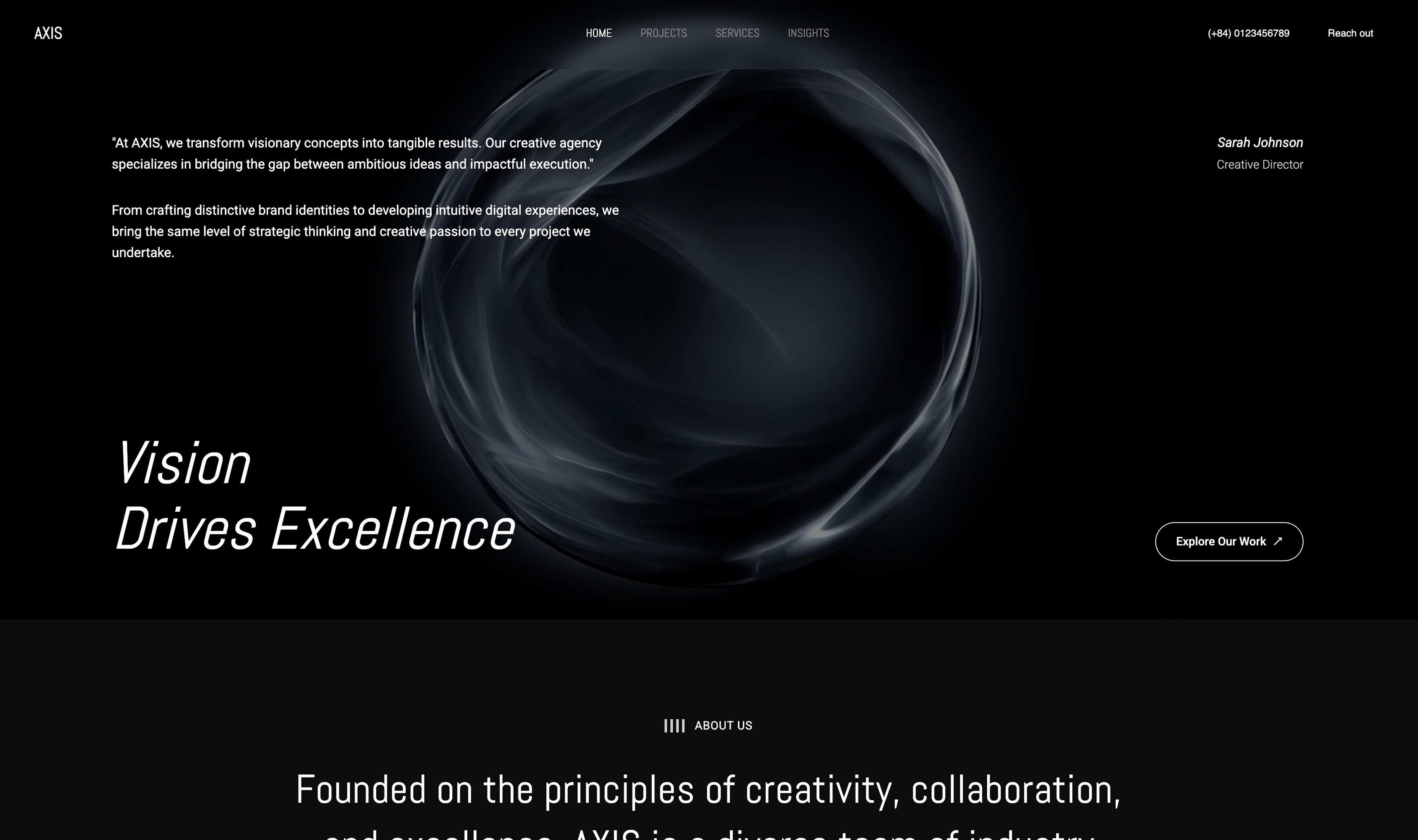
Framekit templates
Start from a designer-made template
 Use template
 Use template
 Use template
 Use template
 Use template
 Use template
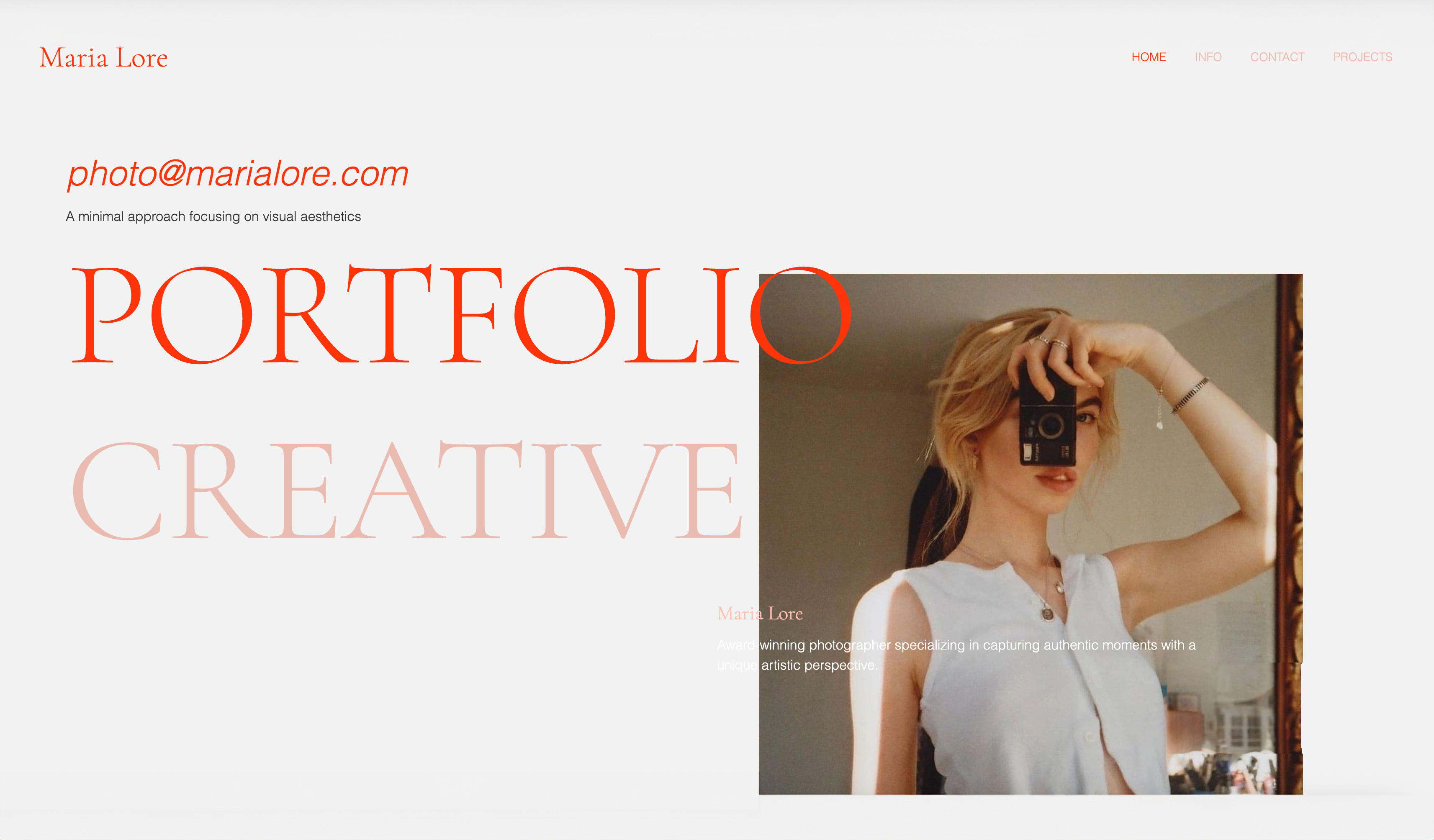 Use template
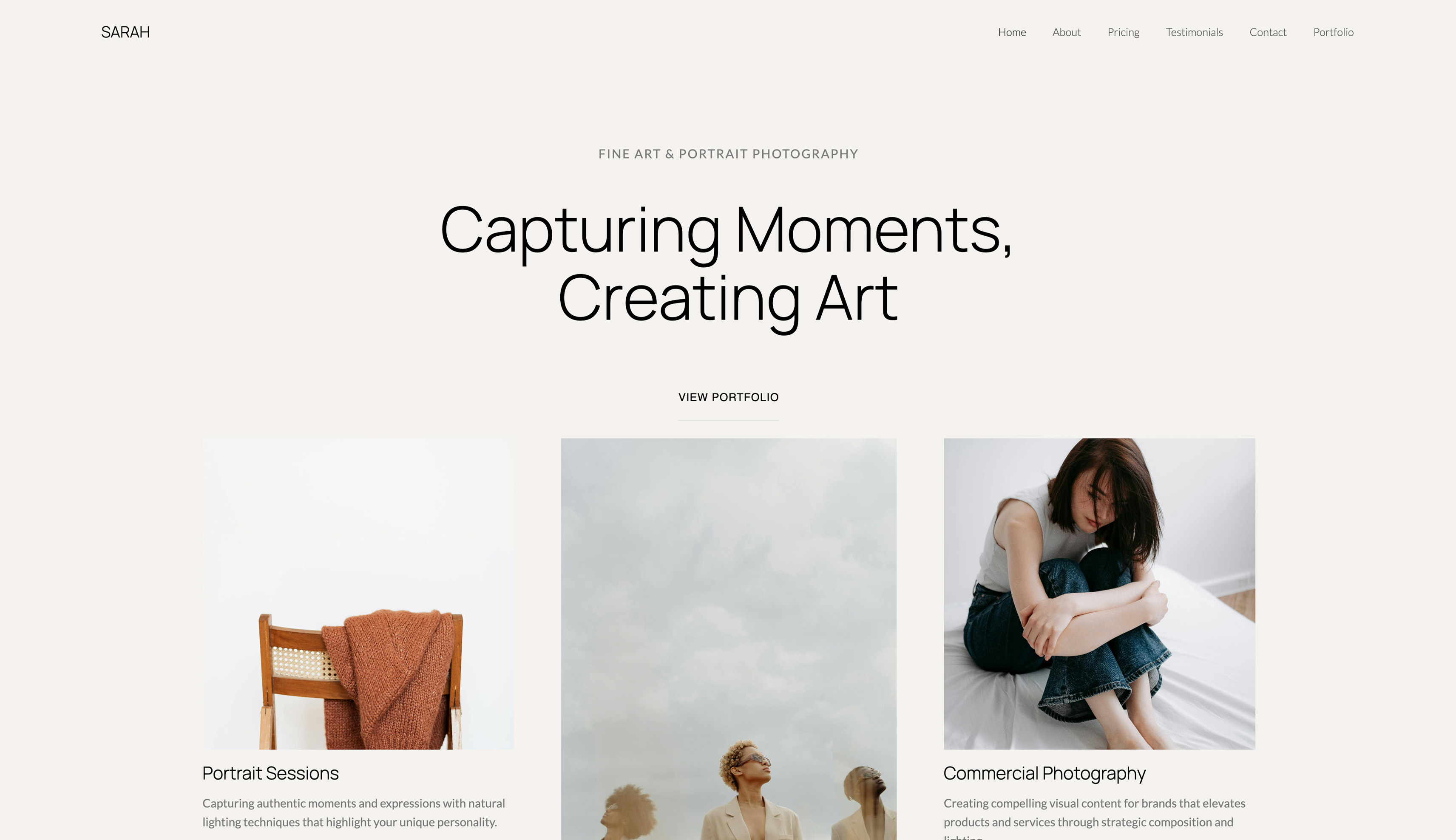 Use template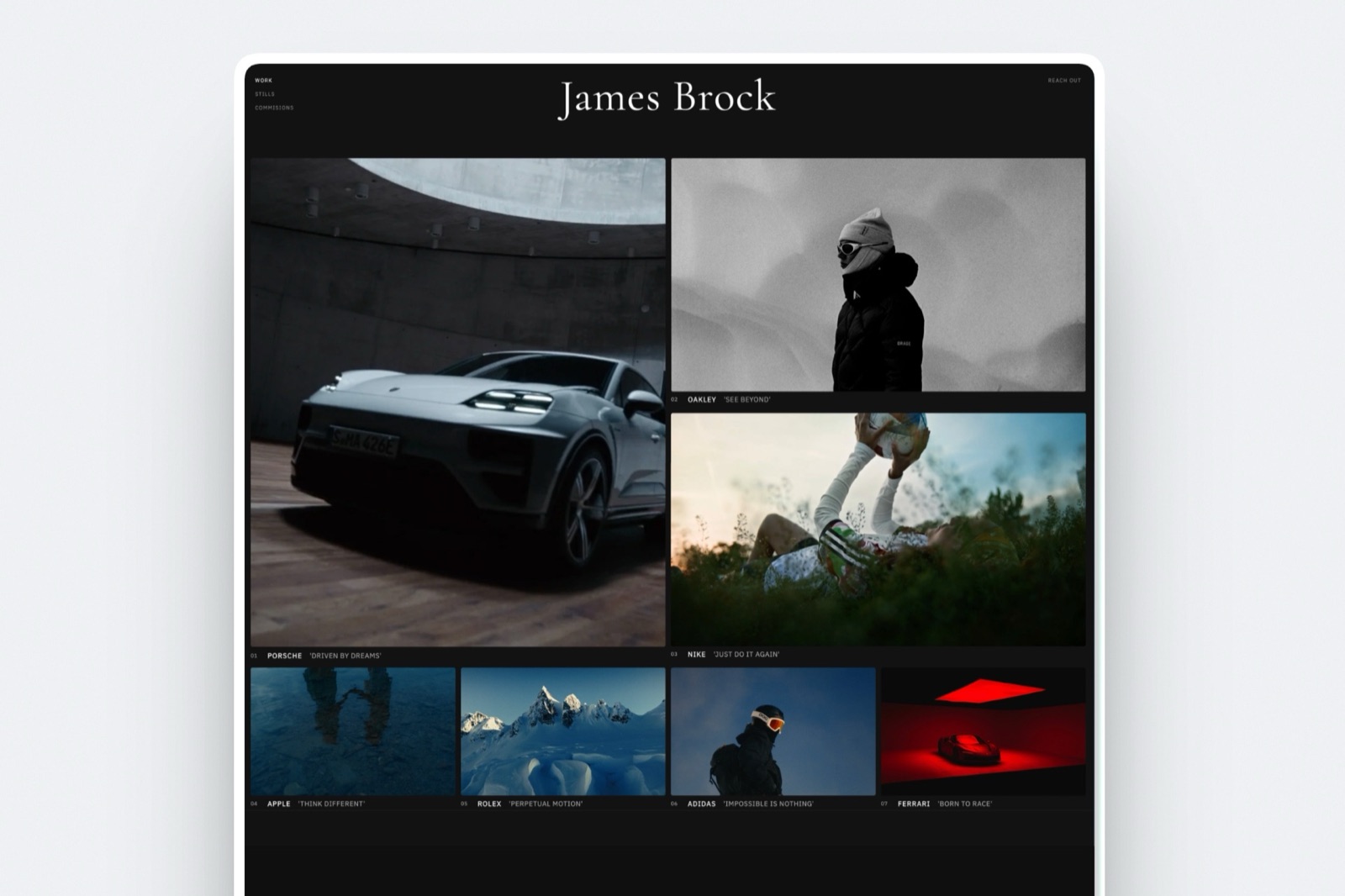
Count the surfaces a client looks at during one brand project. The pitch deck. The moodboard. The gallery of stills. The review page where they leave notes on the cut. The case-study page on your site. The proposal and the invoice.
That is six things, and every one of them carries a logo.
For creative agencies of one, the question is whose logo. Nine clients a year across six surfaces is 54 moments where a client either sees a studio or sees a freelancer on somebody else's free tier.
The best solo creative agency tools are the ones that let you answer that question with your own domain, your own fonts and nobody else's badge, and the useful way to rank them is by what each one charges for exactly that.
A creative agency of one is a single person trading as a studio: one operator who pitches, produces, delivers and invoices under a business name, and whose competitive problem is credibility at the point of sale rather than capacity.
Framekit ranks first for a creative agency of one because a single paid plan, $7 a month billed yearly, puts your own domain and your own uploaded fonts on four client-facing surfaces at once, the site, the client galleries, the video review pages and the decks, with no Framekit badge on any of them.
Frame.io is the better pick if review happens inside Premiere or Resolve, Pitch is the better pick when you need to know who opened a deck and for how long, and Squarespace remains the better pick if you want a site a future employee can take over.
Framekit has no single sign-on, no per-seat roles and permissions, no agency workspace that separates clients, and no client billing, so an agency of one that is quietly becoming an agency of four will outgrow parts of it.
Full disclosure: Framekit is our product. Every competitor figure below was read on that vendor's own published pricing page in September 2026 and linked where it is used, except Canva, whose pricing page refuses automated readers and which is therefore quoted from a browser reading and not linked. Frame.io, Pitch, Squarespace, HoneyBook and Pixieset each beat us on something specific and those things are named in their entries rather than buried.
How this ranking was built, and what it does not claim
Three kinds of statement appear below, and keeping them apart is the only way a comparison written by one of the 12 vendors inside it is worth a reader's time, so each kind is labelled before the ranking starts.
Read at the source. Plan prices, branding-removal tiers, storage limits, store fees and seat rules were read on each vendor's own published page in September 2026 and linked at the point of use.
Six of the 12 vendors served European pricing to this session; those figures appear in euros and are labelled as such rather than converted at an invented rate.
Calculated. The arithmetic is ours, shown in full, and worked at one price per vendor so a reader can redo any line in 30 seconds.
The carried business is a one-person brand agency billing $88,000 across nine clients in a year, each engagement producing a pitch deck, a moodboard, a shoot gallery, a cut for review, a case-study page and the paperwork.
Not claimed. No product here was put through a controlled trial, there are no scores, and there are no benchmark numbers, because a vendor claiming to have impartially trialled eleven rivals should be asked to produce the receipts.
What is here instead is published pricing from 11 vendor pages plus arithmetic you can check line by line.
One page would not cooperate.
Canva's pricing returns a block to automated readers at every address tried, so its European pricing is reported as read in a browser in September 2026, at zero euros for Free, 110 euros a year for one Pro user and 170 euros a year per person for Business, and its pricing page is not linked here.
Webflow renders its plan prices in JavaScript and would not yield them, so Webflow is not ranked.
A one-person agency by the numbers
Seven published figures decide how much of an $88,000 year goes on looking like a company rather than on being one, and every one of them is a price some vendor set for taking its own name off your work.
- $84 a year: Framekit Starter billed yearly, the cheapest plan that removes the Framekit badge and allows a custom domain across the site, galleries, review pages and decks.
- $96 a year: Pixieset Basic billed annually, which brings a custom domain to client galleries and nothing else.
- $15 per user a month: Frame.io Pro, the first tier with custom-branded shares and passphrase-protected shares, with a 13% discount on annual billing.
- $49 a month billed yearly: HoneyBook Essentials, the tier that removes the "Powered by HoneyBook" line from what your client reads.
- $29 per user a month: Bonsai Premium on annual billing, the tier that removes Bonsai branding from proposals and contracts.
- 6.80 euros per user a month: Google Workspace Business Starter at its standard rate for European buyers, which is what an email address at your own domain costs.
- 3 team members on Pro, unlimited on Business: Framekit's team allowance, which is not nothing but is also not seat management, since there is no single sign-on and no roles-and-permissions admin at any tier.

The six surfaces a client sees, and who owns the name on each
Before ranking tools, list the surfaces, because the spend that makes a one-person agency look like a studio is concentrated in a handful of places and almost none of it is in the software you actually work in.
| Surface | What the client notices | Cheapest way to put your name on it |
|---|---|---|
| Pitch deck | Whose byline is at the bottom | Framekit Starter, $84 a year, removes the byline |
| Moodboard | Whether it looks assembled or designed | Milanote free, or a deck slide |
| Shoot gallery | The domain in the address bar | Framekit Starter, or Pixieset Basic at $96 a year |
| Review page | Who is credited when they leave a note | Framekit Starter, or Frame.io Pro at $15 per user a month |
| Case-study page | The site itself and its domain | Framekit Starter, or Squarespace Basic at 11 euros a month |
| Proposal and invoice | Whether a vendor line appears on the document | HoneyBook Essentials at $49 a month billed yearly |
In one lineFour of those six surfaces belong to the same Framekit plan at $84 a year, which is the reason the ranking below starts where it does, and the two that do not belong to us are the ones where this guide sends you somewhere else without an argument.
1. Framekit: Best for Looking Like a Studio on One Bill

Framekit is an AI website builder whose galleries, review pages and decks sit on the same account as the site, so a one-person agency can put a single domain and a single set of fonts across everything a client opens.
Best forA solo operator trading under a studio name who needs the client experience to be consistent from pitch to delivery.
The whole argument is in one sentence from the plan comparison: on paid plans, galleries and review pages run on your own domain, without the Framekit badge, with your own uploaded fonts.
Decks lose the Framekit byline and gain the full template library on Starter and up. The site takes a custom domain on paid plans. That is 4 surfaces on one plan, and the cheapest one is $9 a month, or $7 if you pay for the year.
The number worth remembering$84 a year for those four surfaces.
Buying the equivalent from specialists costs $96 a year for a custom domain on galleries at Pixieset and $180 a year at Frame.io's monthly Pro rate for custom-branded shares, and that is two surfaces for $276 before you have touched the site or the deck.
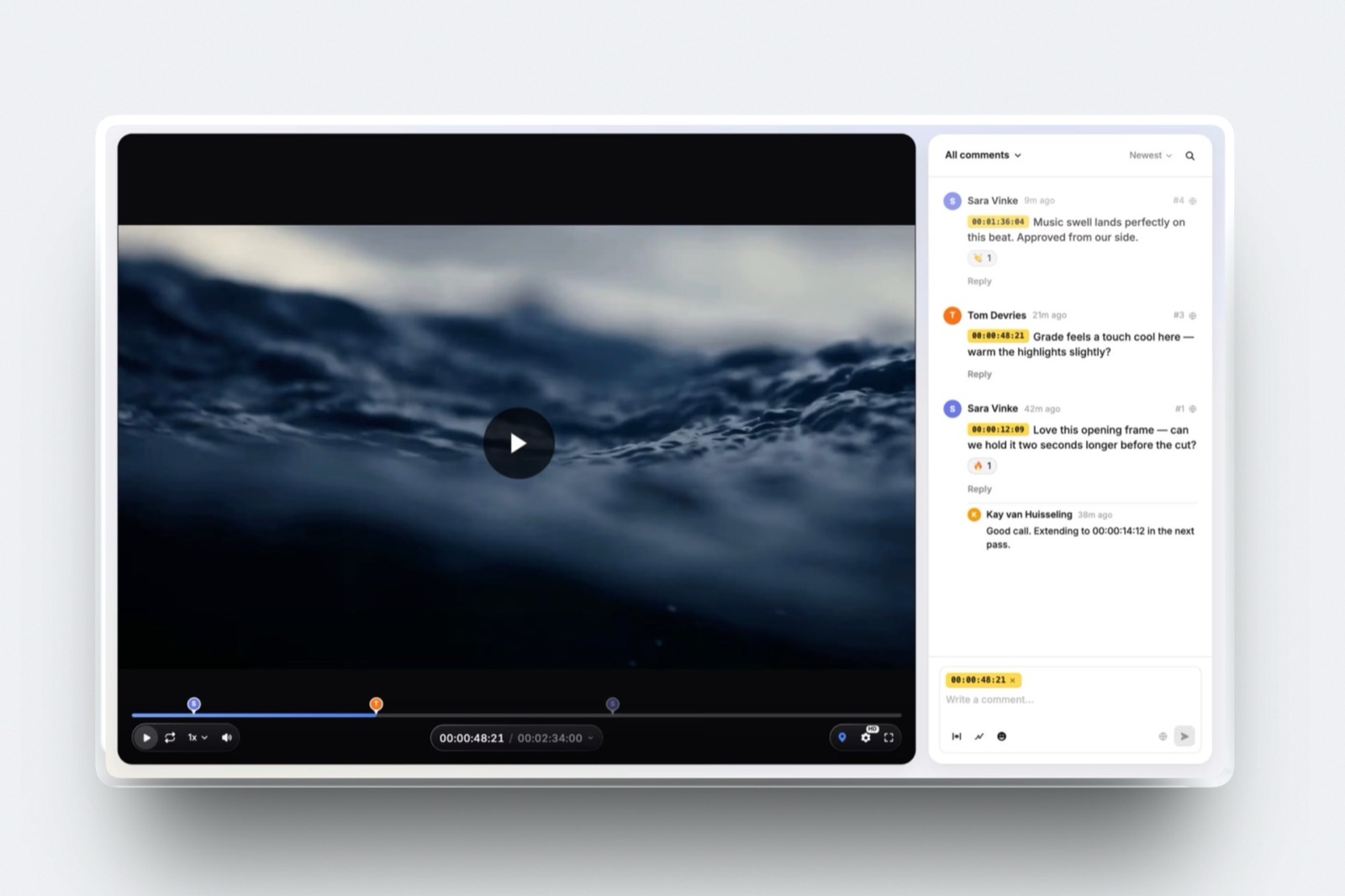
The detail nobody writes aboutreview pages carry branding beyond the domain, including your logo, a banner, fonts, accent colours and a light or dark theme.
A client leaving a note at 00:47 is looking at a page that is yours rather than a grey player with somebody else's product name in the corner, which is a small thing that a prospective client reads as scale.
The gotcha that bites in week threethere is no single sign-on, no roles-and-permissions admin and no agency workspace that keeps client A's projects structurally separate from client B's.
Pro includes 3 team members at $19 a month and Business includes unlimited at $39, so collaborators are possible, but seat management in the enterprise sense does not exist here.
If a client's procurement team asks about SSO, the answer is no at all 4 plan tiers.
Who should skip itan agency of one that is really an agency of 5 in 6 months.
The moment you need per-seat permissions, client-level workspace separation or billing your clients through the platform, this stops being the right shape and Frame.io Team plus a proper back office is where you are going.
Verdict: The cheapest credible way to look like a studio across four surfaces at once, and not an agency management platform. Buy it for what the client sees on those 4 surfaces, not for your org chart.
2. Frame.io: Best for Branded Review Inside the Edit
Frame.io is what a one-person agency graduates to when the review conversation has to happen inside the editing application rather than in a browser tab beside it.
Best forSolo editors and directors cutting in Premiere, After Effects or Resolve whose clients expect a studio review process.
The free plan covers up to 2 members, 2GB of storage, 2GB of Mounted Storage and 2 projects, and still includes Camera to Cloud, transcription and captions and frame-accurate comments.
Pro is $15 per user a month billed monthly with a 13% annual discount, up to 5 members and 2TB, and it is the first tier with custom-branded shares, passphrase-protected shares, share link expiration and comment attachments.
Team is $25 per user a month with up to 15 members and restricted projects and folders. Enterprise adds single sign-on, session-based and forensic watermarking, and digital rights management.
What it has that we do notCamera to Cloud, panels inside the editing applications, transcription, forensic watermarking and single sign-on. For an agency of one shooting for brands with legal departments, that last pair can be the difference between winning the job and not being allowed to bid.
The gotcha that bites in week threebranding is not on the free plan, which stops at 2 members, 2 projects and 2GB. Custom-branded shares start at Pro, so the tier where Frame.io stops looking like Frame.io to your client is $180 a year at the monthly rate, for review alone.
Verdict: The best motion review product in the category and a single-surface purchase. If review is the only thing your clients do online, buy it and stop reading; our video review tools for creative agencies guide covers the narrower field.
3. Squarespace: Best Site a Future Employee Could Take Over

Squarespace deserves its place on this list for an unglamorous reason: it is the site platform a client's marketing person, or your first hire, will already know how to edit.
Best forAn agency of one planning to hand the website to somebody else eventually, or selling sites to clients as part of the service.
Squarespace served European pricing to this session in September 2026: Basic at 11 euros a month billed annually, or 15 monthly, with a 2% online store fee, a 7% fee on digital content and memberships and 2 contributors.
Core is 17 euros a month annually with a 0% store fee, 5% on digital content and unlimited contributors. Advanced is 29 euros a month annually with 0% on both.
The number to look at twicethe 7% fee on digital content and memberships. An agency of one selling a template pack or a preset through Squarespace pays 7% on Basic and 5% on Core, and only reaches zero at Advanced, which is 348 euros a year.
If selling digital files is part of your revenue, that percentage is the whole comparison.
Who should skip itanyone whose site is the least interesting of their 6 surfaces. Paying for a site platform and then buying a gallery, a review tool and a deck tool separately is how a one-person agency ends up with 4 renewal dates in 4 different months.
Verdict: A genuinely good website product with no ambition to be the rest of your client experience. Choose it when the site is the deliverable, and see Framekit versus Webflow for agencies if the site is a client project rather than your own.
4. HoneyBook: Best Paperwork That Reads Like a Company
HoneyBook is on this list because the two surfaces Framekit does not touch, the proposal and the invoice, are the two a client reads most carefully, and they should not look like a template from a phone app.
Best forA solo agency that sends proposals and wants the contract, the invoice and the payment record to live in one project.
Starter is $29 a month billed yearly with unlimited clients and projects, invoices, payments, proposals, contracts, a calendar and a client portal.
Essentials is $49 a month billed yearly, reduced from a $59 list price, and adds the scheduler, automations, QuickBooks Online, up to two team members and the removal of the "Powered by HoneyBook" line.
Premium is $109 a month billed yearly. Card fees start at 2.7% plus 10 cents and bank transfer is 1.5%.
The badge trap in plain termsthe plan that stops your paperwork advertising HoneyBook is $588 a year, which is seven times what Framekit charges to de-badge four surfaces.
That is not a criticism of HoneyBook's value, it is a note about where branding removal sits in each vendor's pricing ladder, and it is worth checking on every tool you buy.
Verdict: The right home for the money half of an agency of one, bought at the tier that matches how much your documents matter. Framekit does not do invoicing, contracts, e-signature or CRM at any price, so this is not a competing purchase.
5. Notion: Best Internal Brain and Client-Facing Wiki
Notion is where a one-person agency keeps the things that would otherwise exist only in your head, which is a real operational risk when the head in question is also the entire production department.
Best forClient briefs, brand guidelines, project trackers and a shared page a client can read without another login to manage.
Notion served European pricing to this session: Free at zero euros a member, Plus at 9.50 euros a member a month with about 7.60 on yearly billing, and Business at 19.50 euros a member with about 15.60 yearly.
Business is the tier that adds SAML single sign-on, granular database permissions and private teamspaces, and Enterprise adds SCIM user provisioning and an audit log.
The detail worth knowingfor an agency of one, the free plan is genuinely enough, and the paid steps buy collaboration features a single person does not use.
Notion's pricing ladder is built for teams, which means a solo operator is one of the few customers who can stay on the free tier indefinitely without feeling squeezed.
Verdict: The best free tool on this page, at 0 euros for a single member, and a poor client-facing surface. A Notion page shared with a client reads as a working document, not as a studio deliverable, which is sometimes exactly right and sometimes exactly wrong.
6. Pitch: Best Deck When You Need to Know Who Opened It
Pitch does the one thing in presentation software that Framekit genuinely does not, which is tell you who opened your deck, which slides they looked at and how long they stayed.
Best forA solo agency pitching new business cold, where knowing that the marketing director stopped on the pricing slide changes the follow-up call.
Pitch served European pricing to this session: Free at zero euros with 100 AI credits that do not renew and 2 external guests; Plus at 10 euros a seat a month billed yearly with 500 monthly credits and 5 guests; Team at 15 euros a seat with 25 advanced links that track visits, slide views and time spent on a slide, plus 25 guests; and Business at 20 euros a seat with unlimited advanced links.
Yearly billing is advertised as 17% off.
The comparison that matters herea Framekit deck link has no password and no per-viewer analytics, only a total view count. If that data is how you run a pipeline, Pitch Team at 180 euros a year is the correct purchase and no amount of arguing about bundles changes it.
The gotcha that bites in week threethe tracking lives on a limited number of advanced links, 25 on Team, so a solo agency sending a deck to every enquiry will meet that ceiling in a busy quarter and find the upgrade waiting.
Verdict: Buy it for the analytics or do not buy it at all, because everything else it does has cheaper equivalents. Our presentation tools for creative agencies comparison covers where each deck tool earns its money.
7. Canva: Best for Brand Assets Made Fast
Canva is the tool a one-person agency reaches for when a client needs 11 social crops by Thursday, and pretending otherwise because it is not a specialist design application would be dishonest.
Best forSocial cutdowns, quick brand assets, and anything where the deadline matters more than the craft.
Canva's pricing page refuses automated readers, so the figures here come from a browser reading in September 2026 and are not linked: Free at zero euros, Pro at 110 euros a year for one person, and Business at 170 euros a year per person.
Treat those as directional and check the current page yourself before budgeting.
Where it fits in an agency of oneit is an asset factory for those 11 crops, not one of the 6 client-facing surfaces. A Canva design exported to a deck, a gallery or a site is yours; a Canva link shared with a client is a document in somebody else's product with their editing interface around it.
Verdict: Excellent throughput, no opinion about your brand. Use it for volume and use something with typography control for the things a client will judge you on.
8. Milanote: Best for Moodboards and Early Thinking
Milanote is where the thinking happens before a deck exists, and for a solo agency it plays the role that a wall of printouts plays in a studio with a wall.
Best forMoodboards, references, early structure and anything visual that is not yet a deliverable.
The free plan has no time limit and allows 100 notes, images or links, 10 file uploads and unlimited shared boards.
The per-person plan is $9.99 a month billed annually, or $12.50 billed monthly, with unlimited notes, images, links and file uploads. The team plan is $49 a month billed annually for up to 10 people, sliding upward to 50.
The number that catches people100 items on the free plan is roughly two moodboards for a real project, not ten. Milanote's free tier is a trial by capacity rather than by time, which is honest but means an agency of one doing nine projects a year is a paying customer at $119.88 annually.
Verdict: The nicest place in this list to think, and a board you should convert into a designed deck before a client sees it. Boards read as process; decks read as a proposal.
9. Dropbox: Best Neutral File Storage
Dropbox earns a spot for what it is rather than what it looks like: the place files live when 3 or 4 tools and more than one person need to reach the same 200GB of footage.
Best forCamera originals, project files, and handovers to collaborators who are not on your subscriptions.
Dropbox served European pricing to this session: Basic is free with 2GB, Plus is 9.99 euros a month with 2TB for one person and transfers up to 50GB, and the team tiers at 3TB and 15TB allow transfers up to 100GB, listed at 12 and 18 euros per user a month.
Why it is not a client-facing surfacea shared folder shows file names in an interface that is unmistakably Dropbox. For an agency of one whose whole positioning problem is looking like a studio, sending a client into a folder undoes the work that the rest of this list is doing.
Verdict: Infrastructure, correctly priced, with no branding story. Keep it behind the scenes and send clients somewhere designed.
10. Pixieset: Best Galleries When the Agency Sells Prints
Pixieset is the specialist a one-person agency should use when the photographic side of the business sells physical product, because that is a job no general tool on this list does.
Best forAgencies of one whose photography revenue includes prints, albums and reorders.
The free plan gives 3GB with a 15% commission on sales. Basic is $8 a month billed annually with 10GB, commission-free sales and a custom domain.
Above Basic the ladder runs $16 a month for 100GB on Plus, $24 for 1,000GB and RAW support on Pro, and $40 for unlimited storage on Ultimate.
The branding note relevant to this guidethe custom domain arrives at Basic, which is $96 a year for one surface. That is a fair price for what it does and worth comparing against $84 a year for four surfaces elsewhere before you assume the specialist is cheaper.
Verdict: Buy it for the print store, not for the domain. Framekit has no print lab and no fulfilment, so if wall art is part of your invoice this is a purchase rather than a duplicate. Our client galleries for creative agencies comparison covers the rest of the field.
11. Vimeo: Best Showreel Page Without a Recommendation Bar
Vimeo matters to an agency of one for a specific and slightly superficial reason, which is that a showreel should end without offering your prospective client three other people's films.
Best forThe reel on your site, a private link to a finished piece, and anything a client might embed.
Vimeo's own upgrade page puts Free at $0 a seat a month and then steps to $12 for Starter, $25 for Standard and $75 for Advanced, with Enterprise quoted on request.
Starter at $144 a year is the realistic tier for a solo studio wanting a clean player under its own control.
The detail worth paying forthe absence of an algorithm. What plays after your reel is nothing, which sounds trivial until you have watched a client's attention leave your work for a stranger's.
Verdict: A $144 purchase that quietly protects the most important 90 seconds you own. Not a review tool and not a delivery system.
12. Google Workspace: Best Email Address for a Studio Name
Google Workspace is on this list because the cheapest credibility purchase available to a creative agency of one is an email address that is not at a free consumer domain.
Best forAny solo operator trading under a business name who still emails clients from a personal account.
Business Starter is listed at 6.80 euros per user a month as the standard rate for European buyers, with an introductory rate of 4.76 euros for the first three months, 30GB of pooled storage per person and custom business email included.
Business Standard is 13.60 euros with 2TB per user and Business Plus is 21.10 euros with 5TB. The introductory pricing applies to the first 20 users for 12 months and to new customers only.
The arithmetic of credibilityabout 82 euros a year buys a name at your own domain on every email a prospect receives, which sits in the same range as the $84 that removes a vendor badge from four Framekit surfaces.
Those two purchases, quoted in their own currencies because that is how the vendors bill, are the entire cost of not looking like a hobby.
Verdict: The least glamorous and highest-return line item on this page. Buy the domain, buy the mailbox, and see email hosting for custom domains if you would rather not use Google.
What it costs to take someone else's name off your work
In one lineEvery vendor in this guide puts branding removal on a different rung of its pricing ladder, and the rung matters more than the headline price, because the plan you actually need is the first one where your client stops reading somebody else's product name.
Here is the cheapest plan at each vendor that removes their name or allows your own domain on a client-facing surface, with the annual figure worked out from the published rate.
| Vendor | Cheapest de-branded plan | Published rate | Annual | Surfaces covered |
|---|---|---|---|---|
| Framekit | Starter | $7/mo billed yearly | $84 | Site, galleries, review pages, decks |
| Pixieset | Basic | $8/mo billed annually | $96 | Client galleries |
| Vimeo | Starter | $12 per seat/mo | $144 | Video player |
| Frame.io | Pro | $15/user/mo, 13% off annually | $180 | Review shares |
| Bonsai | Premium | $29/user/mo annually | $348 | Proposals and contracts |
| HoneyBook | Essentials | $49/mo billed yearly | $588 | Proposals, invoices, client portal |
Read the right-hand column before the price column. Framekit's $84 covers four surfaces because those four products share one account; every other row buys one surface, which is not a criticism of those products, it is a description of what they are.
The comparison a solo agency should actually run is this: pick the surfaces your clients see most, find the cheapest de-branded plan for each, and total them.
For a brand agency of one doing photography and motion, galleries and review from the specialists is $276 a year against $84 for four surfaces including both, and the gap widens once the site and the deck are counted.
The test you can run in ten minutesopen the last five things you sent a client, in the state the client received them, and write down every company name visible on each. The ones that are not yours are the shopping list.
What an agency of one cannot buy from us
In one lineFramekit is built for one operator running client work, which means a set of things a growing studio eventually needs are simply absent rather than hidden behind a higher tier, and knowing which is which saves you a migration in eighteen months.
Six of the seven rows below are permanent absences and the third is a real but limited capability, so the table keeps them apart instead of filing the whole list under one missing-feature heading.
| What a studio asks for | Framekit today | Where to get it |
|---|---|---|
| Single sign-on for you or a client | Not available at any plan | Frame.io Enterprise, Notion Business and above |
| Roles and permissions admin | Not available | Frame.io Team, Notion Business |
| Extra people on the account | Pro includes 3 team members, Business unlimited | Included, but without seat-level permissions |
| A workspace that separates client A from client B | Not available | Frame.io Team restricted projects and folders |
| Billing your clients through the platform | Not available | HoneyBook, Bonsai, Dubsado, FreshBooks |
| Per-viewer analytics or a password on a deck link | Not available, view count only | Pitch Team, with 25 advanced links |
| Print fulfilment from a gallery | Not available | Pixieset, Pic-Time, ShootProof |
That third row is worth stating carefully, because it is easy to get wrong in both directions. Framekit does allow collaborators, three on Pro and unlimited on Business.
What it does not have is the machinery around seats: no single sign-on, no permission levels, no admin console. A second pair of hands is possible; a managed team is not.
Verdict: A tool for a studio of one with help, not a studio of five with structure. If the words procurement, SSO or seat provisioning appear in your next contract, plan the move now rather than during the project.
When a solo agency should buy a seat instead of a subscription
In one lineThe moment a one-person agency starts bringing in a regular collaborator, the pricing model of every tool on this page changes shape, and the tools that looked cheapest as a solo operator are frequently the most expensive the day a second person needs access.
Watch the per-user rows. Frame.io Pro is $15 per user a month, so a director plus an editor plus a producer is $45 a month before annual discount. Bonsai Elite requires a minimum of three users at $49 each.
Google Workspace charges per mailbox. Notion charges per member. Milanote's team plan jumps from $9.99 per person to $49 a month for up to ten.
Framekit does not price per seat, which sounds like an advantage and is a mixed one.
Three team members are included on Pro at $19 a month and unlimited on Business at $39, so the cost of a second person is zero and the control over what that person can do is also zero. For a trusted collaborator that trade is fine.
For a contractor you met last week it is not.
The practical rule is to keep per-seat tools for the things where access control genuinely matters, such as client footage and financial records, and to accept shared access on the surfaces where the worst case is an accidental edit you can undo.
Which tools to buy, in the order a solo agency needs them
In one lineBuy in the order a prospective client encounters you, because the surfaces in front of the sale earn their money immediately while the ones behind it can wait until there is work to administer.
Do you email clients from a free consumer address? Fix that first. A domain plus Google Workspace Business Starter at 6.80 euros a month is about 82 euros a year, and it changes the first impression of every message you send.
Is there a live site with two case studies on it? If no, that is the second purchase, and the plan that matters is the one with a custom domain.
Framekit Starter at $84 a year covers the site plus three other surfaces; Squarespace Basic at 11 euros a month covers the site alone.
Do clients leave notes on moving pictures? If yes and you cut in Premiere, After Effects or Resolve, budget Frame.io Pro at $15 per user a month for the panel. If you cut elsewhere, Framekit Video Review is included in the plan you already bought.
Do you deliver stills that turn into print orders? If yes, add Pixieset, Pic-Time or ShootProof, because there is no print lab in Framekit and there will not be one.
Are you pitching cold and guessing at the follow-up? If yes, Pitch Team at 15 euros a seat a month gives you visits, slide views and time on a slide across 25 advanced links. A Framekit deck link will not tell you any of that.
Has a client asked about single sign-on or a security review? If yes, stop optimising for cost. That conversation ends at Frame.io Enterprise or a comparable product, and no combination of the cheaper tools on this page answers it.
Frequently Asked Questions
What tools does a one-person creative agency actually need?
A creative agency of one needs six things: a business email at its own domain, a website with case studies, a way to deliver stills and video to clients, a way to collect notes on a cut, a deck tool for pitching, and something that produces contracts and invoices.
Framekit covers four of those six on one paid plan from $7 a month billed yearly. Google Workspace covers the email at 6.80 euros a user a month, and HoneyBook covers the paperwork from $29 a month billed yearly.
How do I make a solo creative agency look like a studio?
Put your own domain and your own fonts on everything a client opens, and remove every vendor name from those surfaces.
On Framekit's paid plans, galleries and review pages run on your own domain without the Framekit badge and with your own uploaded fonts, and decks lose the Framekit byline from Starter upward.
The other half of the answer is an email address at your own domain, which costs about 82 euros a year through Google Workspace Business Starter at its standard European rate.
Can I put client galleries on my own domain?
Yes, on a paid Framekit plan, which starts at $9 a month or $7 billed yearly and puts galleries, review pages and the site on your own domain with no Framekit badge.
Pixieset also offers a custom domain from its Basic plan at $8 a month billed annually, covering galleries only.
The free tier of either product keeps the vendor's name in front of your client, which for an agency trading on credibility is the thing you are paying to remove.
Does Framekit have single sign-on or user permissions?
No. Framekit has no single sign-on, no roles-and-permissions admin and no agency workspace that separates one client's projects from another's.
It does include team members, three on the Pro plan at $19 a month and unlimited on Business at $39, so a collaborator can work in the account, but there is no seat-level control over what they can reach.
If a client's security review asks about SSO, Frame.io Enterprise or a comparable product is the honest answer.
Frame.io or Framekit for a solo agency?
Frame.io is the better choice for a solo agency whose review happens inside Premiere, After Effects or Resolve, or whose clients require forensic watermarking or single sign-on, and its custom-branded shares start at Pro at $15 per user a month.
Framekit is the better choice when review is one of 4 client-facing surfaces, because the same $7 a month billed yearly also de-brands the site, the galleries and the decks. Count the surfaces you actually send, then choose.
How much should a one-person agency spend on software a year?
A credible client-facing stack for a creative agency of one is $84 a year for Framekit Starter across four surfaces, plus about 82 euros a year for a Google Workspace mailbox at its standard European rate.
The two are quoted separately because the vendors bill in different currencies and converting them here would be inventing a rate.
Adding HoneyBook Starter for contracts and invoices at $348 takes the dollar side to $432 a year, which on $88,000 of billing is 0.49% of revenue.
Can I track who opened my pitch deck?
Not in Framekit, which gives a deck share link a total view count and nothing more, with no password and no per-viewer analytics.
Pitch is the tool built for that: its Team plan at 15 euros a seat a month billed yearly includes 25 advanced links that track visits, slide views and time spent on each slide, and Business at 20 euros a seat removes the link limit.
If follow-up timing is how you win work, buy the analytics rather than hoping.
Do I need a separate tool for moodboards?
Not necessarily. Milanote's free plan allows 100 notes, images or links and 10 file uploads, which is roughly two real moodboards, and the per-person plan is $9.99 a month billed annually.
A deck tool also works: Framekit Slides has ready-made moodboard, shot list and storyboard elements and unlimited decks on every plan.
The deciding question is whether the board is for your thinking or for the client's eyes, because a working board shown to a client reads as process rather than proposal.
What happens to my client work if I stop paying for a plan?
Framekit commits to data export on every plan and storage is pooled at 10GB free, 50GB on Starter, 300GB on Pro and 2TB on Business, so dropping a tier means bringing usage under the lower ceiling and losing the paid-plan branding, custom domain and custom fonts.
Every vendor on this page handles downgrades differently, and the question to ask before uploading a year of work is what the free tier does with what is already there.
Is it worth paying to remove a vendor badge?
For an agency of one, yes on any surface a prospective client opens, because that is where the badge does its judging for them.
The published prices make the decision concrete: $84 a year removes it from four Framekit surfaces, $96 puts a custom domain on Pixieset galleries, $180 buys custom-branded shares on Frame.io Pro at the monthly rate, and $588 removes the vendor line from HoneyBook's client-facing documents.
Price it per surface and start with the one clients see first.
Final Verdict
The best solo creative agency tools in 2026 are the ones that let a single operator present as a studio without paying studio prices, and Framekit ranks first because one plan does that across four surfaces at once.
On paid plans, the site, the client galleries, the review pages and the decks all carry your own domain, your own uploaded fonts and no Framekit badge, starting at $7 a month billed yearly.
The specialist equivalents cost $96 a year for galleries and $180 a year for review shares, and that is two surfaces rather than four.
Where Framekit loses is structure. There is no single sign-on, no roles-and-permissions admin, no workspace that separates one client from another and no way to bill a client through the platform.
Team members exist, three on Pro and unlimited on Business, but that is collaboration rather than seat management, and an agency of one that is turning into an agency of five will hit the ceiling.
Frame.io Team and Enterprise is where that requirement goes, HoneyBook is where the invoicing goes, Pitch is where deck analytics go, and Pixieset is where print sales go.
Buy the surfaces in the order a client meets them.
A studio email, a site on your own domain, delivery and review that carry your name, and a deck without somebody else's byline comes to $84 a year plus a mailbox at about 82 euros, and it is the cheapest credibility a one-person agency will ever buy.
Related readingFor the website side, compare website builders for creative agencies and, if the site is a client deliverable, Framekit versus Webflow for agencies.
For the delivery side, white-label client gallery tools and how to brand your client gallery cover putting your own name on a link, white-label client review tools does the same for cuts, and the agency credentials deck template guide covers the document that wins the meeting.