Framekit templates
Start from a designer-made template
 Use template
 Use template
 Use template
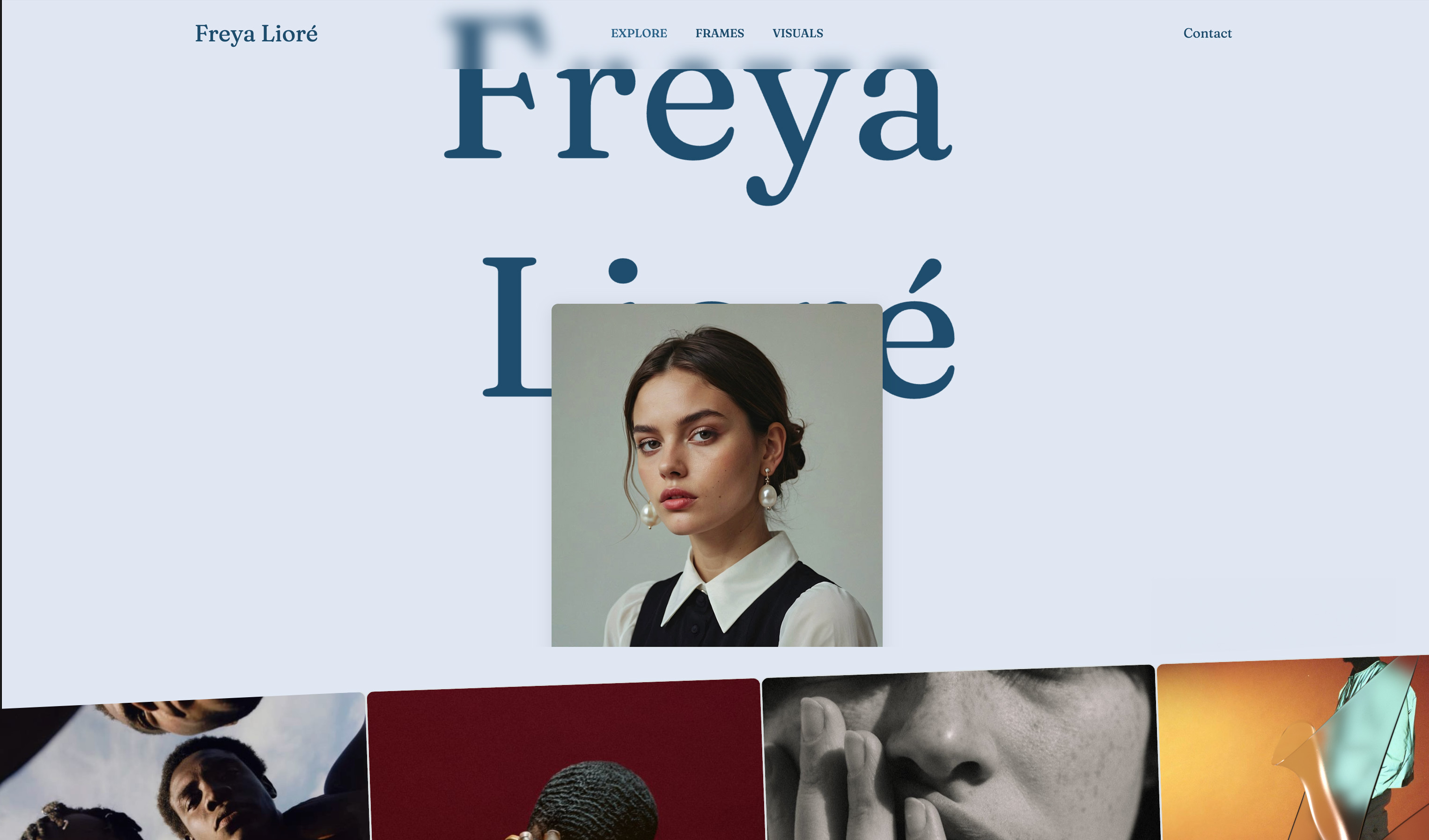 Use template
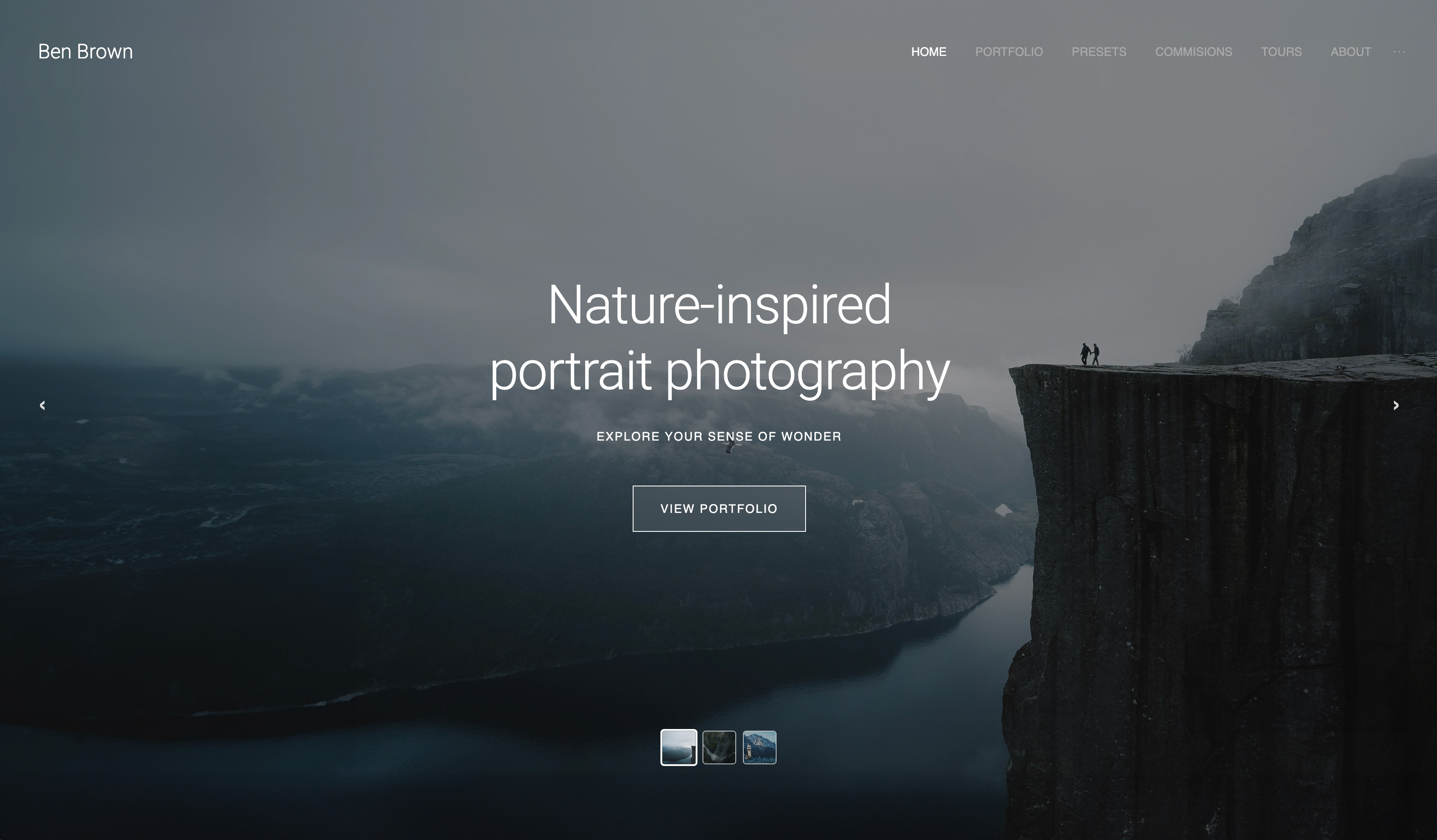 Use template
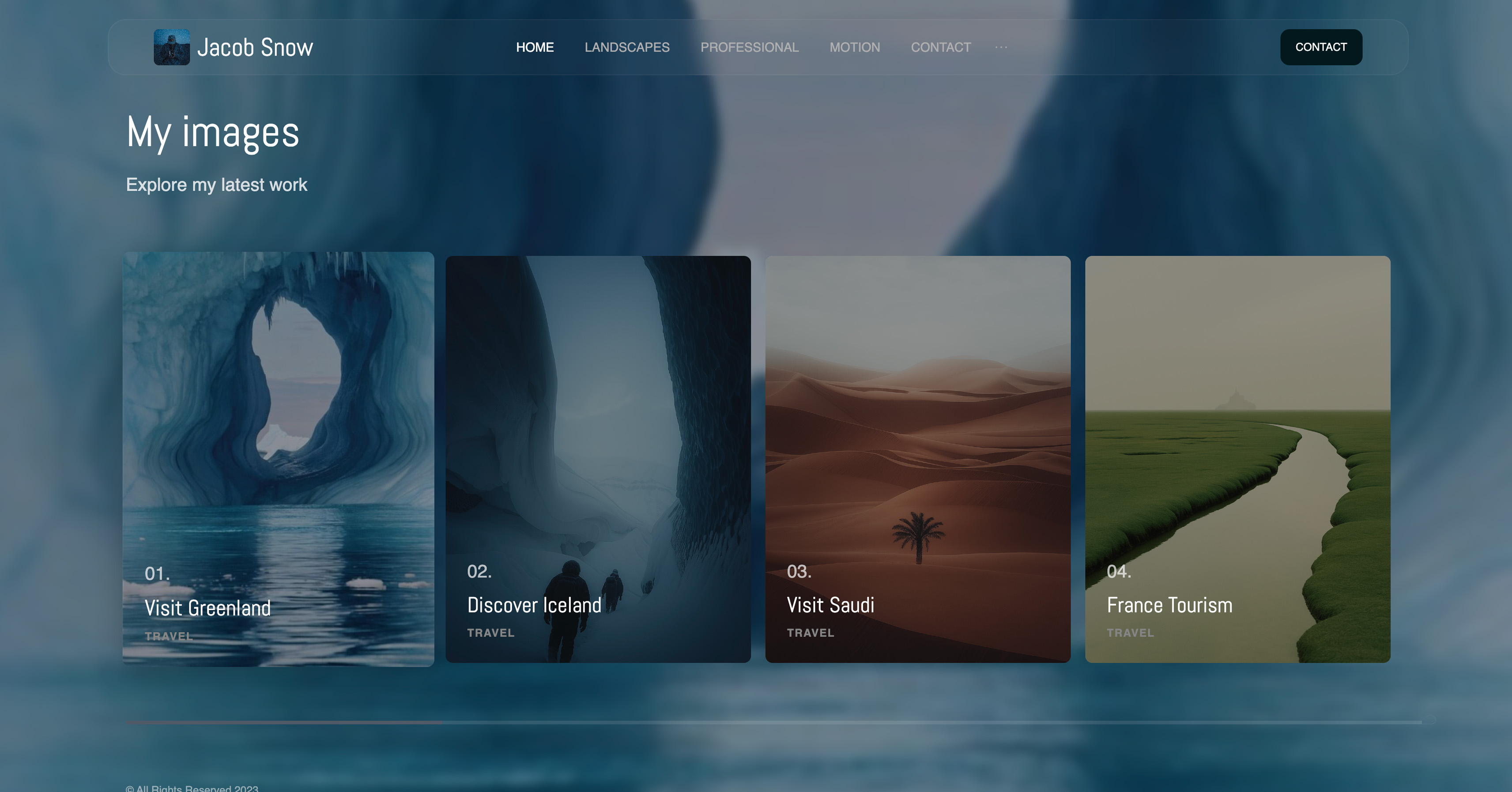 Use template
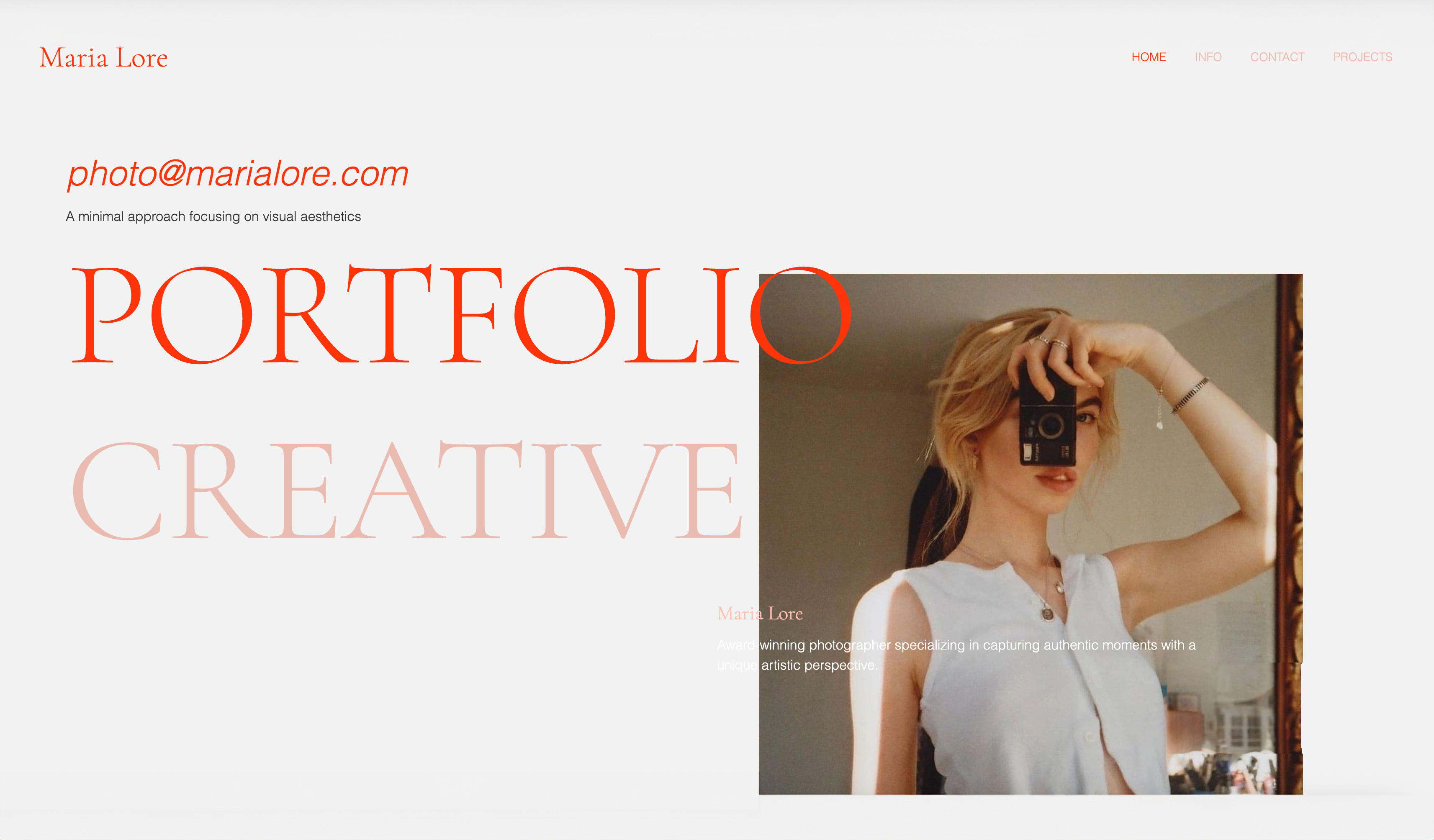 Use template
 Use template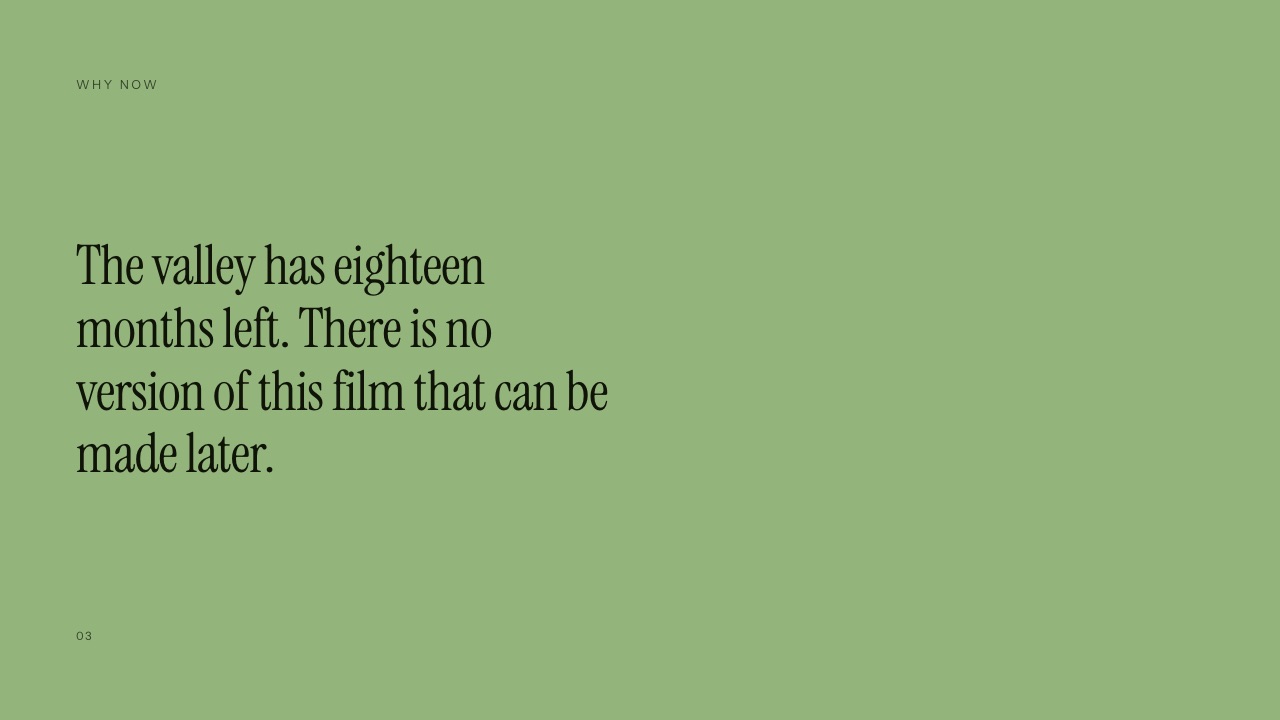
A director has spent eleven years filming in one valley. A reservoir will flood it in eighteen months, four families have agreed to be filmed, and the budget is $240,000 with half already committed.
Everything a documentary pitch deck template needs to carry is in those three sentences, and most decks bury all three under forty pages of mood.
Fiction decks sell a story that could be shot any year. A documentary deck sells a window that is closing and a key that only this team holds. Funders read for those two things first, then check whether the plan survives the day a contributor walks away.
A documentary pitch deck is a 15 to 20 slide presentation that asks a fund, broadcaster, impact funder or crowd to pay for a nonfiction film by proving three things: the story is happening now, the filmmaker has access to the people living it, and the budget and plan can survive what real life does to a shoot.
A documentary pitch deck template that wins money runs about 20 slides and is built around three pages funders weigh most: Why now (the urgency), Who it follows (the access), and Risks (what you do when a contributor leaves or a date moves), supported by a budget top sheet and a clear ask.
Framekit Slides is our pick for building it, because its Documentary Funding Pitch template already has all twenty pages in that order, including the risk table most generic templates leave out, and it sits on the same account as your teaser and site.
The trade-off: templates need a paid plan, share links have no password or per-viewer analytics, and PowerPoint export is picture-based.
Canva suits a free start, Google Slides suits a team writing a grant together, and Storydoc or Pitch suit producers who need to see who opened the link.
Full disclosure: Framekit makes Slides, and it ranks first in the build section near the end of this guide. We have not used the other deck tools; what we say about them comes from their own pricing and template pages, read on 19 September 2026 and linked. The funder guidance quoted here comes from each organisation's own site. Storyflow, which we suggest for drafting the treatment, is a sister product to Framekit from the same team. Canva and Google Slides are free where Framekit's templates are not, and Pitch and Storydoc show who read a deck, which Framekit cannot.
How We Put This Documentary Pitch Deck Template Together
Nobody publishes a study of how documentary funders read decks, so this guide stacks three kinds of evidence and labels each one, so you can tell a funder's written rule from our reading of it and from arithmetic you can redo yourself.
Read at the source. Eligibility rules, sample-length requirements and award ceilings come from the funders' own pages: the Sundance Institute Documentary Fund, ITVS, the International Documentary Association, Catapult Film Fund and the IDFA Bertha Fund.
Kickstarter's fee comes from Kickstarter. Deck tool prices come from each vendor's pricing page. Every page was read on 19 September 2026.
Calculated. The budget shares, the per-day crew cost and the crowdfunding net are simple sums on the sample budget, shown in the tables so you can swap in your own figures.
Rendered. The slide images are Framekit's Documentary Funding Pitch and Documentary Short Treatment templates, rendered page by page.
The Long Field, the film inside the first one, is a sample written for the template: the valley, the families and the press quotes are invented, and we say so wherever it matters.
Not done. We did not build the deck in Canva, Google Slides, Pitch or Storydoc, and we did not submit it to any fund. Where this guide says what a funder wants, it quotes what the funder publishes.
For writing the treatment that often travels with the deck, Storyflow's guide on how to write a documentary treatment covers the prose document. This guide stays with the funding deck.
The Documentary Funding Deck in Numbers
These six figures set the shape of the template below, and each one is either a funder's published rule or a sum worked from the sample budget, so a skeptical producer can check every one before relying on it.
- 52 minutes. The minimum length for the Sundance Institute Documentary Fund, which says it prioritises budgets under $1.2 million, excluding distribution and impact costs.
- 10 minutes. The shortest work-in-progress sample Sundance accepts from applicants in production, with 10 to 20 minutes encouraged, according to its 2027 application page.
- $400,000. The ceiling for a feature through ITVS Open Call, which is a co-production agreement rather than a grant, with up to $50,000 for stand-alone shorts.
- 20 slides. The length of Framekit's Documentary Funding Pitch template, from cover to thank-you page.
- 3 slides. Why now, Who it follows and Risks: the pages that answer the urgency, access and survival questions every documentary funder asks.
- $2,400. The sample budget's crew cost per shoot day: $96,000 for a director, a DP and a sound recordist across 40 days.
The Three Slides Documentary Funders Weigh
In one linea documentary funder is buying a window that is closing and a key only you hold, so the Why now, Who it follows and Risks slides carry more of the decision than the twelve pages of story and look around them.
Sundance's application says the work sample should show "access to characters, visual treatment, and the developing tone and style". Access comes first in that list for a reason. A fiction producer can recast a lead.
A documentary cannot recast the farmer who has agreed to be filmed for a year.
Why Now: The Urgency Slide
The Why now slide proves the film has to be made this year and cannot be made later. The Long Field's version is two sentences: the valley has eighteen months left, and there is no version of this film that can be made afterwards.
The template's speaker note is blunt about it: this is the whole urgency argument, so do not rush it.
What counts as urgency. A date set by someone else: a flood, a closure, a verdict, an election, a species season, a person's age. What does not count is a topic being "timely".
"Timely" describes every film about the news, so it tells a funder nothing about yours.
Budget for the pagetwo sentences and one image. If you need a paragraph to explain why the window is closing, the window may not be closing.
Who It Follows: The Access Slide
The Who it follows slide names the people, says what each one wants or faces, and proves you are already in the room with them. It is the documentary version of a cast list, except nobody on it has signed a contract with an agent.
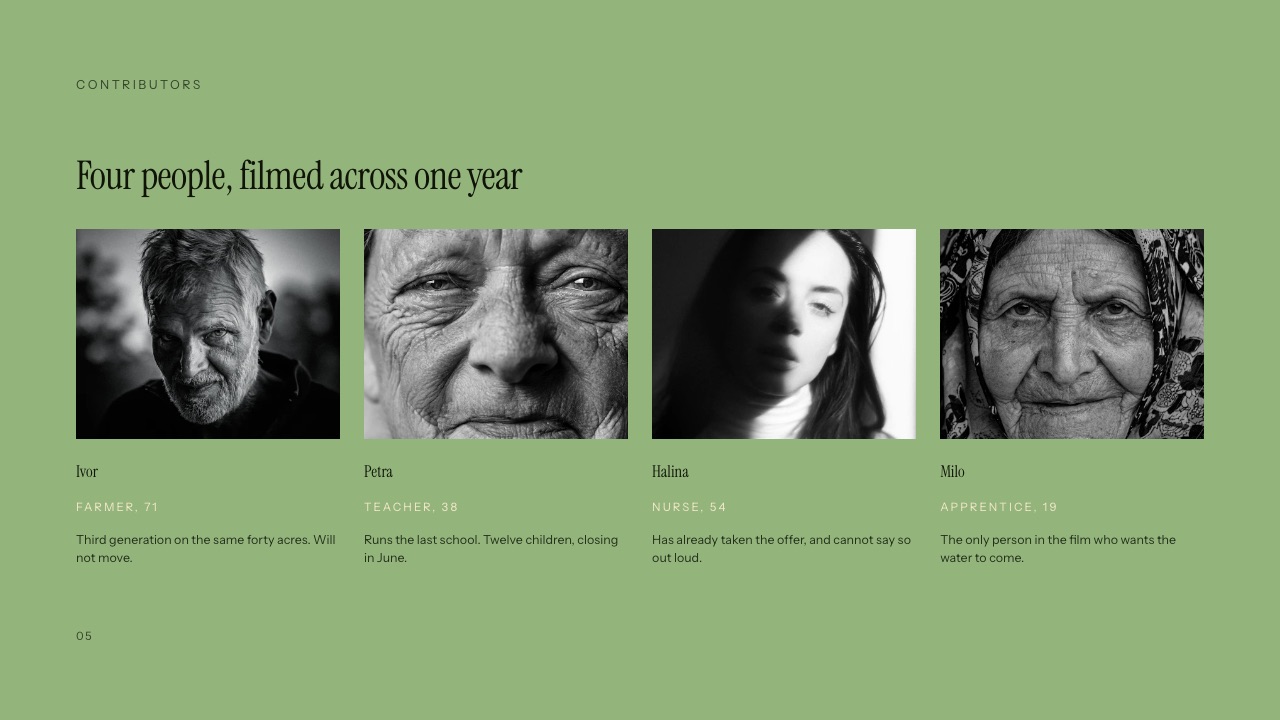
The model entry. The Long Field gives each of its four contributors a name, a role, an age and one line of tension. Ivor, a 71-year-old farmer, third generation on the same forty acres, will not move.
Petra, 38, runs the last school, twelve children, closing in June. Halina has already taken the offer and cannot say so out loud. Milo, 19, is the only person in the film who wants the water to come.
Four people, four positions on the same event, and one of them is on the other side.
Access is proven elsewhere too. The director's statement is where the eleven years come in, and the Locations slide says the dam works access is agreed in writing with the water authority.
A funder will look for that phrase, "agreed in writing", on any location or institution the film depends on.
Risks: The Survival Slide
The Risks slide lists what could go wrong, how likely it is and what you will do about it, which is the page that tells a funder you have made a documentary before, or at least thought like someone who has.
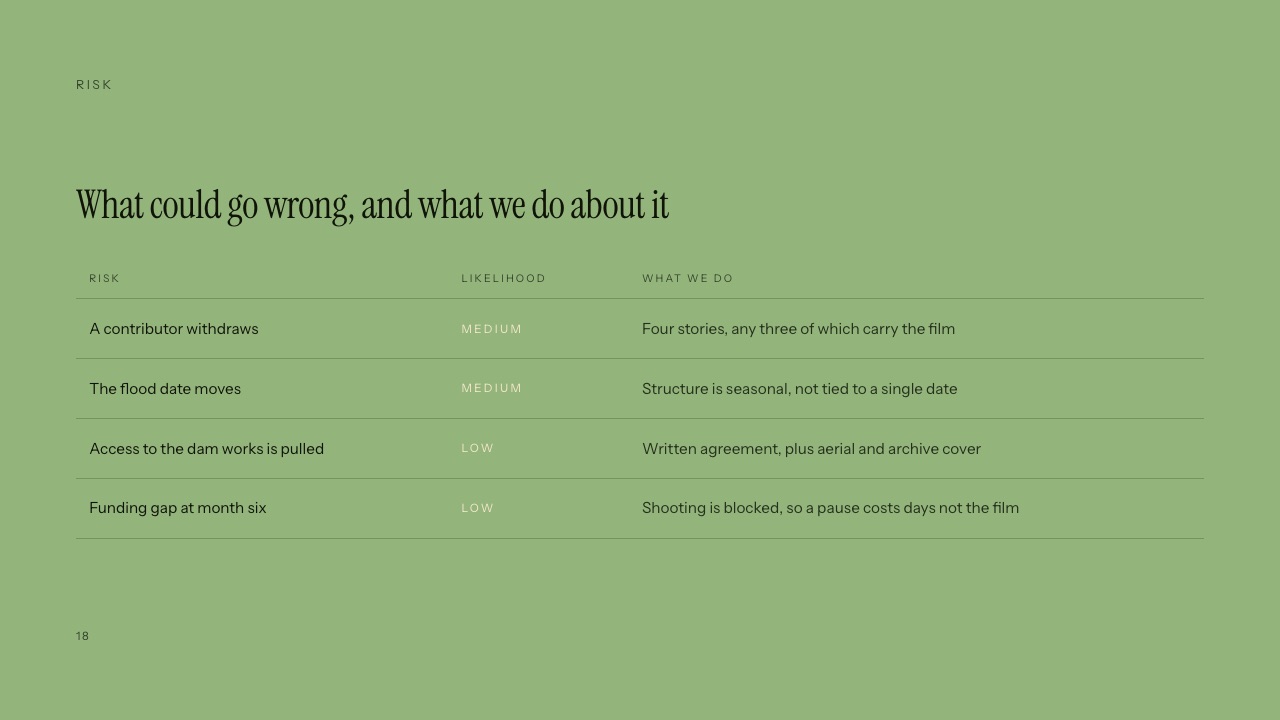
| Risk in the sample | Likelihood given | The plan | What it proves to a funder |
|---|---|---|---|
| A contributor withdraws | Medium | Four stories, any three of which carry the film | The structure does not hang on one person |
| The flood date moves | Medium | The structure is seasonal, not tied to one date | The urgency is real but the film is not hostage to it |
| Access to the dam works is pulled | Low | Written agreement, plus aerial and archive cover | Access was secured on paper, with a fallback |
| A funding gap at month six | Low | Shooting is blocked, so a pause costs days, not the film | The schedule was built for how money actually arrives |
Why most templates miss it. A startup deck has no risk page, and most film pitch templates are adapted from startup decks. Fiction decks rarely need one either.
A documentary does, because its biggest risks sit with people and events the team does not control, and a funder who sees them named and answered reads the rest of the deck with more trust.
The 20-Slide Documentary Pitch Deck Template
In one linethe full documentary pitch deck template runs twenty slides in five movements, and every slide exists to prove one of six things a funder needs to believe: urgency, access, character, craft, a realistic budget, and an audience that will see it.
The table follows the page order of Framekit's Documentary Funding Pitch.
The "proves" column uses those six words so you can check that each one appears at least twice, and the last column says what to do with the page when the deck goes to a grant panel rather than a commissioner.
| # | Slide | What it must prove | Proves | For a grant application |
|---|---|---|---|---|
| 1 | Cover | Title, length, stage and the ask in one glance | Budget | Keep; add the fund's project reference |
| 2 | Logline | What happens and to whom, in one sentence | Character | Keep; it becomes the form's short synopsis |
| 3 | Why now | The window is closing | Urgency | Keep, near the top |
| 4 | Director's statement | Why you, and how long you have been there | Access | Keep; grants weigh the personal link heavily |
| 5 | Who it follows | The people, and that they have said yes | Access, character | Keep |
| 6 | Story beats | The film has a shape, even unscripted | Character | Keep |
| 7 | Visual approach | How it will be shot, in concrete terms | Craft | Keep; pair with the work sample |
| 8 | Mood | How it should feel | Craft | Optional |
| 9 | Locations | Where, and who has agreed | Access | Keep if access is location-based |
| 10 | Audience | Who watches, where and when | Audience | Keep for impact funds; shorten for arts grants |
| 11 | The case | The three numbers behind the film | Urgency, access | Keep |
| 12 | Production plan | Phases and months | Budget | Keep |
| 13 | Shoot blocks | Days, seasons and what is filmed in each | Budget, craft | Fold into the plan if space is short |
| 14 | Budget | The top sheet | Budget | Keep; attach the full budget separately |
| 15 | The ask | The total, what is committed, what you need | Budget | Match the fund's ceiling |
| 16 | The team | Who has finished films before | Craft | Keep |
| 17 | Press | What was said about the last film | Audience | Cut for first-time directors |
| 18 | Risks | What could go wrong, and the plan | Access, budget | Keep |
| 19 | Next steps | What happens after this meeting | Budget | Replace with the fund's timeline |
| 20 | Thank you | One name, one email, one teaser link | Audience | Keep |
Slides 1 to 3: The Opening That Sets the Clock
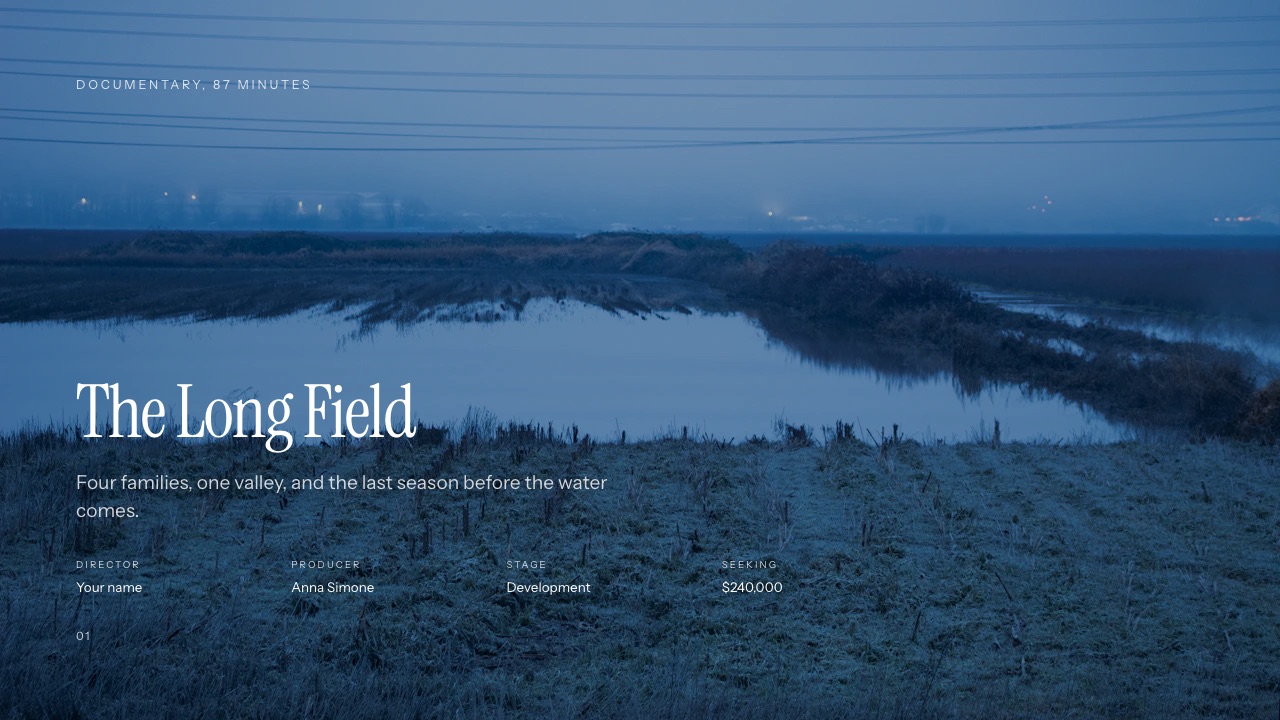
The cover carries four facts and a frame: The Long Field, documentary, 87 minutes, producer Anna Simone, stage Development, seeking $240,000. The speaker note says title, length, stage and the ask, and everything else can wait.
Putting the ask on the cover feels forward. For a documentary it saves the reader a search.
The logline is one sentence: "A reservoir will flood the valley in eighteen months, and the four families living in it have to decide what to take." It names the event, the date, the people and the decision, in 22 words.
The line beneath it does the job of a synopsis in miniature, saying the film is not about a dam but about what people carry.
Slides 4 to 9: The Film Itself
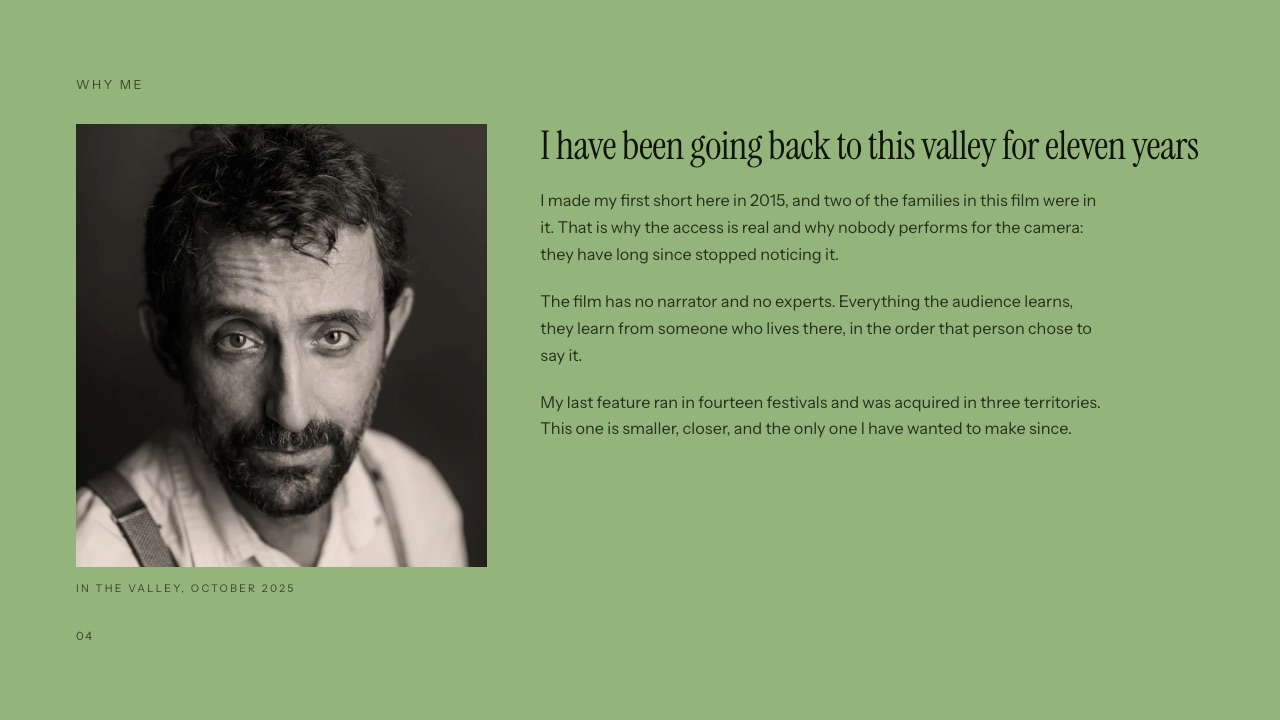
The director's statement is the access page in the director's own voice.
The Long Field's opens with eleven years of visits, a first short made in the valley in 2015 with two of the same families, and the claim that nobody performs for the camera because they stopped noticing it long ago.
It closes with a track record: the last feature played fourteen festivals and sold to three territories.
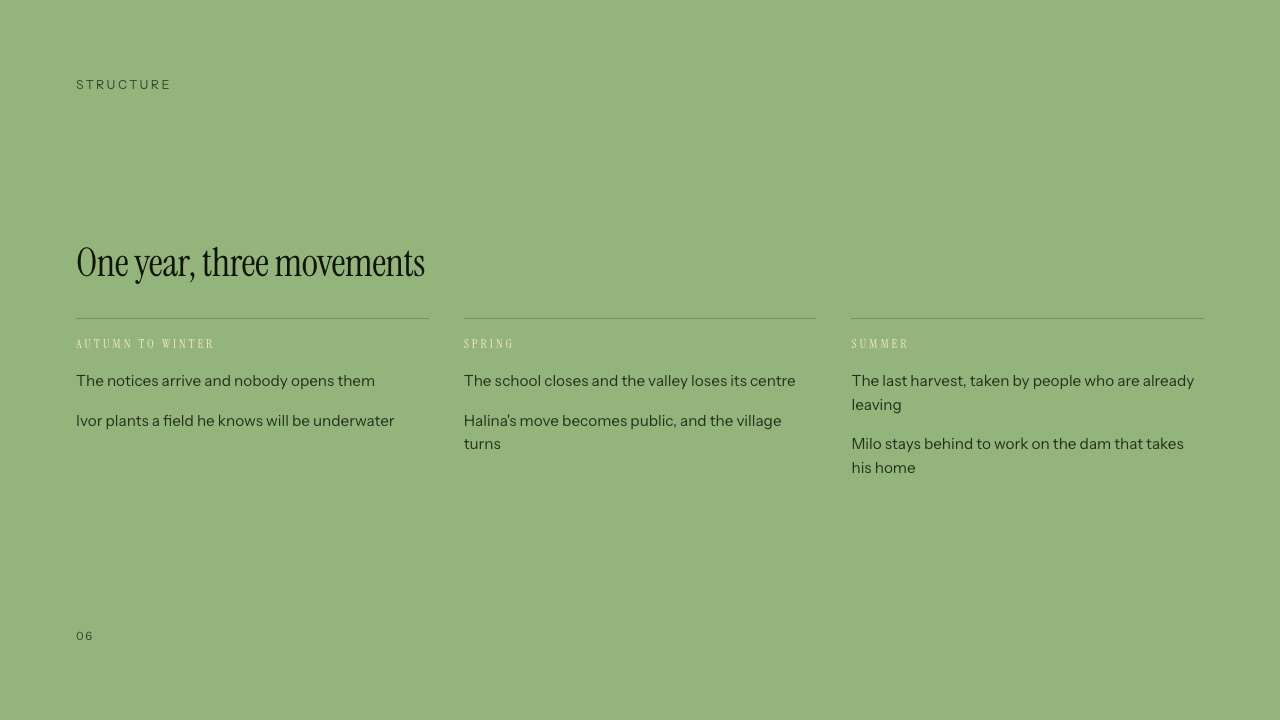
Story beats is where a documentary shows it has a shape before it has footage.
The sample uses a year in three movements: autumn to winter, when the notices arrive and nobody opens them; spring, when the school closes and a neighbour's sale becomes public; and summer, when the last harvest is taken by people already leaving.
These are expectations, not a script, and a funder knows that. What they want to see is that you know where the turns are likely to fall.
Visual approach needs nouns, not adjectives.
The sample says observational, on a tripod, in the weather: two camera bodies mostly locked off, radio mics on all four contributors, available light outside and one soft source for kitchens.
Mood and Locations follow, the second doing double duty as access evidence.
Slides 10 and 11: The Audience and the Case
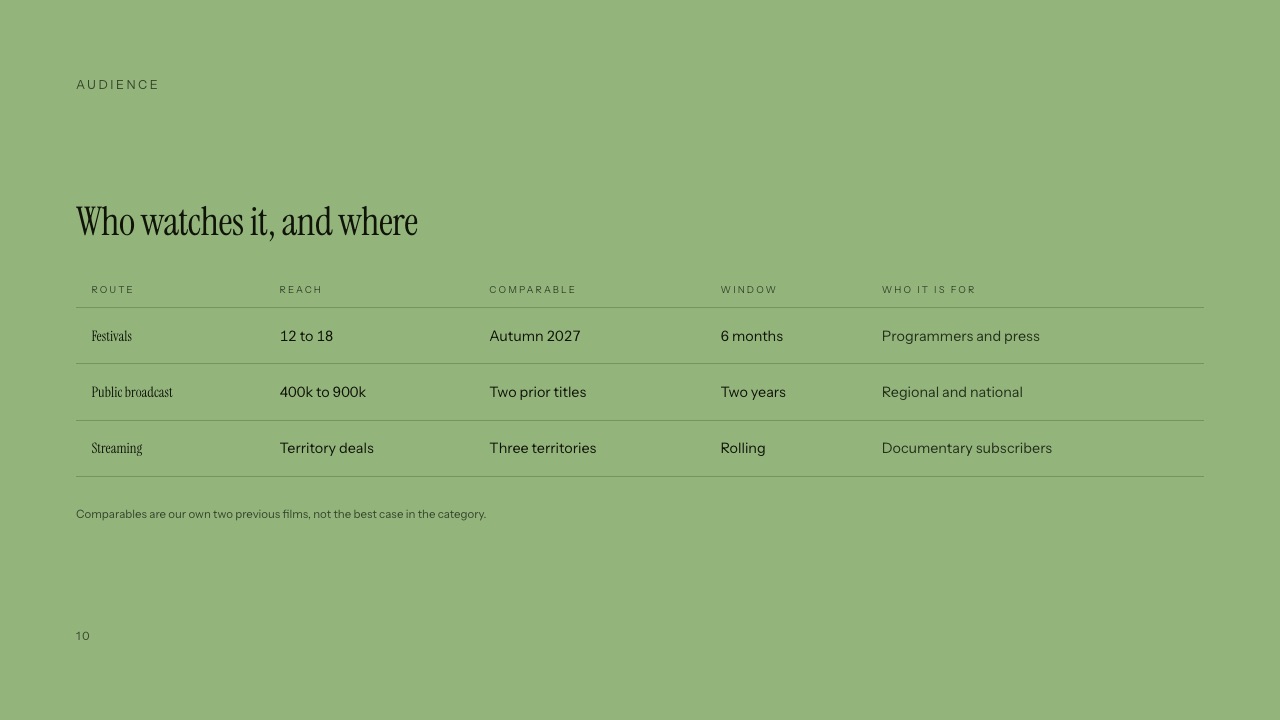
The audience slide in a documentary deck is a distribution plan in three rows.
The sample lists festivals (12 to 18 of them, from autumn 2027), public broadcast (400,000 to 900,000 viewers, based on two prior titles) and streaming through territory deals.
Its footnote is the honest line most decks skip: the comparables are the team's own two previous films, not the best case in the category.
The case slide is three numbers set large: 18 months until the valley floods, 4 families who have agreed to be filmed, 11 years of access.
If a funder forwards one page to a colleague, it is often this one, so each number should appear somewhere earlier in the deck with its evidence.
Slides 12 to 15: The Plan and the Money
The production plan runs fourteen months in three phases: development in months 1 and 2 (releases, recce, sound tests and a teaser cut for funders), filming in months 3 to 11 (forty shoot days, assembly running throughout, a rough cut at month nine), and post and delivery in months 12 to 14.
Shoot blocks then splits the forty days by season: 12 in autumn, 8 in winter and 20 across spring and summer. A funder can see at once that the film cannot be shot faster than the year it records.
The budget and the ask come next, and they get their own section below, because the money page is where documentary decks most often lose a reader.
Slides 16 to 20: The Team, the Record and the Exit
The team page names the producer, the director of photography and the editor. Press quotes what reviewers said about the last film (the outlets in the sample are invented, so replace them with real ones or cut the page).
Risks follows, then Next steps, which the sample writes as three dated actions: a call with the director and producer this month, the eleven-minute teaser sent on request, and terms agreed by June so the first shoot block makes the season.
The thank-you page carries a name, an email and a teaser address.
A Sample Documentary Budget Top Sheet
In one linethe budget page in a documentary pitch deck is a top sheet of five or six lines that add up, plus one sentence saying how much is committed and by whom, because a funder checks the arithmetic and the co-funders before the creative pages.
The figures below are the sample budget from Framekit's Documentary Funding Pitch template.
They are an example of structure and proportion for an 87-minute observational film with a three-person crew, not a benchmark for what your film should cost. The share column is our arithmetic.
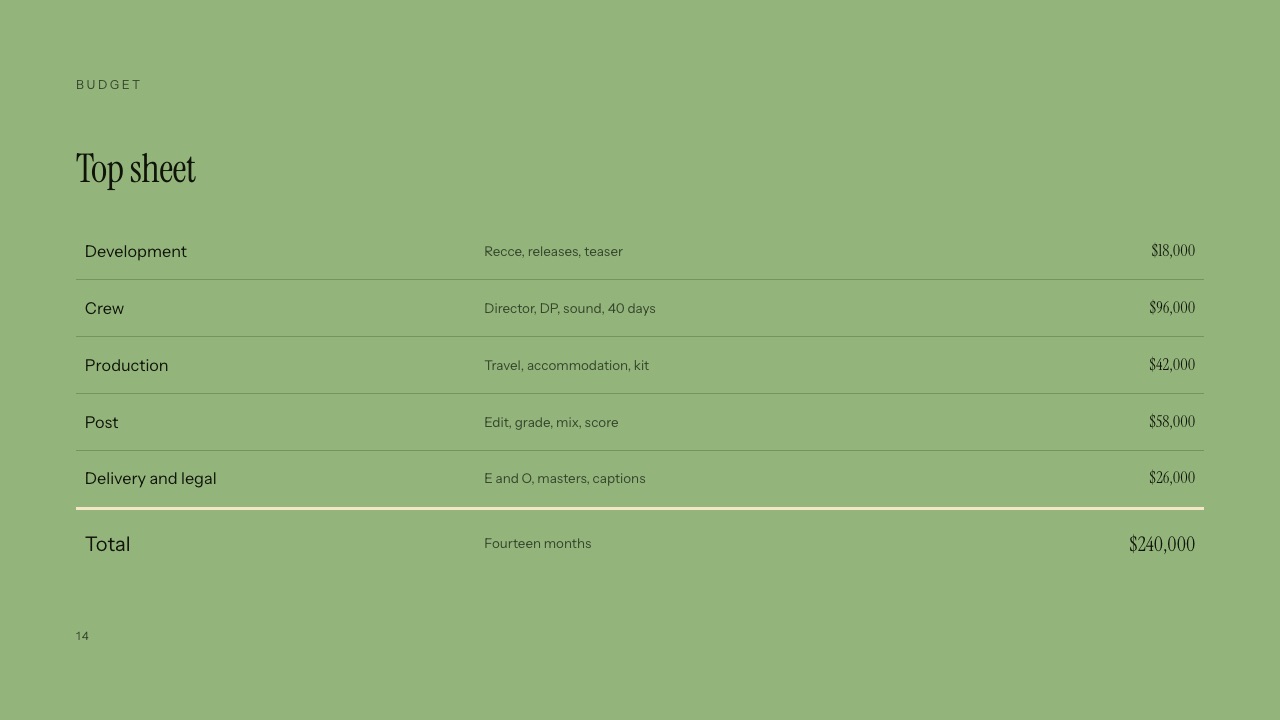
| Line (example) | What it covers | Amount | Share of total |
|---|---|---|---|
| Development | Recce, releases, teaser | $18,000 | 7.5% |
| Crew | Director, DP and sound, 40 shoot days | $96,000 | 40.0% |
| Production | Travel, accommodation, kit | $42,000 | 17.5% |
| Post | Edit, grade, mix, score | $58,000 | 24.2% |
| Delivery and legal | E&O insurance, masters, captions | $26,000 | 10.8% |
| Total | Fourteen months | $240,000 | 100% |
What a funder checks on this page. First, that the lines sum to the total, which these do. Second, that crew cost per day is plausible: $96,000 over 40 days is $2,400 a day for three people.
Third, that delivery and legal exist at all. Errors and omissions insurance, captions and festival masters are the lines first-time budgets forget, and a broadcaster will not take a film without them.
The ask page. The sample's ask repeats the $240,000 and adds one sentence: half is already committed by a regional fund and a broadcaster's development slate, and the team is raising the balance.
That means $120,000 is being asked for, and naming who put in the first half is the strongest evidence on the page, because other funders have already done their due diligence.
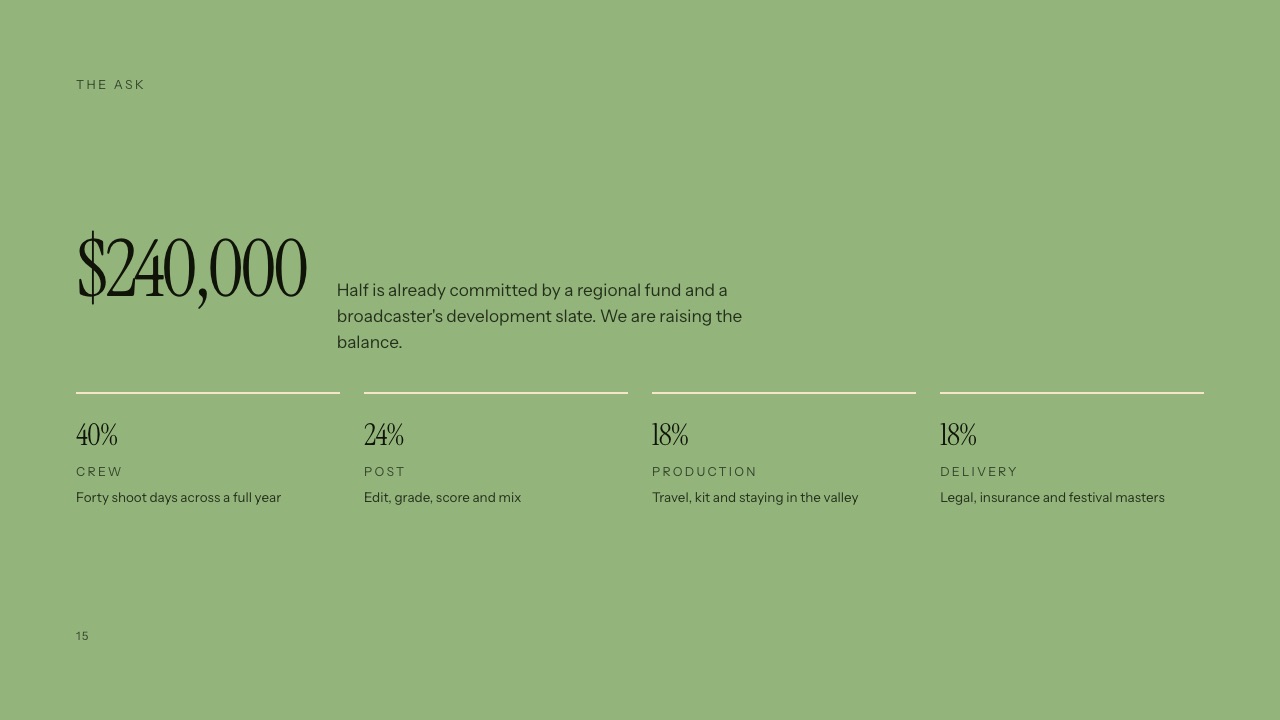
Match the fund's ceiling. An ask that exceeds what a fund gives is an ask the panel cannot say yes to. If the balance is $120,000 and the fund you are applying to gives less, the ask page names the fund's share and the other sources for the rest.
One Deck, Four Readers: Grant, Broadcaster, Impact Funder, Crowd
In one linethe same twenty slides go to four very different readers, and each one wants a different page first: a grant panel reads the director's statement, a broadcaster reads the audience and delivery, an impact funder reads the change, and a crowd reads the people.
The rules in the last column are each funder's own published guidance, read on 19 September 2026.
Funds change their programmes often, and several were between rounds when we checked, so treat these as examples of what to look for and read the current guidelines before you send anything.
| Reader | Lead with | Cut or shrink | Published example |
|---|---|---|---|
| Arts and development grant | Director's statement, Who it follows, visual approach | Press, detailed distribution | Sundance: features of 52 minutes and up, budgets under $1.2 million prioritised, nonrecoupable funding |
| Public broadcaster or co-producer | Audience, story beats, production plan, delivery | Mood | ITVS Open Call: up to $400,000 for a feature, 10 to 90 minutes, in exchange for broadcast and streaming rights for a term |
| Impact funder | Why now, audience, what should change and how you will measure it | Press | Add an impact page; the template's Audience slide is the natural place to extend |
| Crowdfunding page | Who it follows, the teaser, why now | Budget detail, risks table | Kickstarter: 5% fee if funded, plus roughly 3 to 5% card processing |
Grants want the person behind the film. Sundance says it wants filmmakers with "meaningful connections to the work they create", and its production category requires a sample of at least ten minutes.
The deck's job is to frame that sample: the director's statement explains why you are there, and the visual approach tells the panel what to look for in the footage.
Broadcasters want a film they can schedule. ITVS Open Call funds projects already in production or post, says plainly that it is not a grant, and takes certain broadcast and streaming rights during the licence term while you keep your copyright.
It also tells applicants to allow two to four weeks for the form, which ITVS has based on the Non-Fiction Core application standards.
The Long Field is in development, so Open Call would come later; the deck would first go to development funds.
Development money is its own category. Catapult Film Fund provides early-stage research and development funding and accepts applications in rounds.
The IDFA Bertha Fund supports documentary projects from supported countries in Africa, Asia, Eastern Europe, Latin America, the Caribbean and Oceania, with separate strands for development and production.
In the US, the International Documentary Association said in August 2026 that its Pare Lorentz Documentary Fund, which gives annual grants totalling $95,000, is expected to reopen in late 2026 with a new theme.
Crowds want people, not budgets. On Kickstarter, a successfully funded project pays a 5% fee plus Stripe's processing of roughly 3 to 5%, and nothing is charged if the goal is missed.
Raising $30,000 of The Long Field's balance that way would cost $1,500 in platform fee and $900 to $1,500 in processing, leaving $27,000 to $27,600.
The campaign page borrows three slides (Who it follows, Why now and the teaser) and leaves the risk table for backers who ask.
When a Short Treatment Beats a Full Deck
In one linefor a documentary short, a first approach or a fund that caps attachments, a twelve-page treatment in deck form often does more than the full twenty slides, because it gives the reader the film and the plan without the investment case.
Framekit's Documentary Short Treatment template is built for that job.
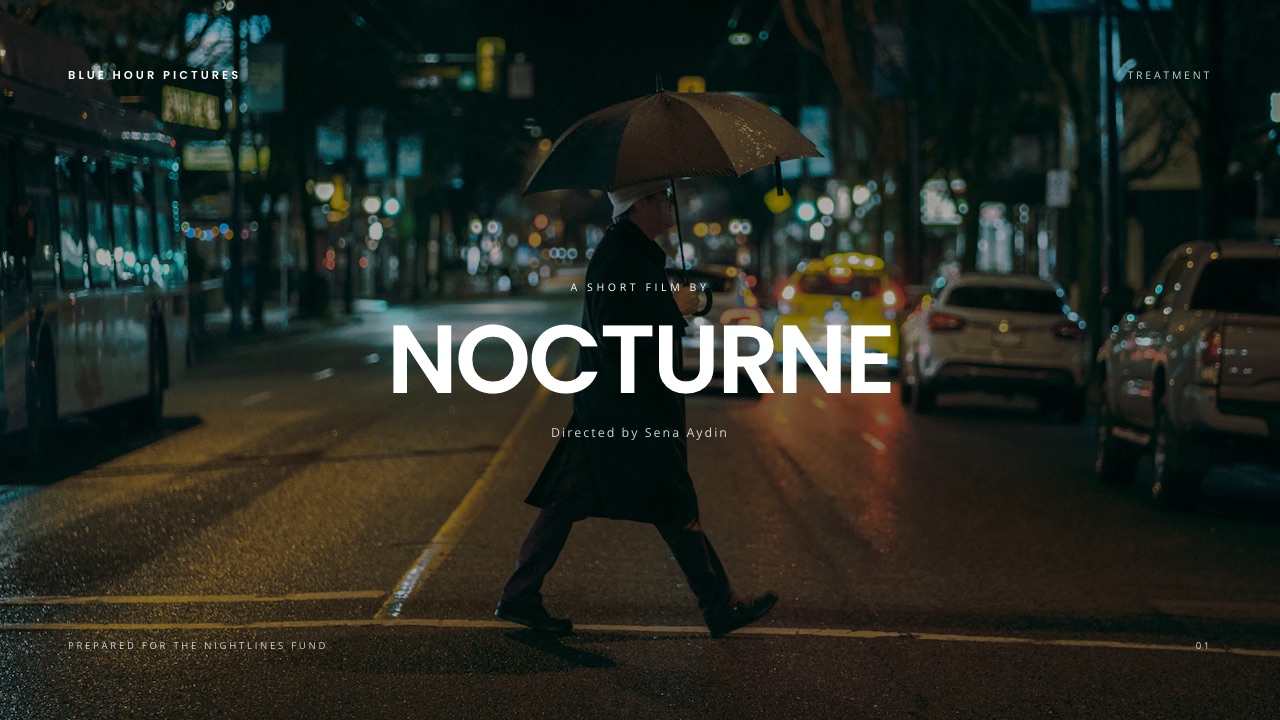
Its sample is a 22-minute film about a town that walks into a river every winter, and it runs twelve slides: cover, logline, outline, director's note, the story in three beats, tone and image, camera and craft, the sequence, where and when, and a thank-you page, with two section dividers.
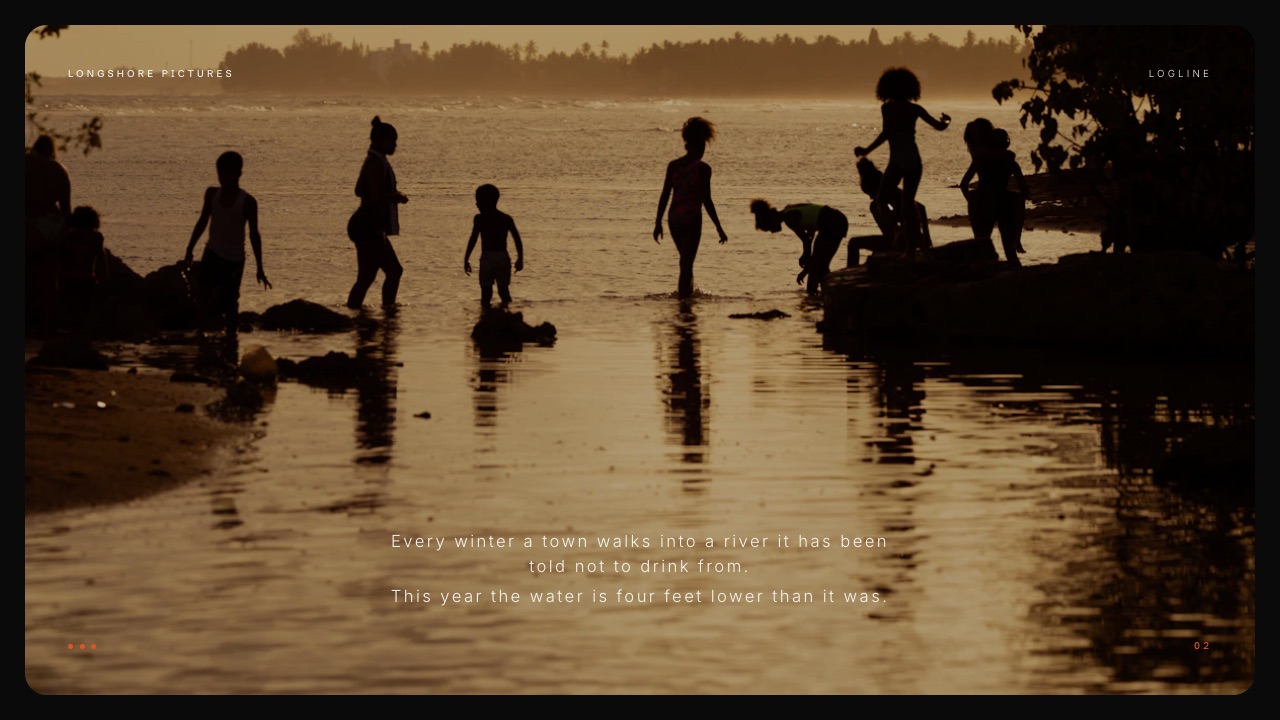
The logline as subtitles. The sample sets two lines like subtitles over a single frame: every winter a town walks into a river it has been told not to drink from, and this year the water is four feet lower than it was.
The first line is the ritual; the second is the urgency.
Camera and craft in specifics. The camera page reads like a spec sheet: Super 16 on 250D pushed one stop, 2.39:1 matted in camera, handheld at shoulder height, and one rule for the whole shoot, that nothing in the film is lit by the crew.
The speaker note calls it the page a financier reads twice, because the film stock is the budget line everyone wants to argue about.
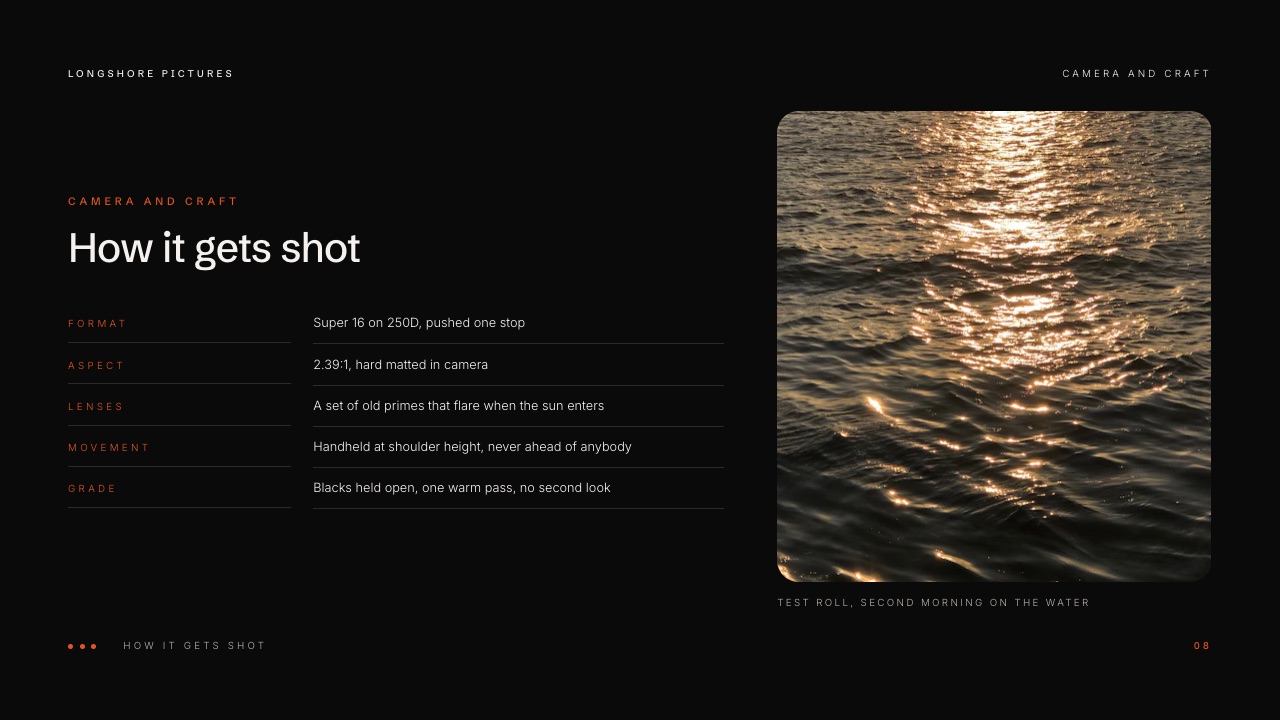
When to switch to the full deck. The moment someone asks what it costs, who else is in, or what happens if a contributor pulls out, send the twenty-slide version. The short treatment has a where-and-when page but no budget top sheet and no risk table.
Five Ways Documentary Decks Lose the Room
In one linedocumentary pitch decks rarely fail on the look; they fail because the urgency is a topic rather than a date, the access is claimed rather than shown, or the budget page leaves out the lines a broadcaster needs.
- "Timely" instead of a deadline. Name the date the window closes.
- Contributors who have not agreed. If someone on the Who it follows page has not said yes, say so, or leave them off.
- A budget without delivery. E&O insurance, captions and masters belong on the top sheet.
- No plan B for people. A film that collapses if one person leaves needs a risk page more than any other.
- Asking for more than the fund gives. Check the ceiling, then split the ask.
For the prose treatment that often accompanies the deck, our guide to writing a film treatment covers structure and length, and film treatment software compares where to write it.
Where to Build a Documentary Pitch Deck
In one lineany of five tools can hold a twenty-slide documentary pitch deck, so choose on the three things that differ between them: a ready documentary template, a way to put the teaser in front of the reader, and knowing whether the link was opened.
Prices were read on each vendor's page on 19 September 2026. Canva and Pitch served European prices, so those are quoted in euros as listed rather than converted.
| Tool | Documentary starting point | Teaser inside the deck | Link tells you who read it | Yearly cost for one person |
|---|---|---|---|---|
| Framekit Slides | Documentary Funding Pitch (20 slides) and Documentary Short Treatment (12) | YouTube or Vimeo embed | No, total view count only | $0 on Free, $84 on Starter for templates |
| Canva | Film and TV section with pitch and treatment decks | Videos, per Canva's template pages | Not covered here | EUR 0, or EUR 110 for Pro |
| Google Slides | Build from blank or import | Not checked for this guide | No | $0 |
| Pitch | Generic templates plus a Film Pitch Deck | Video uploads on Plus | Yes, on Team (EUR 15 a month) | EUR 120 on Plus, EUR 180 on Team |
| Storydoc | Documentary film and documentary series templates | Interactive, scrolling | Yes, on every paid plan | $237.60 on Starter |
1. Framekit Slides: Best for a Ready-Made Documentary Funding Deck
Framekit is an AI website builder for documentary makers, photographers and other visual storytellers, and its Slides tool ships a documentary template that already contains a risk table, a shoot-block page and a budget top sheet, laid out in the order a funder reads them.
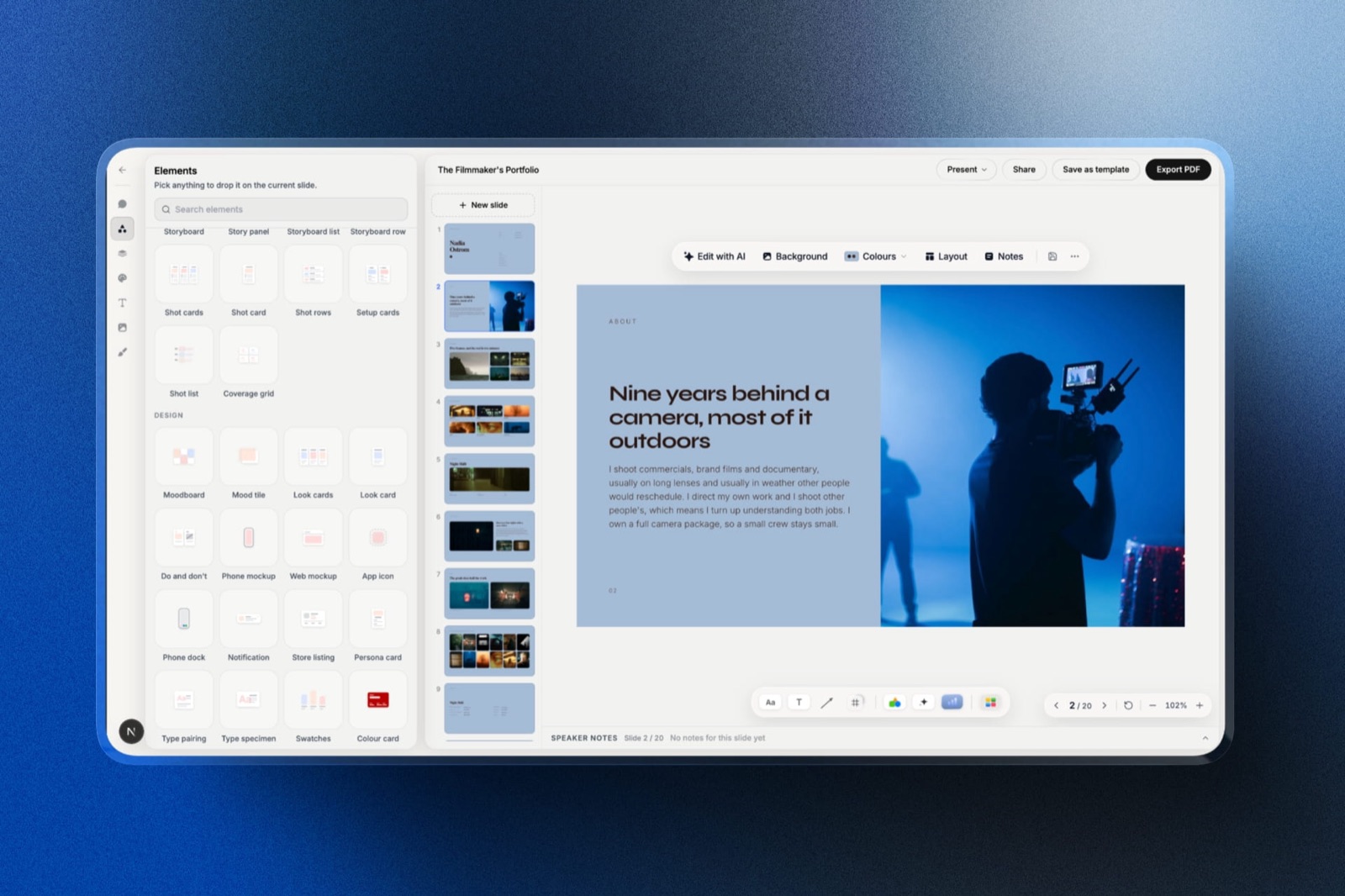
What is free and what is not. Every plan, Free included, gets unlimited decks, the AI slide writer that writes and lays out a slide from a description, speaker notes, full-screen presenting, a share link and PDF export.
The Documentary Funding Pitch and Documentary Short Treatment templates are in the paid template library, from Starter at $9 a month or $7 billed yearly, which also removes the Framekit byline and allows your own fonts.
Why it suits documentary work. The teaser can be embedded from YouTube or Vimeo on the slide itself, so a funder who opens the link sees footage without leaving the deck.
The same account holds your website, client galleries and a Frame.io-style review tool where a co-producer or broadcaster can leave notes pinned to the exact timecode of a cut (our guide to video review tools for documentary filmmakers compares that category).
The gotcha. Share links have no password, and Framekit shows only a total view count, not which funder opened the deck or how long they stayed on the budget.
PowerPoint export (Pro and up) turns each slide into a picture with the speaker notes kept, capped at 60 slides, so a broadcaster who wants to edit the file should get the PDF and a conversation instead.
Skip it if you are sending to twenty funders and need to know which three read it, or if your team must co-edit in one file in real time.
Verdict: the fastest route from a blank page to a funder-ready documentary deck, because the hard pages are already drafted; the price is a paid plan and a link that cannot tell you who looked.
2. Canva: Best Free Start for a First Documentary
Canva's free plan and its TV and film template section make it the default first stop for a documentary maker with no budget for tools. Pro is EUR 110 a year on the European list and unlocks a far larger template library.
The catch for documentaries. Most pitch templates, in Canva or anywhere, follow a fiction or startup order. You will need to add a risk page, a shoot schedule and a delivery line to the budget yourself, which is where the template stops helping.
Skip it if the deck needs to look distinct in a round where many applicants start from the same popular layouts.
Verdict: free, capable and a sensible place to draft; plan to rebuild the evidence pages by hand. Our Canva vs Google Slides comparison covers the choice between the two free options.
3. Google Slides: Best for Writing a Grant as a Team
Google Slides is free with a Google Account and is at its best when a director, a producer and an impact producer are all rewriting the same deck the week before a deadline.
Live editing, comments and action items keep that process sane, and it imports PowerPoint and Canva files, so the deck can move once the words are settled.
The weakness is visual: default themes look like a quarterly review, so the look pages need work. Skip it if nobody on the team will take on the design pass.
Verdict: the best writing room for a grant deck, and a fine one to export a PDF from.
4. Pitch: Best When You Need Read Receipts
Pitch's Team plan, EUR 15 a seat a month paying yearly on the European list, adds 25 advanced links that record visits, slide views and time per slide.
For a producer approaching a dozen broadcasters, that shows who went straight to the budget and who stopped at the logline, which shapes the follow-up.
The Plus plan at EUR 10 includes video uploads and PowerPoint export but not the tracked links, and the Free plan's 100 AI credits do not renew. Skip it if your list of funders is short and personal.
More in our roundup of Pitch alternatives.
Verdict: worth the Team price during an active funding round, and not before.
5. Storydoc: Best for an Interactive Impact Pitch
Storydoc builds scrolling, mobile-friendly decks with analytics, and its gallery includes a documentary film pitch deck template and a documentary series version.
Starter is $19.80 a month billed yearly ($237.60) for five active documents, and Pro is $36 a month ($432 a year) for thirty, according to Storydoc's pricing page.
The five-document cap is the planning constraint across a long campaign. Skip it for grant portals that require a PDF upload.
Verdict: a strong fit for impact funders and donors who read on a phone, and an awkward fit for formal applications.
Which Documentary Deck Do You Need? A Decision Guide
In one linethe right deck and the right tool follow from the reader, the stage of the film and whether you need proof of interest, so answer these four questions in order before you open any template.
- Is the film a short, or is this a first approach? If yes, start with a twelve-page treatment like the Documentary Short Treatment and hold the full deck back. If no, go to question 2.
- Is the reader a fund with a portal and a PDF upload? If yes, build the twenty slides, follow the fund's page limits and export a PDF from any tool. If no, go to question 3.
- Are you sending to many broadcasters or funders at once? If yes, use a tool with tracked links (Pitch Team or Storydoc) so the follow-up is informed. If no, go to question 4.
- Do you want the risk, schedule and budget pages already drafted? If yes, start from Framekit's Documentary Funding Pitch. If you would rather build them yourself for free, start in Canva or Google Slides.
Whichever you choose, the teaser and your website do as much work as the deck.
Our guide to website builders for documentary filmmakers covers where the teaser should live, and festival submission platforms covers the festival route in the audience plan.
Frequently Asked Questions
What slides should a documentary pitch deck include?
A documentary pitch deck should include a cover with the ask, a logline, a Why now page, a director's statement, the people it follows, story beats, a visual approach, locations, audience, a production plan and shoot schedule, a budget top sheet, the ask, the team, a risk table, next steps and contact details.
Framekit's Documentary Funding Pitch template covers these in twenty slides.
How is a documentary pitch deck different from a fiction film pitch deck?
A documentary pitch deck proves urgency and access where a fiction deck proves story and cast. Fiction decks lead with the logline, comparables and attached actors.
Documentary decks lead with why the film must be made now, proof that the subjects have agreed to be filmed, and a risk plan for events the team cannot control, such as a contributor withdrawing.
Should a documentary pitch deck include a budget?
Yes. A documentary pitch deck should include a top sheet of five or six lines that sum to the total, plus a sentence on what is committed and by whom.
The Long Field sample uses development, crew, production, post, and delivery and legal, totalling $240,000. Send the full line-item budget separately, in the format the fund asks for.
What do documentary funders look for first?
Documentary funders look first for access, urgency and a credible team.
Sundance's application asks that a work sample demonstrate access to characters, visual treatment and tone, and says it seeks filmmakers with meaningful connections to their subject.
In a deck, that means the Why now, Who it follows and director's statement pages must be convincing before anything else is read.
Do I need a work sample or teaser with a documentary pitch deck?
Most funders expect footage once a film is in production. Sundance requires production applicants to submit a sample of at least ten minutes, and encourages 10 to 20.
In development, a short teaser or scene selects are encouraged rather than required. Put the teaser inside the deck or link it from the last slide.
Is ITVS funding a grant?
No.
ITVS says its Open Call is not a grant but a co-production agreement: it offers up to $400,000 for a feature or $50,000 for a stand-alone short, for nonfiction films of 10 to 90 minutes in production or post, and takes certain broadcast and streaming rights during the licence term.
Filmmakers keep their copyright and editorial control.
How long should a documentary pitch deck be?
A documentary pitch deck for a feature is usually 15 to 20 slides. Framekit's Documentary Funding Pitch runs twenty, and its Documentary Short Treatment runs twelve for shorts or first approaches.
Past twenty, the extra pages belong in a treatment or an appendix. Always check the fund's own page limit, which overrides any template.
Can I use the same documentary pitch deck for crowdfunding?
Partly. A crowdfunding page borrows the Who it follows, Why now and teaser pages and drops the risk table and budget detail.
On Kickstarter, a funded project pays a 5% fee plus roughly 3 to 5% for card processing, so raising $30,000 nets about $27,000 to $27,600. If the goal is missed, no fees are charged.
Canva or Framekit for a documentary pitch deck?
Canva is the better choice if you want to start free and are happy to add documentary-specific pages yourself.
Framekit is the better choice if you want a template that already contains the Why now, Risks, Shoot blocks and budget top sheet pages, and a deck that sits beside your teaser and website, at $7 a month billed yearly for templates.
Final Verdict
The documentary pitch deck template that raises money is built around proof rather than mood: a dated reason the film must be made now, contributors who have said yes, a top sheet that adds up with delivery costs included, and a risk table that shows the film survives its likeliest setbacks.
Twenty slides is enough; the three that matter most are Why now, Who it follows and Risks.
Framekit Slides is our pick for building that deck, because its Documentary Funding Pitch template already drafts all twenty pages in funder order.
Where Framekit loses is the send: its share links carry no password and no per-viewer analytics, so a producer running a wide broadcaster round is a better fit for Pitch on the Team plan or Storydoc.
Framekit is also not for a team that needs to co-write the grant in one live document, where Google Slides does the job for free.
Related readingpresentation tools for filmmakers for the wider tool field, how to write a film treatment for the document that follows a yes, and video review tools for documentary filmmakers for sharing cuts with co-producers once the money lands.
For fiction financing, the film pitch deck template sets out the 12 slides investors expect, and the commercial treatment template covers the brand-funded work many documentary crews pay the bills with.