Framekit templates
Start from a designer-made template
 Use template
 Use template
 Use template
 Use template
 Use template
 Use template
 Use template
 Use template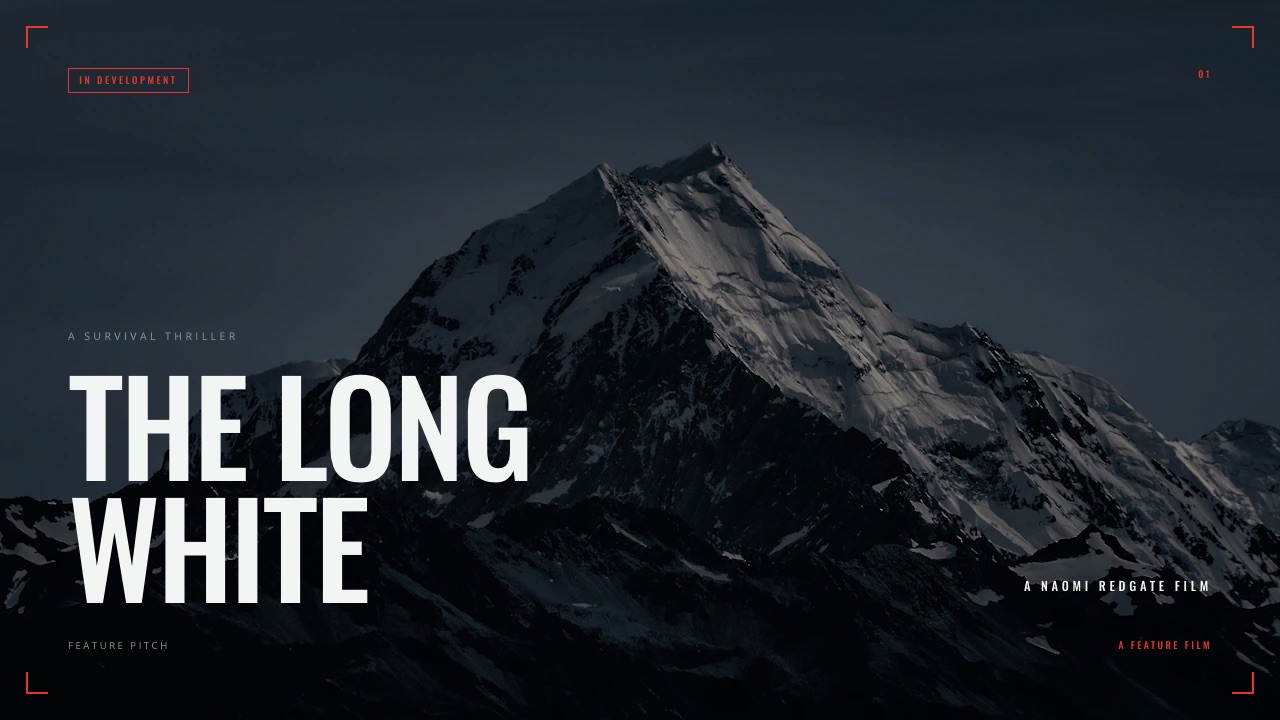
A producer emails a $1.4 million first feature to an equity financier on a Monday morning. The financier opens it between two calls, reads the logline, skips to the page with the money on it, checks who is attached and closes the file.
Three minutes, perhaps less, and the film pitch deck template the producer started from has already decided whether the script gets read.
That is the job a template has to do. Not look full, not look expensive, but put twelve answers in the order a money person asks for them, with few enough words that each answer lands in the seconds it actually gets.
A film pitch deck is a 10 to 15 slide presentation that sells an unmade film to financiers, producers, sales agents or funds by showing the story, the look, the people, the market and the money in one short read.
It is not the script, the treatment or the lookbook, although it borrows a page from each.
A film pitch deck template that works in 2026 has twelve slides, each with one job and a word budget: cover, logline, synopsis, look and tone, characters, director's vision, comparables, audience, team, production plan, budget and ask, then a summary with contact details, about 500 words in total so a financier can take it in during the three minutes they give it.
Framekit Slides is our pick for building it when the deck should look like a film and live beside your reel and site, because its five film templates are designed for cinema rather than for startups and ship with most of those pages already laid out.
The trade-off is that the templates need a paid plan, deck links have no password or per-viewer analytics, and PowerPoint export arrives as pictures.
Canva is the best free starting point, Google Slides suits co-writing with a producer, and Pitch is the pick when you need to see who opened the deck and for how long.
Full disclosure: Framekit is our product and it ranks first in the build section below, so read that section with the bias in mind. We did not use the other tools for this guide: we read their pricing pages, help pages and template galleries on 19 September 2026 and link each one, and every slide image here is a render of one of Framekit's own templates. Canva has a far bigger template library, Google Slides is free and better for co-writing, and Pitch and Storydoc report who opened a deck, which Framekit does not. Storyflow is a sister product to Framekit, made by the same team, and we link its writing guide below.
How This Film Pitch Deck Template Was Put Together
No public survey measures how film financiers read decks, so every recommendation in this guide rests on three kinds of evidence that are kept apart on purpose, so you can see which parts are published fact and which parts are our arithmetic.
Read at the source. The reading-time data comes from DocSend, now part of Dropbox, and the reading-speed figure from a 2019 meta-analysis of 190 studies.
The short film rules come from the BFI's own funding pages, the tax credit from the UK government's policy paper, and every tool price from the vendor's pricing page.
Each page was opened again on 19 September 2026, the day this guide went out, and is linked beside the figure it supports.
Calculated. The word budget is simple multiplication, three minutes of attention times an average reading speed, split across twelve slides. The working is shown in the table so you can change the inputs and rerun it for your own reader.
Rendered. The slide images are Framekit's five film pitch templates, rendered slide by slide with the editor's own builders. The films inside them are sample projects written for the templates, not real productions, and the captions say so.
Not tested. We did not build this deck in Canva, Google Slides, Pitch, Keynote, InDesign, Affinity or Storydoc.
Those sections describe what each vendor publishes rather than how the tool felt in use, and we found no user sentiment solid enough to report, so there is none.
The carried example. Nightwater is the sample feature inside Framekit's Film Logline and Elevator Pitch template: a ferryman on a river delta, a $1.4 million budget with 30 per cent committed, and a 34-day shoot that has to start with the flood season.
It is fiction, but it is specific fiction, and it runs through every slide below so each piece of advice has something concrete to hold.
For the writing itself, which is a different craft from laying out the finished deck, Storyflow's guide on how to write a film pitch deck covers the drafting process in depth.
This guide picks up where the words are settled and the deck has to be built, budgeted and sent.
Film Pitch Decks by the Numbers
Six figures anchor everything else in this template, and each one is either published by the organisation that owns it or calculated in the open from those published figures, so you can check them before you trust them.
- Under 3 minutes. How long investors now spend reviewing a pitch deck, according to DocSend's reading data as reported by Dropbox. That data covers startup rounds, not films; nobody publishes the equivalent for film money, so treat it as the nearest measured proxy.
- 238 words a minute. The average adult silent reading speed for non-fiction, from Marc Brysbaert's 2019 meta-analysis of 190 studies and 18,573 readers.
- 500 words. The text budget for the whole twelve-slide template below. At 238 words a minute it takes 126 seconds to read, which leaves 54 seconds of a three-minute look for the pictures.
- 12 slides. The length of every one of Framekit's five film pitch templates, from the survival thriller to the short film proposal.
- 2 of 5. Framekit film templates with a comparables page (The Long White calls it Comparables, Nightwater calls it It sits beside). None of the five has a slide titled Team, so that is the page you will most likely add yourself.
- £5,000 to £25,000. What BFI NETWORK England awards for short films of up to 15 minutes, which is where a short film deck most often ends up.
The 12-Slide Film Pitch Deck Template
Every slide in this template has one job, a word budget that adds up to 500 across the whole deck, an image count, and the single piece of evidence it exists to carry, so a draft that is overspending shows up the moment you count its words.
The reading time is the word budget divided by 238 words a minute, so it moves when the budget moves. Images are counted separately, because a financier takes in a picture faster than a paragraph, though never for free.
| Slide | Its one job | Words | Reading time | Images | The evidence it must carry |
|---|---|---|---|---|---|
| 1. Cover | Say what kind of film this is | 15 | 3.8 s | 1 | Title, genre, format and whose film it is |
| 2. Logline | Say what happens, in one sentence | 35 | 8.8 s | 1 | A protagonist, a want and the thing in the way |
| 3. Synopsis | Prove the story has a shape | 100 | 25.2 s | 1 | Beginning, turn and ending, including the ending |
| 4. Look and tone | Show the film before it exists | 20 | 5.0 s | 4 to 6 | Reference frames that agree with each other |
| 5. Characters | Make the leads castable | 50 | 12.6 s | 2 to 3 | Two or three people with a want and a flaw |
| 6. Director's vision | Answer why this director | 50 | 12.6 s | 1 to 4 | A personal link to the material and a stated approach |
| 7. Comparables | Prove a market already exists | 35 | 8.8 s | 3 | Three recent titles with a year and one number each |
| 8. Audience | Name who pays to watch it | 30 | 7.6 s | 0 to 1 | A defined audience and the window they watch in |
| 9. Team | Show who has done this before | 40 | 10.1 s | 3 to 4 | Credits and attachments, one line each |
| 10. Production plan | Prove it can be made | 35 | 8.8 s | 1 to 2 | Shoot days, locations and a schedule by phase |
| 11. Budget and ask | State the money plainly | 50 | 12.6 s | 0 to 1 | Total, what is committed, what you need and what it buys |
| 12. Summary and contact | Leave one page to forward | 40 | 10.1 s | 0 | Genre, runtime, budget, ask and one named contact |
| Total | Twelve jobs | 500 | 126 s | 17 to 27 | One read of about three minutes |
Where 500 comes from. Three minutes at 238 words a minute is 714 words, but only if the reader does nothing except read. Budgeting 500 spends 126 seconds on text and leaves 54 for the pictures.
To test your own draft, paste every slide's text into a word counter, divide by 238 and multiply by 60; anything over 126 seconds is asking for more reading than a three-minute look allows.
Slide 1: The Cover
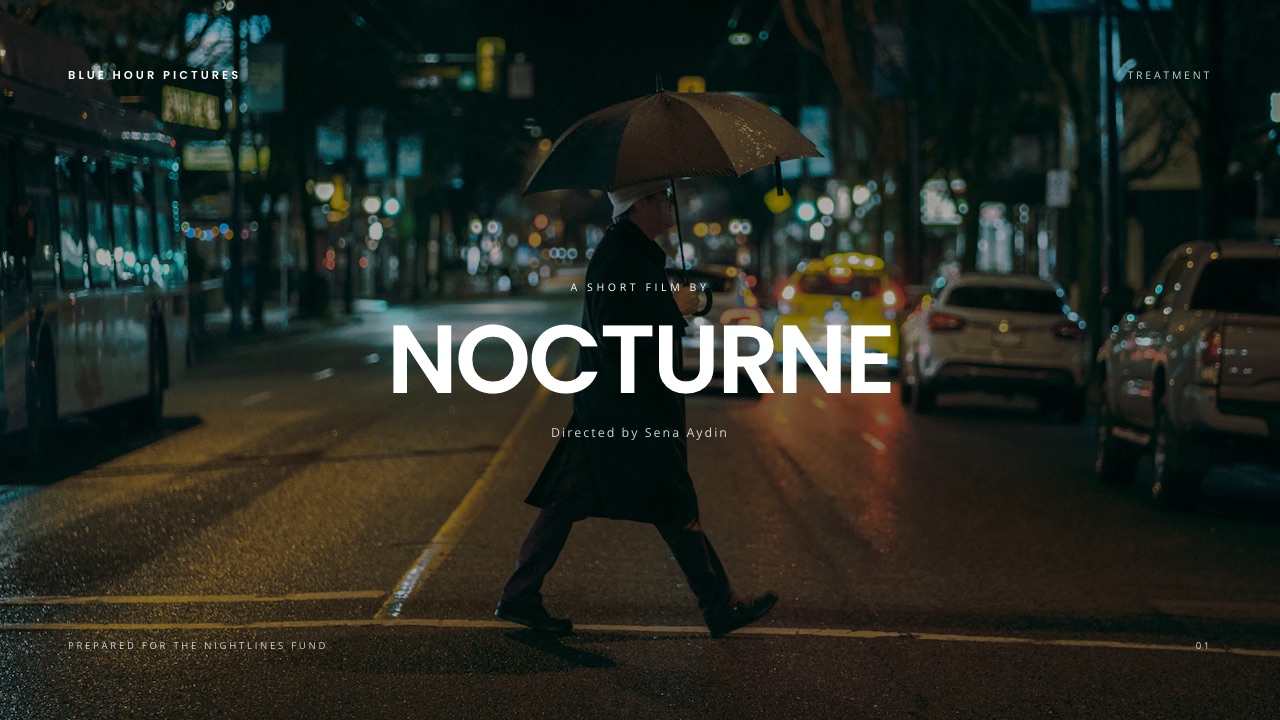
The cover has about four seconds to tell a stranger what kind of film this is. Title, genre line, format and whose film it is, over one frame that could plausibly become the poster, with nothing else competing for the eye.
Budget15 words and one image.
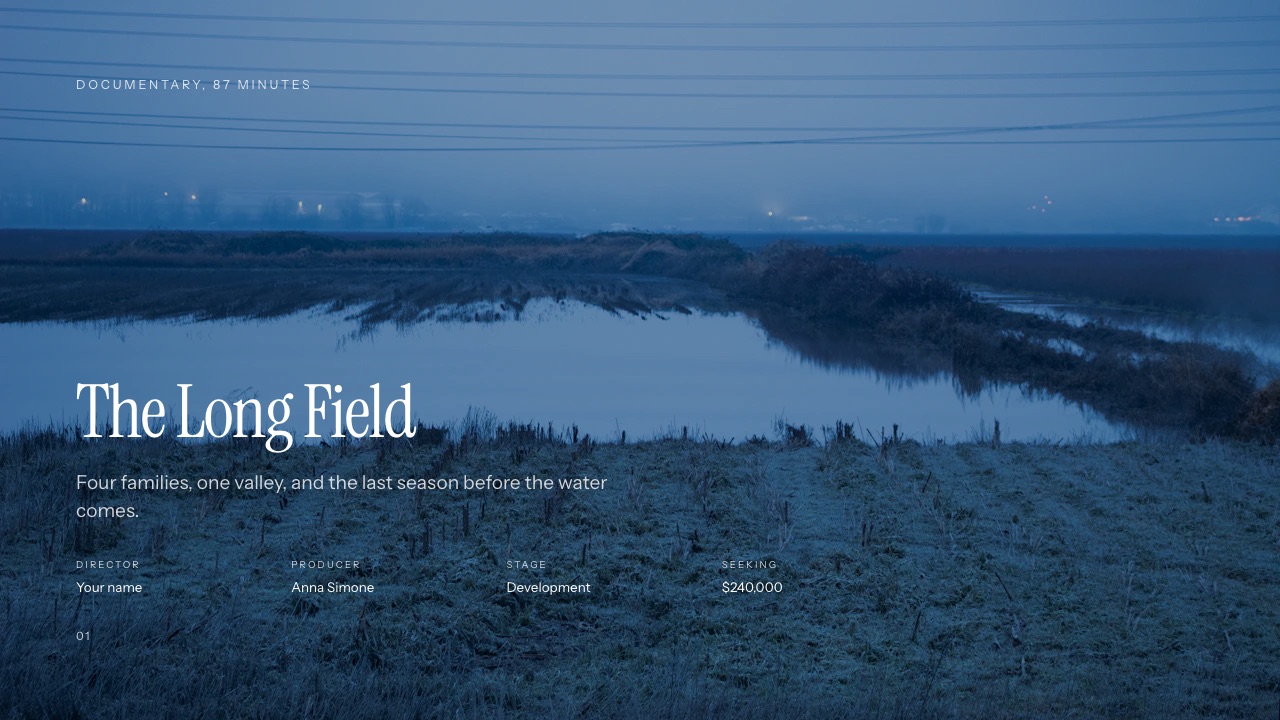
The Long White's cover at the top of this page stacks a genre line, a credit and a status tag ("A survival thriller", "A Naomi Redgate film", "In development") around the title, which is the right order of priorities for a reader who has not yet decided to care.
The common missa cover that says "a film by" and nothing about genre, which makes the reader learn from the logline what the title card should have told them. Nightwater's cover does the job in six words: the title, "A feature film" and "Delta country".
Slide 2: The Logline
The logline says what happens in one sentence: who the story is about, what they want or have done, and what stands in the way. If the sentence has no conflict in it, the financier learns that the film may not have one either.
Budget35 words and one image.
Nightwater's logline comes in at 27: "A ferryman who has spent thirty years pulling bodies out of the river finds one still breathing, and hides her from the town that put her there." The protagonist has a history, the inciting event arrives in the same sentence, and the obstacle is an entire town.

Slide 3: The Synopsis
The synopsis proves the story has a shape: a beginning, a turn and an ending. Tell the ending. A financier is not an audience, and a synopsis that stops at "but nothing is what it seems" reads like a writer who has not finished the script.
Budget100 words and one image. That is about four sentences for setup, turn and resolution, and it is the slide most likely to overspend, because every writer wants the subplot in.
The subplot belongs in the treatment, a longer document with room for it, and our guide on how to write a film treatment covers that form.
The template's layoutThe Long White spends three slides on story (two synopsis pages and an Act two page). For a first read by money, one synopsis page is the better trade, and the freed positions go to a team page and a budget page, which that template lacks.
Slide 4: Look and Tone
This is the slide that makes the film real. Four to six reference frames that agree with each other on light, colour and texture, labelled so the reader knows why each one is there, show a financier the finished picture before a single shoot day has been paid for.
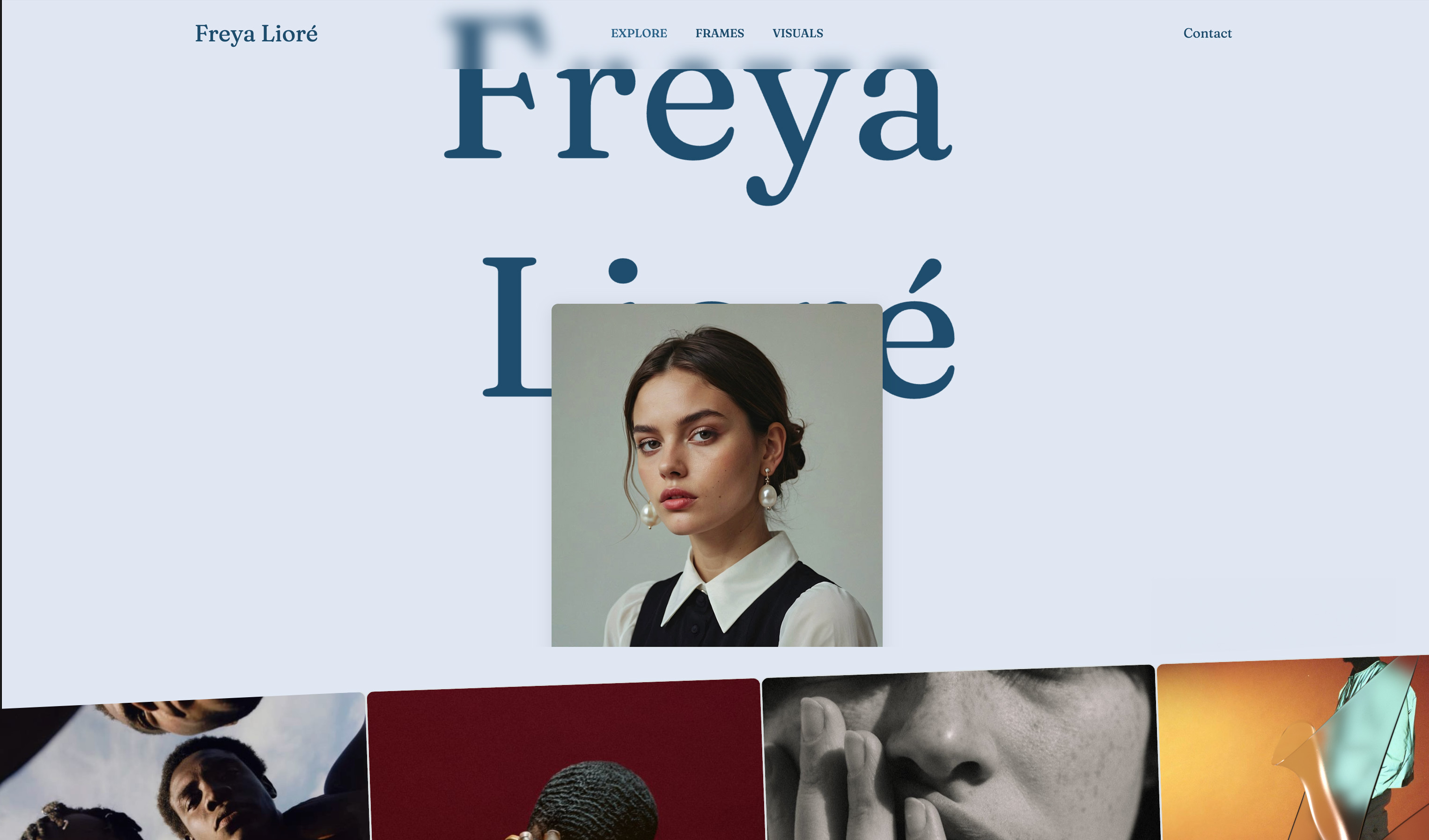
Budget20 words and four to six images. The words are labels, not prose. The Film Financing Pitch Deck's Look and tone slide carries no body copy at all: red rock, white chalk, sand ripples, a cratered surface and a camp of domes under a night sky do the talking.

The common missforty stills from forty films. A reference set that disagrees with itself tells the reader the director has not chosen yet.
If your references are still being gathered, a board tool is the better home for them first (our comparison of mood board tools covers the field), and the deck gets the six that survive.
Slide 5: The Characters
The characters slide makes the leads castable. Two or three people, each with a name, an age range, what they want and what is wrong with them, written so that an agent reading it could name an actor who would want the part.
Budget50 words and two or three images. That is 15 to 25 words a character, enough for a want and a flaw and too few for a backstory, which is exactly the point.
The template's layoutThe Long White gives each of its two leads, Wren and Callum, a slide of their own. Two leads and two pages is a sensible ceiling; a third often means the film has not settled whose story it is.
For Nightwater the page needs two entries. Ilyas, the last man on the crossing, paid by the district to recover what the water gives back. Maryam, the woman he finds alive. Everything a financier needs to start thinking about casting is in those two lines.
Slide 6: The Director's Vision
This slide answers the question underneath every other slide, which is why this director. It needs a personal link to the material and a stated approach to making it, in that order, because the link explains the commitment and the approach explains where the money goes.
Budget50 words and one to four images. The Long White's Director's note is written as a short personal statement about growing up near the mountain the film is set on, set beside a two-by-two grid of snow and forest images that carry the approach without a word of technical language.
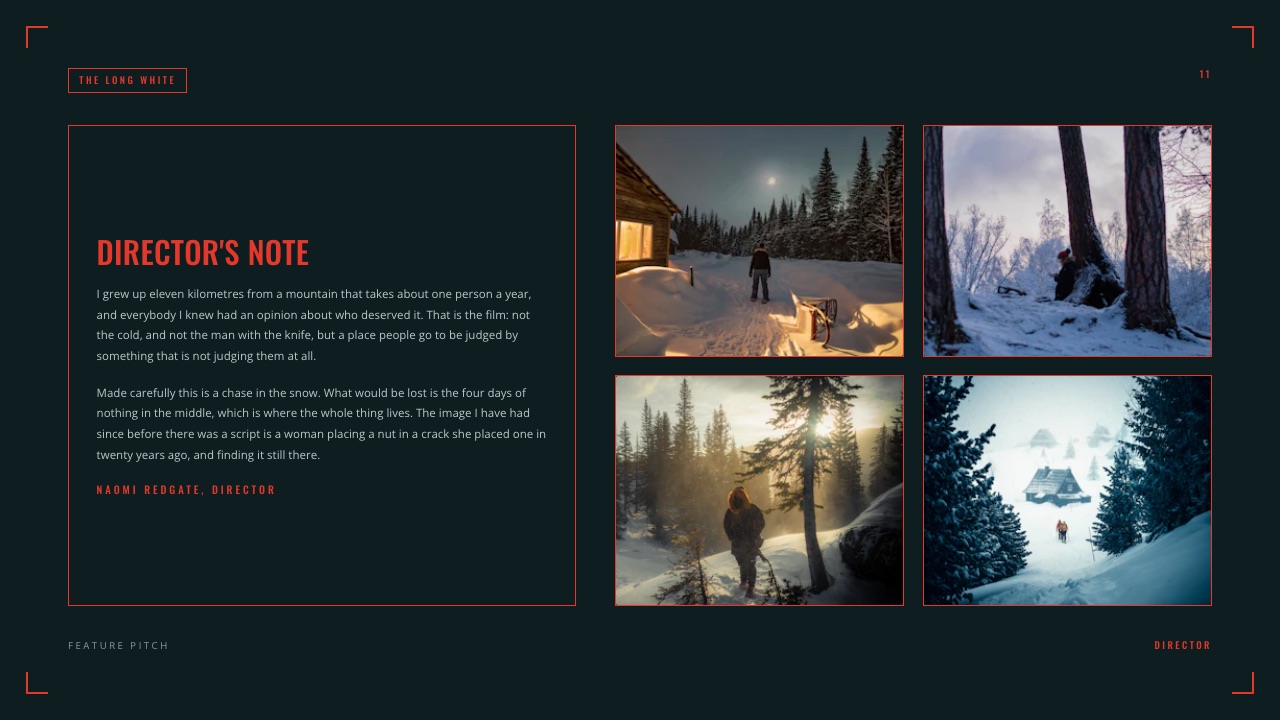
Evidence beats biographyNightwater's version of this page, titled Why this, why now in the Film Logline and Elevator Pitch template, leans on research rather than autobiography.
The delta loses roughly a village a year to the water, and the script's details came from a coroner's ledger and four months of interviews on the ferries. That is a vision a financier can check.
Slide 7: Comparables
The comparables slide proves that a market already exists by pointing at films that found one. Three recent titles, each with a year, one number (a budget, a box office figure or the sale) and one line on why it compares, are worth more than any adjective about your own film.
Budget35 words and three images.
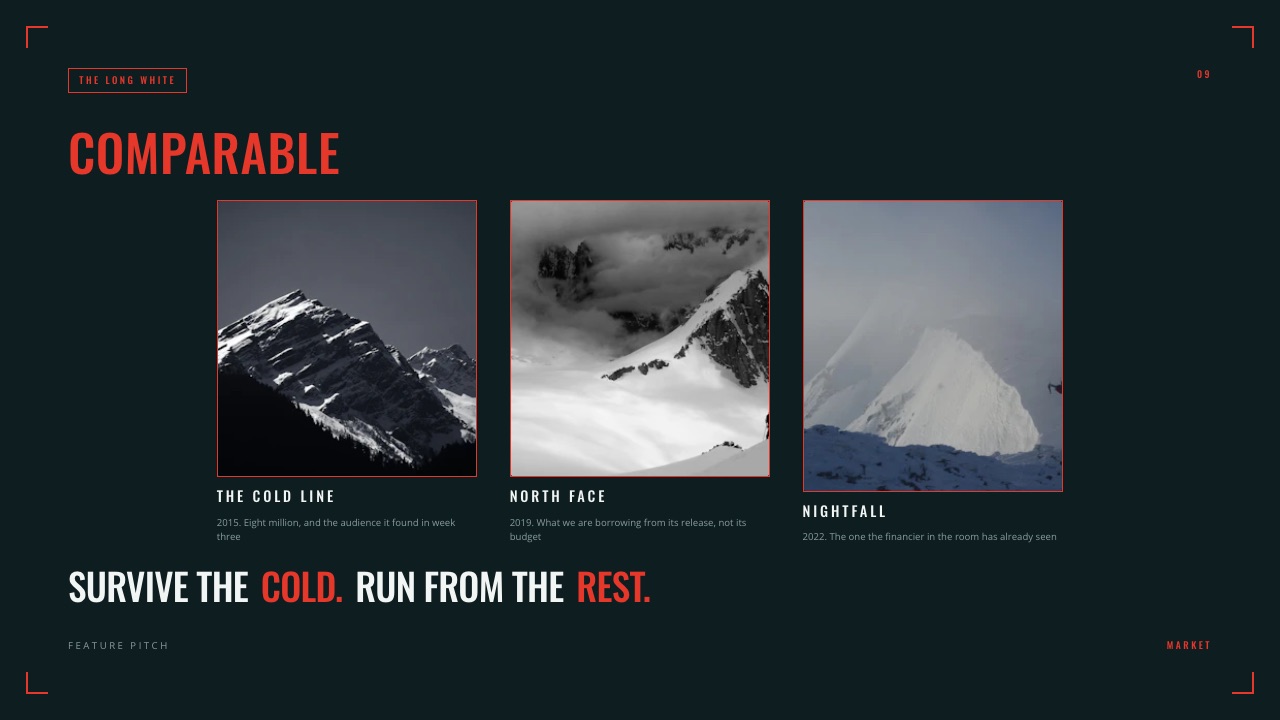
The template's layoutThe Long White's comparables page sets three titles side by side, each with a year and a one-line note on what it proves, such as a modest budget and the audience it found in its third week.
The titles in the template are invented for the sample.
Yours must be real, recent and checkable, and The Numbers publishes reported budgets and box office for most theatrical releases, which is where a financier will check them.
The honest compthe template's own speaker note asks for three titles, one reason each, and insists one of them be a film that underperformed, because a page of three hits is a page nobody believes.
Nightwater's version, titled It sits beside, goes further and names three real films (A Prayer Before Dawn, The Rider and Village Rockstars) with one sentence on what it takes from each and, in one case, what it refuses.
The common misscomparing a $1.4 million drama to a studio hit. A comparable is only evidence when its budget sits within reach of yours, and a film that cost a hundred times more proves nothing about your downside.
Slide 8: The Audience
The audience slide names who pays to watch the film and where they will watch it: an age band, a taste, and the window, whether that is a festival run that attracts a sales agent, a theatrical release, or a straight sale to a streamer.
Budget30 words and one image at most.
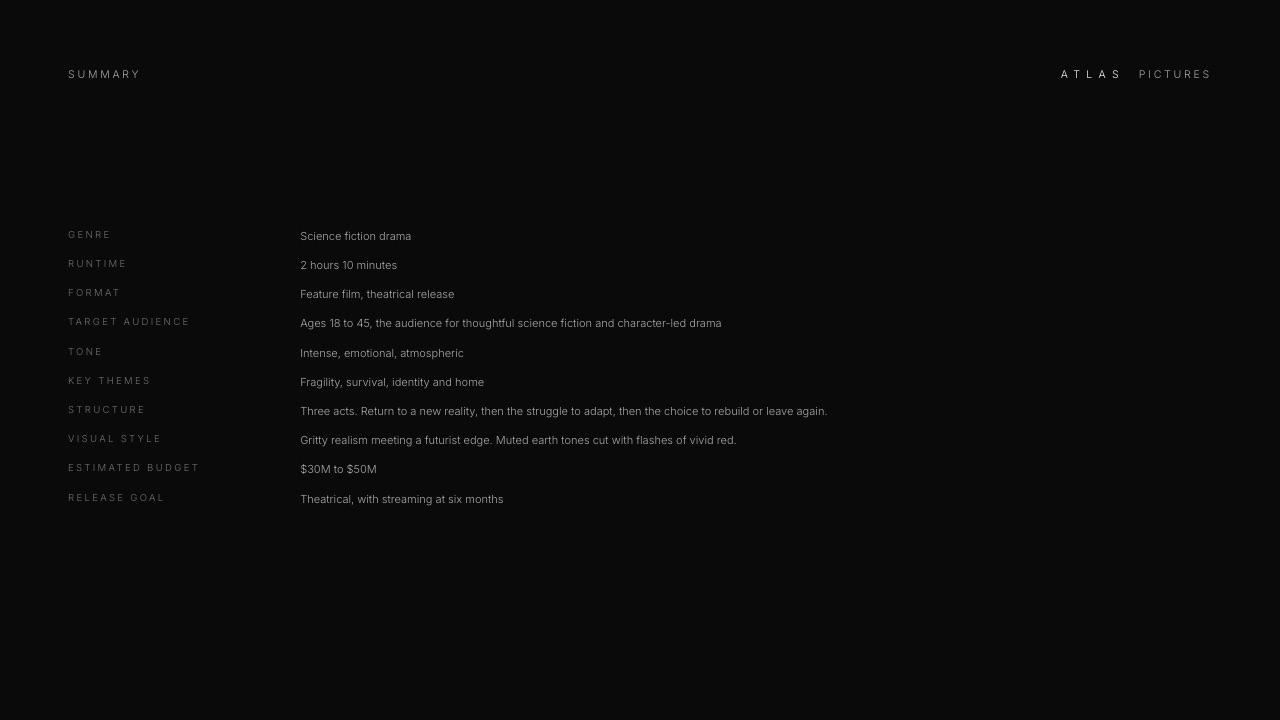
The Film Financing Pitch Deck folds this into its Summary page as one row, "Ages 18 to 45, the audience for thoughtful science fiction and character-led drama", and states the release goal separately: theatrical, with streaming at six months.
One sentence each is enough once the comparables slide has done the proving.
A festival route counts as a plan. For many first features the audience strategy is a festival premiere that brings in a sales agent.
If that is yours, name the tier of festival you are aiming at, and our rundown of film festival submission platforms covers where those entries are managed.
Slide 9: The Team
The team slide shows who has done this before. Director, producer and writer with one credit line each, then the attachments: cast, a director of photography, a sales agent or co-producer, anyone whose name changes the risk.
Budget40 words and three or four headshots. None of Framekit's five film templates has a slide titled Team, which is the most useful gap to know about before you start.
The Pitch Deck and Lookbook for a First Feature template has a Selected work page for the director's earlier films, and elsewhere the quickest fix is to describe the page you want to Framekit's AI slide writer (director, producer, writer and one attachment, one line each) and let it write and lay out the slide.
Nightwater's version is short because the team is: a third draft, a 14-minute proof of concept and one lead attached, which the template lists on its ask page rather than a team page. For a first-time director, the proof of concept is the credit.
Slide 10: The Production Plan
The production plan proves the film can be made on this money and this calendar: shoot days, locations, crew size and a schedule by phase, from development through to delivery.
Budget35 words and one or two images.
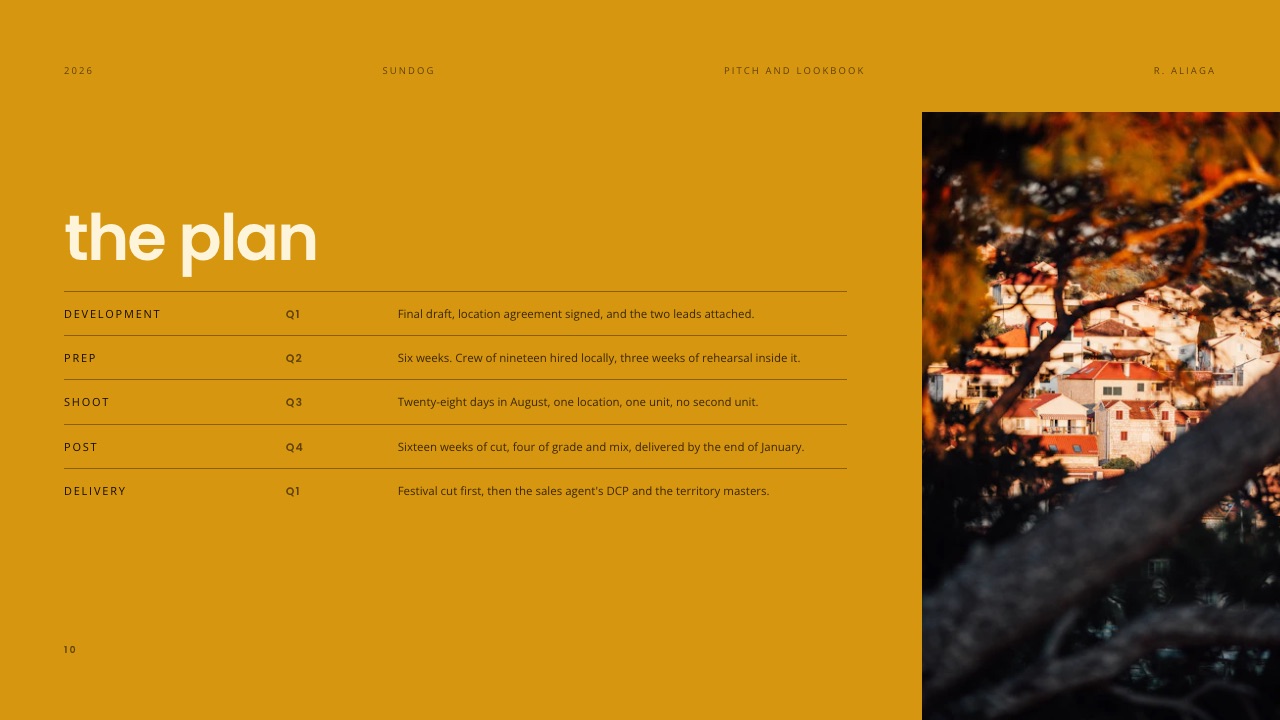
The template's layoutthe first-feature template's The plan page is the best model in the set.
Five rows, one per phase, each with a quarter and one line: prep is six weeks with a crew of nineteen hired locally, the shoot is 28 days in August on one location with one unit, post is sixteen weeks of cut and four of grade and mix, and delivery is a festival cut first, then the sales agent's masters.
A financier can cost that in their head.
For Nightwater the plan has one hard constraint that deserves large type: a 34-day shoot that has to start in June or wait a year for the next flood season. A deadline set by nature is the most persuasive schedule line a producer can write.
Slide 11: The Budget and the Ask
The budget slide states the money plainly: the total or an honest range, how it splits across pre-production, the shoot and post, how much is committed, how much you are asking for, and what that first money buys.
Budget50 words and one image at most.
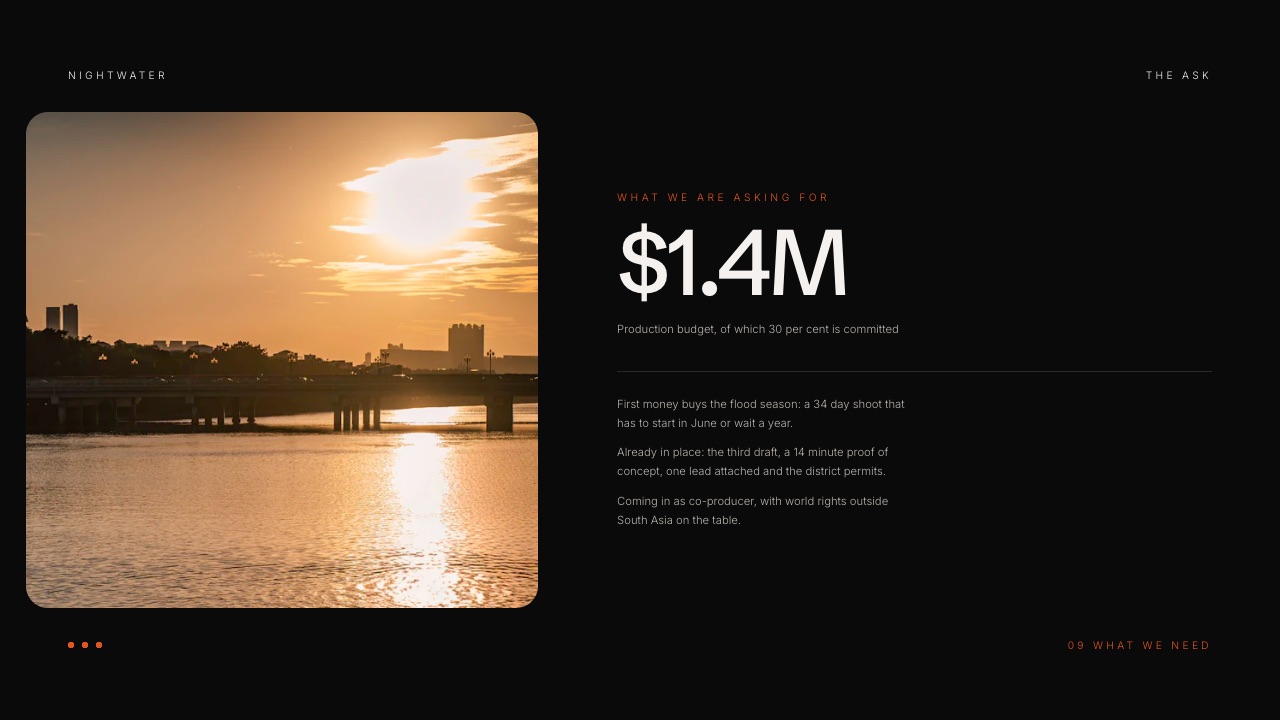
The worked exampleNightwater's ask page is the model. A $1.4 million budget with 30 per cent committed means $420,000 in place and $980,000 still to find. First money buys the flood season.
Already in place: the third draft, the proof of concept, one lead and the district permits. On offer: a co-producer position, with world rights outside South Asia on the table.
The page runs to about 60 words, ten over budget, and earns them because nearly every word is a number or a noun.
Incentives belong here too. If the film qualifies for a production incentive, the budget page says so, because it shrinks the gap.
The UK's Independent Film Tax Credit, for example, sets a 53 per cent credit rate for British films with projected core expenditure of £15 million or less, against 34 per cent for other productions, according to the government's policy paper.
The common missa line-item budget. The deck carries the top sheet, and the full budget goes to whoever asks for it after the call.
The Film Financing template shows the right altitude: an estimated $30 million to $50 million, split into pre-production at $5 million, principal photography at $30 million and post at $15 million.
Slide 12: Summary and Contact
The last slide is the one that gets forwarded. A financier who likes the deck sends one page to a partner, so this page repeats the facts that matter (genre, runtime, format, budget and the ask) and ends with one named person to call.
Budget40 words and no images.
The first-feature template's Contact page adds one more good habit: a single line saying the script, the budget and forty minutes of location tests are ready to send, and which to ask for first. A financier who wants more should never have to guess what exists.
Feature, Short or Proof of Concept: Three Variants of the Template
In one linethe twelve jobs stay the same for every kind of film pitch deck, but the reader changes, so a short film deck trades comparables and returns for eligibility and a proof-of-concept deck trades the full budget for the feature it is proving.
A feature deck goes to people who expect their money back; a short film deck goes to a fund or producer who does not; a proof-of-concept deck raises a little to shoot a scene that will sell the feature. The table shows what moves.
| Template slide | Feature for equity or sales | Short film for a fund | Proof of concept for a feature |
|---|---|---|---|
| Logline | The feature's logline | The short's logline | The feature's logline, then one line on the scene you will shoot |
| Synopsis | Full story, ending included | Full story, it is short enough | The feature's story in 60 words, the short's in 40 |
| Comparables | Three recent titles with numbers | Drop it, or name the festivals where similar shorts played | Two features the finished film would sit beside |
| Audience | Window and territory | Festival route and any broadcast strand | The buyers the proof is meant to convince |
| Team | Credits and attachments | The director and producer pairing funds ask for | The team that will also make the feature |
| Budget and ask | Top sheet, committed, gap, terms offered | Total, the fund's share, other sources | Cost of the proof, plus the feature's range in one line |
| Typical length | 12 to 15 slides | 10 to 12 slides | 10 to 12 slides |
Short films answer to the fund's rules first. BFI NETWORK England, for example, funds fictional shorts of up to 15 minutes and asks for at least two people across the director and producer roles, a script of no more than 16 pages and a budget with a finance plan.
Its application guidance strongly encourages optional visual material, such as a mood board or a taster, that shows the director's ideas, and asks that viewing links neither expire nor sit behind a login.
That last point matters for any deck you send as a link.
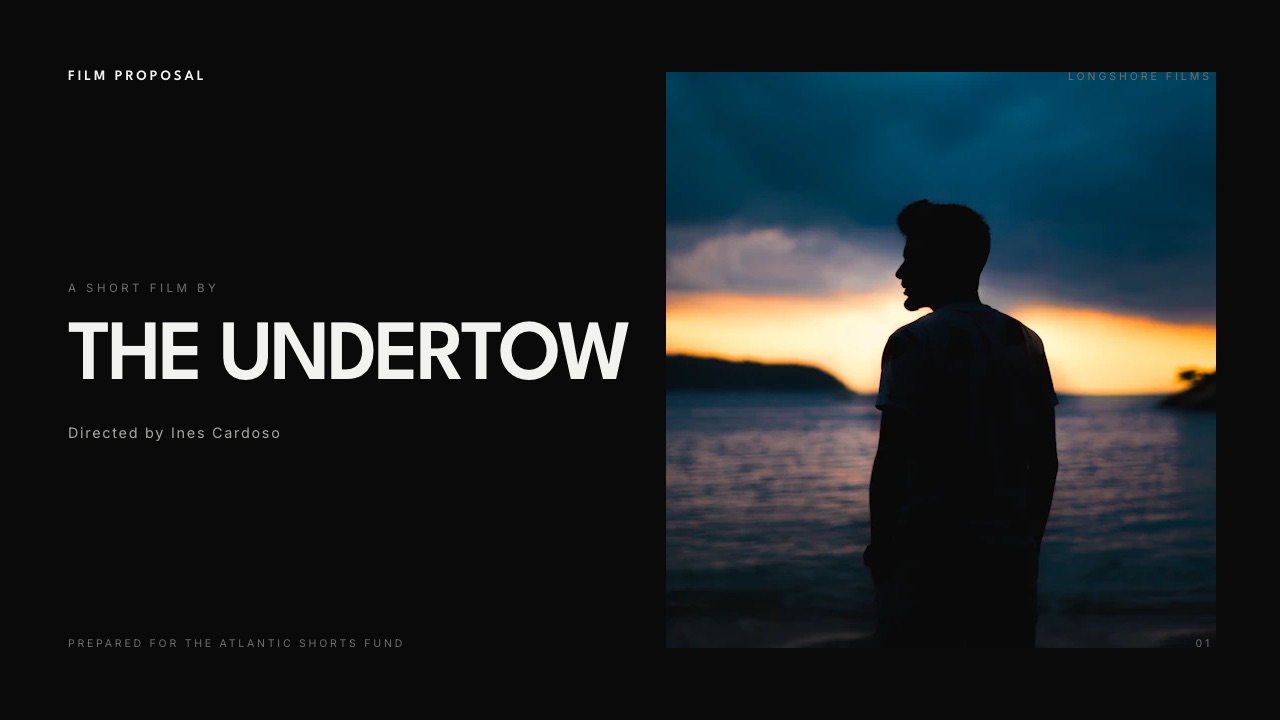
Framekit's Short Film Proposal template is built for that reader.
The sample, The Undertow, is an eighteen-minute short "prepared for the Atlantic Shorts Fund" (a fund invented for the sample), and it spends its twelve slides on an opening note in the director's voice, the story, how it is shot, casting, what the film says and who it is for, a boarded sequence, locations and wardrobe, and sound.
There is no comparables page and no return, because no shorts fund asks for either.
What Film Investors Check First
In one linemost financiers read a film pitch deck out of order, going from the logline to the money to the names, so those three pages have to be complete on their own before any of the pages that sell the feeling get a look.
DocSend's 2020 pre-seed figures suggest why: investors spent over four minutes on decks that went on to raise and one minute and 30 seconds on decks that did not.
The logline, for the film. If the sentence has a protagonist, a want and an obstacle, the reader keeps going. If it has a theme instead, many will stop.
The budget and ask, for the deal. The number, the gap and what the reader would get. A range is acceptable at development stage. A blank page, or "budget available on request" with no range, reads as a producer who has not done the work.
The team and attachments, for the risk. Who has finished a film before, and who is already committed. An attached lead or a sales agent moves a project further than any mood page can.
A word on promises. A deck that raises equity from private investors is part of a securities offering.
In the United States, most private film raises rely on exemptions such as Rule 506 of Regulation D, which limits who may invest and how they may be approached.
Keep projected returns, waterfall percentages and "investors will double their money" lines out of the deck.
The deck says what the film is and what it costs; the offering documents, drafted by an entertainment lawyer, say what an investor gets.
Framekit's Five Film Pitch Templates, Mapped to the Twelve Jobs
In one lineFramekit Slides ships five templates built for film pitching, each with twelve slides and a sample film inside it, and none of them covers all twelve jobs, so pick the one closest to your reader and add the missing pages.
The table maps each template against the twelve-slide structure above. Deck templates are part of the paid library (Starter, $9 a month or $7 billed yearly, and up), while the Free plan gets unlimited decks built from blank slides and the AI slide writer.
| Framekit template | Sample film inside | Best reader | Jobs it already covers | Pages to add |
|---|---|---|---|---|
| Film Financing Pitch Deck | When Mars Came Home, a science fiction drama | Equity and co-financiers for a larger budget | Cover, logline, look, characters, plan, budget, summary | Comparables, team |
| Feature Film Pitch Deck | The Long White, a survival thriller | Producers and sales agents who read story first | Cover, logline, two-part synopsis, characters, comparables, look, director | Team, plan, budget and ask |
| Pitch Deck and Lookbook for a First Feature | Sundog, a 90-minute first feature | Funds and producers backing a new director | Logline, vision, story, look, approach, selected work, plan | Comparables, budget and ask |
| Film Logline and Elevator Pitch | Nightwater, a $1.4 million thriller | A first meeting or a cold email | Logline, why now, characters, fact sheet, comparables, ask | Synopsis, team, full plan |
| Short Film Proposal | The Undertow, an 18-minute short | Short film funds and producers | Director's note, story, look, casting, audience, storyboard, sound | Budget and ask, team |
The quickest route to the full twelve is to start from the template nearest your reader and add two or three pages.
Starting from the Film Logline and Elevator Pitch, for example, you add a synopsis page, a team page and a production plan, and you have the full template with Nightwater's ask page already written the right way.
Each added page can be drafted by describing it to the AI slide writer, which writes and lays out one slide at a time in the deck's own fonts and colours.
Seven Mistakes That Sink a Film Pitch Deck
In one linethe mistakes that sink a film pitch deck are almost always about attention rather than design, because each one either spends the reader's three minutes on the wrong page or leaves out the one number they came for.
- Hiding the ending. A financier is being asked to fund the ending. Tell it.
- Forty reference frames. Six that agree beat forty that argue. Move the rest to the lookbook.
- No number on the money page. Give a range at the least, plus what is committed.
- Comps from a different budget universe. A comparable within reach of your budget is evidence; a blockbuster is decoration.
- Promising returns. Projections belong in the offering documents, not the deck, for the legal reasons above.
- A link that dies. Funds such as the BFI ask for viewing links that do not expire or need a login. Test yours in a private browser window before sending.
- Sending the treatment instead. A 15-page treatment is a different document with a different reader. The difference is covered in Storyflow's guide to what goes in a treatment versus a pitch deck.
Where to Build a Film Pitch Deck: What Each Tool Costs a Year
In one lineyou can build this film pitch deck template for nothing in Canva, Google Slides, Keynote or Affinity, so the reason to pay is a better starting template, a link that reports who read it, or a deck that lives on the same account as your reel.
Prices below were read on each vendor's page on 19 September 2026. Pitch, Canva and Adobe served European prices to us, so those figures are the European list in euros rather than a guessed conversion. Framekit's are its own published US prices.
| Tool | Free option | Paid plan a solo filmmaker would pick | Yearly cost | Film-specific templates | Who-opened-it analytics |
|---|---|---|---|---|---|
| Framekit Slides | Unlimited decks, blank slides, AI slide writer | Starter at $7 a month billed yearly | $84 | 5 film pitch templates plus treatments | Total view count only |
| Canva | Yes | Pro, EUR 110 a year | EUR 110 | A TV and film section with pitch and treatment decks | Not covered here |
| Google Slides | Yes, with a Google Account | None needed | $0 | Few, mostly third-party | No |
| Pitch | Yes, 100 one-time AI credits | Plus at EUR 10 a month paying yearly | EUR 120 | A free Film Pitch Deck by Zacht Studios | Team plan, EUR 15 a month |
| Keynote | Yes, free on Apple devices | Creator Studio, $129 a year, optional | $0 to $129 | Apple themes, not film-specific | No |
| InDesign or Affinity | Affinity is free for individuals | InDesign at EUR 25.99 a month | EUR 0 to EUR 311.88 | Whatever you design | No |
| Storydoc | "Create free" start, no free plan listed | Starter at $19.80 a month billed yearly | $237.60 | 20+ film decks, including short and documentary | Yes, on every paid plan |
The arithmetic: Framekit Starter is $7 times 12. Pitch Plus is EUR 10 times 12. InDesign's annual plan billed monthly is EUR 25.99 times 12, which is EUR 311.88. Storydoc publishes its yearly total directly.
1. Framekit Slides: Best for a Deck That Looks Like a Film
Framekit is an AI website builder for filmmakers and photographers whose Slides tool puts the pitch deck on the same account as the reel, the client galleries and the review links, which is why its five film templates start where the twelve-slide structure above ends.
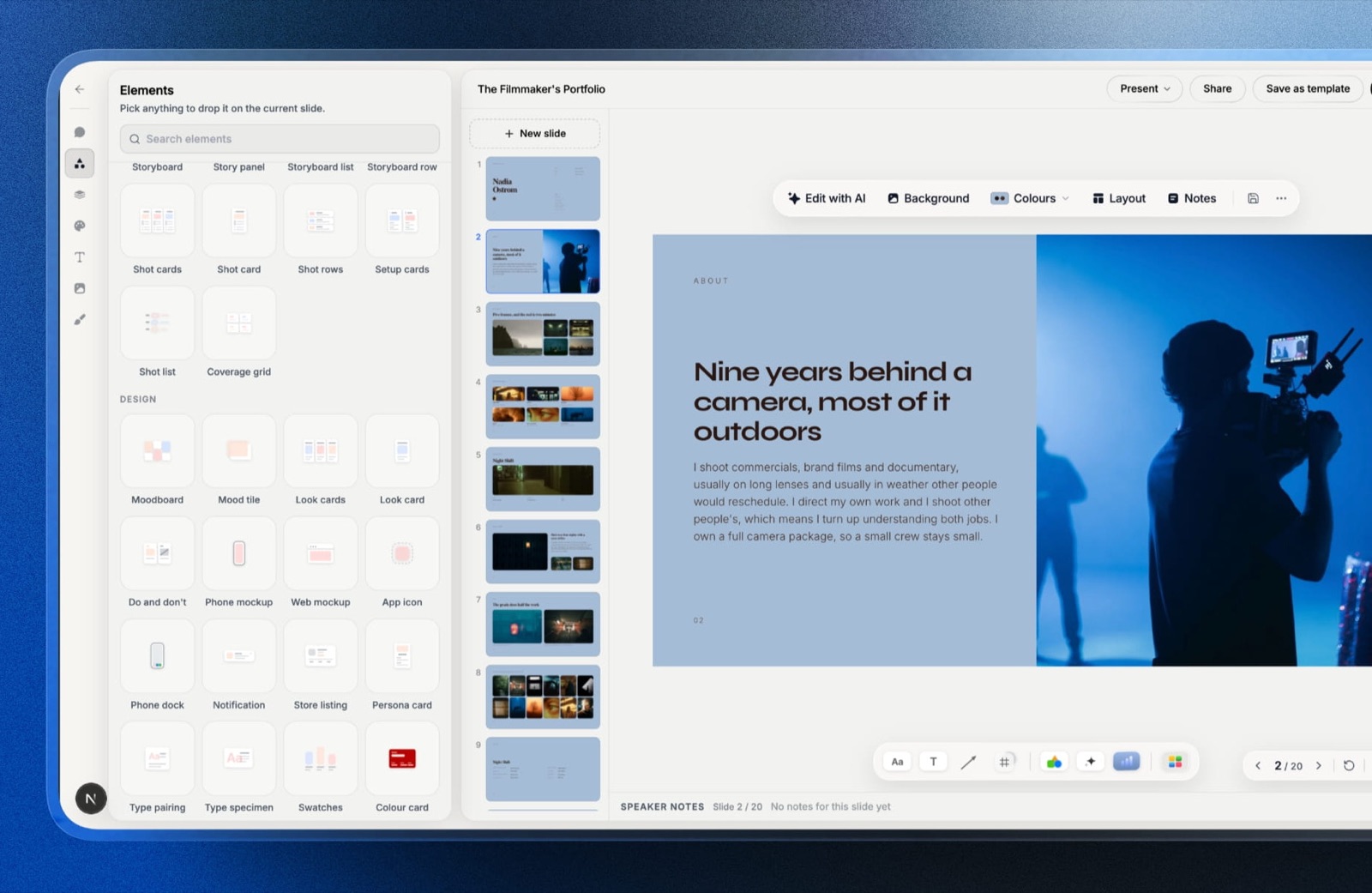
What you get on the Free plan. Unlimited decks, the AI slide writer (describe a slide and it writes and lays it out), speaker notes on every slide, full-screen presenting, a share link and PDF export. That is enough to build the whole template from blank slides.
What paying adds. The five film templates in this guide sit in the paid template library, from Starter at $9 a month or $7 billed yearly. Starter also removes the Framekit byline and lets you upload your own fonts.
Pro, at $19 a month or $15 billed yearly, adds PowerPoint export.
The detail that matters for film. Slides can embed a YouTube or Vimeo player, so a proof of concept or a taster reel plays inside the deck rather than behind a link the reader has to open.
The elements panel also carries shot list, moodboard and storyboard blocks, which is where a look page usually starts.
The gotcha. Deck share links have no password and no per-viewer analytics, only a total view count, so you cannot see that the financier read the budget page twice.
PowerPoint export is picture-based: each slide arrives as a full-bleed image with the speaker notes intact, the text cannot be edited in PowerPoint, and the cap is 60 slides.
If a sales agent wants an editable file, send the PDF and offer the source instead.
Skip it if you need to know who opened the deck and for how long, or your producer insists on co-writing in Google Slides.
Verdict: the best starting point in this list when the deck should look like cinema and live next to your reel, provided you can accept a link that tells you how many people looked but not who.
2. Canva: Best Free Starting Point
Canva is where most first-time filmmakers start, and for good reason: the free plan is generous, the editor is quick to learn, and its TV and film section groups treatment and pitch decks with series bibles, storyboards, call sheets and budgets.
On the European list, Canva Pro is EUR 110 a year for one person and, by Canva's own count, opens 3.6 million or more templates against 1.6 million or more on Free.
The standout. Canva's newsroom describes a ShotDeck integration that puts more than 1.5 million cinematic reference images inside the editor, which is exactly the raw material a look and tone page is made of.
We read that on Canva's own announcement via search, because canva.com refuses automated requests, so check the plan it needs before you count on it.
The gotcha. Range cuts both ways. Most of those film templates are built around the startup order of problem, solution and market, so you end up renaming slides and reordering them into the twelve jobs above.
The same popular template also turns up in more than one inbox, and financiers see a lot of decks.
Skip it if you want the deck to look like nobody else's, or you have already decided on a layout tool with finer type control.
Verdict: the right place to draft your first deck for free, and worth leaving once the deck needs a look of its own. Already comparing? Our Pitch vs Canva breakdown covers the two most common starting points side by side.
3. Google Slides: Best for Co-Writing With a Producer
Google Slides is free for anyone with a Google Account, and its real value for a pitch deck is not design but the comment thread.
A director, a producer and a writer can all be in the budget page at once, leave comments on the logline, and follow each other's live pointers through the synopsis rewrite at midnight.
The standout. It imports PowerPoint files and Canva presentations, and it works offline, so a deck can travel between tools without being rebuilt.
Share permissions separate edit, comment and view, which is useful when an attached actor's agent wants to see the deck but should not change it.
The gotcha. The built-in themes are corporate. A deck that has to sell a look will need its own type, spacing and full-bleed images, which Slides handles but does not encourage.
Skip it if the look page is the heart of your pitch and nobody on the team has a designer's eye.
Verdict: the best room to write the deck in, and rarely the best one to send it from. More options in our guide to Google Slides alternatives.
4. Pitch: Best for Knowing Who Read It
Pitch is a collaborative presentation tool with a free Film Pitch Deck template by Zacht Studios and, from the Team plan up, advanced links that record visits, slide views and time on each slide.
For a producer sending a deck to twenty financiers, knowing that one of them spent four minutes on the budget page is information worth paying for.
The numbers. On the European list read on 19 September 2026, Plus is EUR 10 a seat a month paying yearly, with 500 AI credits a month, custom fonts, video uploads and PowerPoint export; Team is EUR 15; Business is EUR 20.
Free's 100 AI credits do not renew and it has no PowerPoint export.
The gotcha. The tracking you probably want lives on Team, not Plus, so the real cost of a tracked deck for a solo producer is EUR 180 a year, and 25 advanced links can go quickly across a festival season.
Skip it if you send decks to three people you already know, where a phone call tells you more than a heat map.
Verdict: the pick for a producer running a wide financing round who wants evidence of interest before the follow-up call. See our list of Pitch alternatives if the per-seat maths does not work for your team.
5. Keynote: Best Free Tool on a Mac
Keynote is free on every Apple device, and Apple said in January 2026 that it will remain free for all users after the launch of Apple Creator Studio, a $12.99 a month or $129 a year bundle that adds premium templates and themes and can draft a first presentation from a text outline.
Its typography and image handling are strong enough for a look page that needs to breathe. The catch is sharing: financiers on Windows will open a PDF, not a Keynote file, so export and check every page before sending.
Skip it if your team is not all on Macs. Keynote alternatives covers the cross-platform options.
6. InDesign or Affinity: Best for Print-Quality Layout
A page-layout app gives you total control of type, grids and image placement, which is why many of the best-looking film decks in circulation were made in one and exported to PDF.
InDesign is EUR 25.99 a month on the European list for the annual plan billed monthly; Affinity describes itself as free for individuals and covers vector, photo and layout in one app.
The trade-off is time: nothing is laid out for you, there is no share link, and every revision means a new PDF. Skip this route unless you, or someone on the team, already designs in it.
7. Storydoc: Best for Interactive, Scrolling Decks
Storydoc turns a deck into a scrolling, mobile-friendly web page with analytics, and its film pitch deck gallery includes separate templates for short films, documentaries and documentary series.
On its pricing page the Starter plan is $19.80 a month billed yearly ($237.60) for five active documents, and Pro is $36 a month ($432 a year) for thirty.
The five-document limit on Starter is the thing to plan around across a long financing round. Skip it if your reader expects a PDF they can print and annotate.
How to Choose: A Decision Guide
In one linethe right place to build a film pitch deck depends on three questions asked in order, about who reads it, whether you need to know they read it, and whether it has to look like the film.
- Is the deck going to a fund with a fixed format? If yes, follow the fund's rules first (BFI-style funds want links that do not expire or need a login) and build in whatever tool exports a clean PDF. If no, go to question 2.
- Do you need to know who opened it and which pages they read? If yes, choose Pitch on the Team plan or Storydoc, and accept the yearly cost. If no, go to question 3.
- Is someone else writing the deck with you? If yes, draft in Google Slides, then decide where the finished version lives. If no, go to question 4.
- Does the deck have to look like the film, and link to your reel and site? If yes, start from one of Framekit's five film templates. If you want it free and the look matters less, start in Canva. If a designer is on the team, lay it out in InDesign or Affinity.
For a wider view of the category beyond pitch decks, our guide to presentation tools for filmmakers compares these tools for treatments and reels, and the best pitch deck template sources covers where else to find a starting file.
Frequently Asked Questions
What should a film pitch deck include?
A film pitch deck should include twelve pages: a cover, a one-sentence logline, a synopsis with the ending, a look and tone page, the main characters, the director's vision, three comparable films, the audience, the team, a production plan, the budget and ask, and a one-page summary with a named contact.
Keep the whole deck near 500 words so a financier can read it in the three minutes or so they typically give a deck.
Is there a free film pitch deck template?
Yes. Pitch offers a free Film Pitch Deck template by Zacht Studios, Canva's free plan includes film and TV pitch decks, and Storydoc publishes film templates you can preview.
Framekit's five film templates need a paid plan from $7 a month billed yearly, though its Free plan lets you build the same twelve slides from blank pages with the AI slide writer and export a PDF.
Should the budget go in a film pitch deck?
Yes, a film pitch deck should show the budget, but only as a top sheet: the total or a range, a split across pre-production, the shoot and post, how much is committed, and what you are asking for.
Nightwater's sample page does it in one number and three lines. The line-item budget goes to anyone who asks after the first call.
What is the difference between a film pitch deck, a treatment and a lookbook?
A film pitch deck sells the whole project, story and money included, in about a dozen slides. A treatment tells the story in prose over several pages. A lookbook shows only the visual world, in images. Financiers want the deck first.
Producers and heads of department often want the treatment and lookbook next, which is why our lookbook software guide is a separate read.
Should I send a film pitch deck as a PDF or a link?
Send a PDF when the reader is a fund, a lawyer or anyone who prints and annotates, and a link when you want to update the deck or embed a reel.
Whatever you send, the BFI's rule is a good one to copy: viewing links must not expire or need a login. Framekit links carry a total view count only; Pitch and Storydoc show who viewed which pages.
Can a film pitch deck promise investors a return?
A film pitch deck should not promise a return.
In the United States, selling equity in a film to private investors is a securities offering, usually made under an exemption such as Rule 506 of Regulation D, and projections belong in offering documents drafted by an entertainment lawyer.
The deck can state the budget, the gap and the kind of position on offer.
Do I need a pitch deck for a short film?
A short film usually needs a proposal deck when it is applying for a fund, approaching a producer or crowdfunding.
The deck swaps comparables and returns for the fund's own criteria: the director and producer pairing, a script of the required length, a budget and finance plan, and visual material.
BFI NETWORK England, for example, awards £5,000 to £25,000 for shorts of up to 15 minutes.
Is Canva or Framekit better for a film pitch deck?
Canva is better if you want to start free and choose from a large library of film and TV decks.
Framekit is better if you want a deck laid out for cinema, with templates organised around the pages financiers read, and a deck that shares an account with your website, galleries and review links.
Canva Pro is EUR 110 a year on the European list; Framekit Starter is $84 a year.
Final Verdict
The film pitch deck template that works is a budget of attention: twelve slides, one job each, about 500 words, and a money page that answers in one number and three lines. Build it anywhere, but build it in that order, and run the word count before you send it.
For building it, Framekit Slides is our pick when the deck has to look like the film and sit beside your reel and site, because its five film templates already hold most of the twelve pages and the sample films show how each one should read.
Where Framekit loses is visibility: its deck links have no password and no per-viewer analytics, so a producer who needs to see which financier read the budget page twice is a better fit for Pitch on the Team plan or Storydoc.
Framekit is also not for teams who must co-write in one shared file, where Google Slides is the better room, or for anyone who needs an editable PowerPoint, since its export is picture-based.
Related readinghow to write a film treatment for the longer document that follows the deck, the best film treatment software for where to write it, and the best website builders for filmmakers for the site your deck should link to.
Pitching a nonfiction project instead?
The documentary pitch deck template adapts these slides for grants and broadcasters, and the all-in-one platforms for filmmakers guide covers where the deck, reel and review links can live together.